Since Bengaluru’s lakes were formed by damming water flowing down valleys, they are typically wedge-shaped, with a gentle slope and a deep basin towards the embankment. This promotes the growth of diverse vegetation and animals, each adapted to a particular water depth. The result is a natural zonation – reedbeds and shoreline vegetation at the edges, floating and submerged vegetation in the middle, and open water at the deepest end.
During the Open City biodiversity datajam held in December 2025, our group examined the ecological trends around Bengaluru’s lakes. In an earlier article, we examined how migrant and resident waterbirds are surviving across 14 of Bengaluru’s lakes.
But how are different microhabitats within a lake, and the individual species that depend on them, faring today? Here, we analyse how the ‘soup bowl’ model of rejuvenation, along with the aesthetic bias against ‘messy’ habitats like reedbeds, might be driving the decline of edge-habitat specialists.
How the shape of a lake influences biodiversity
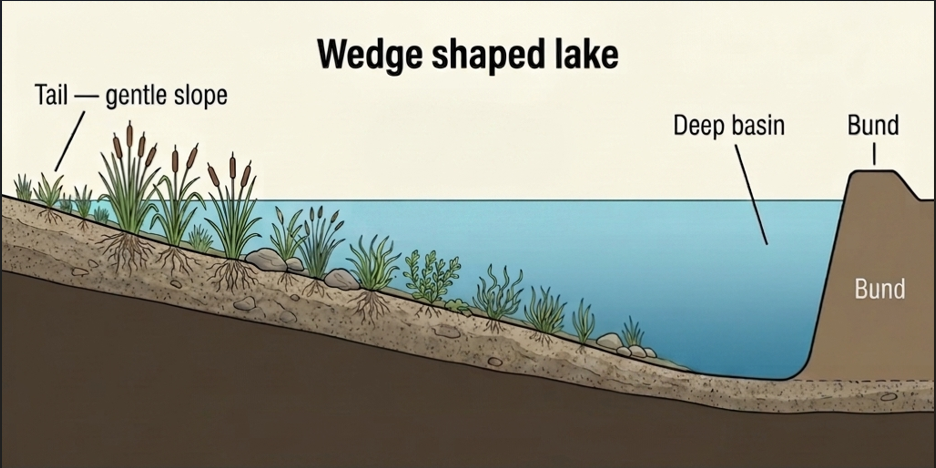
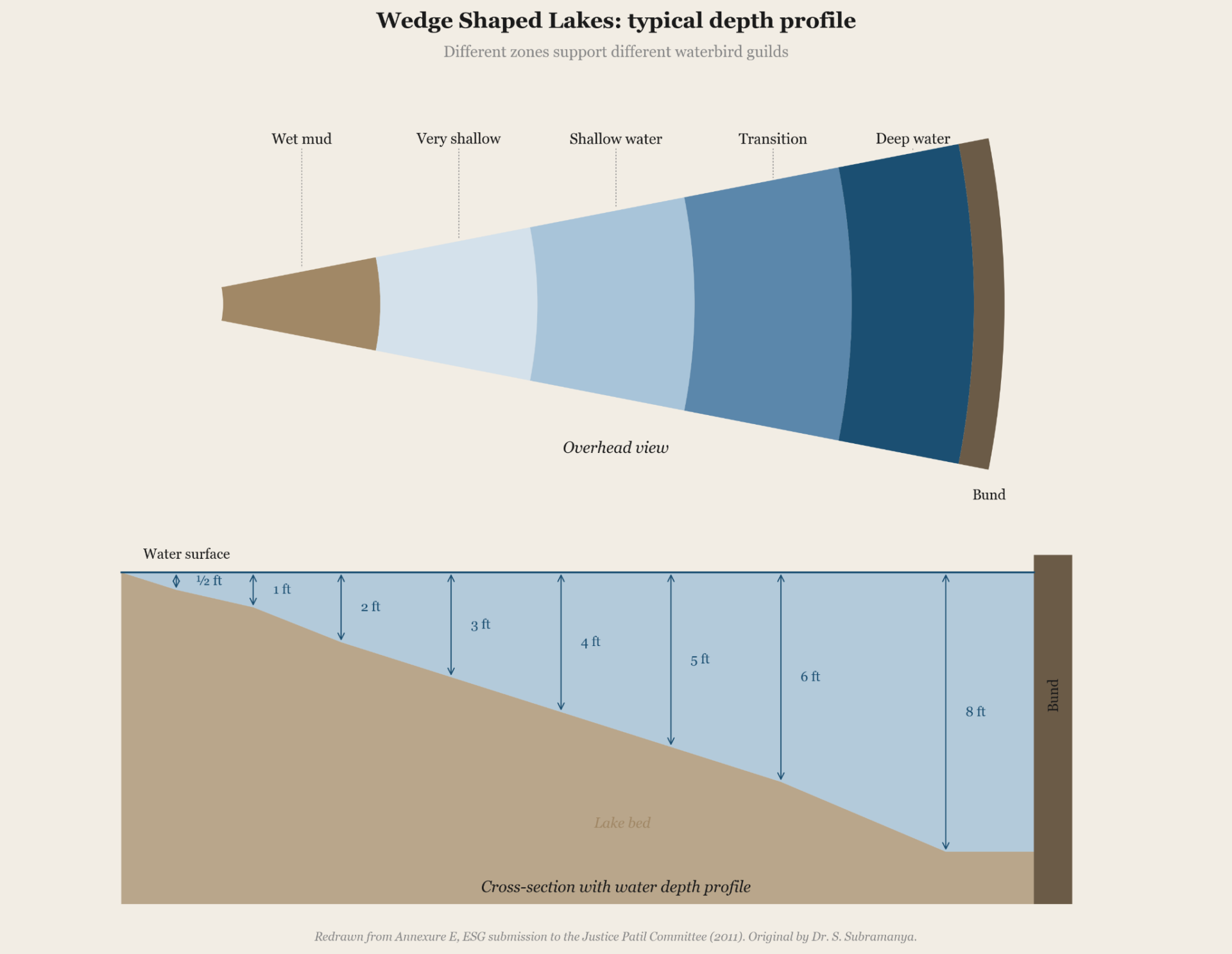
This microhabitat diversity is what makes wetlands incredibly bird-rich. Bengaluru’s wetlands cover under 2% of the land area but account for at least a third of the bird species recorded in the city.
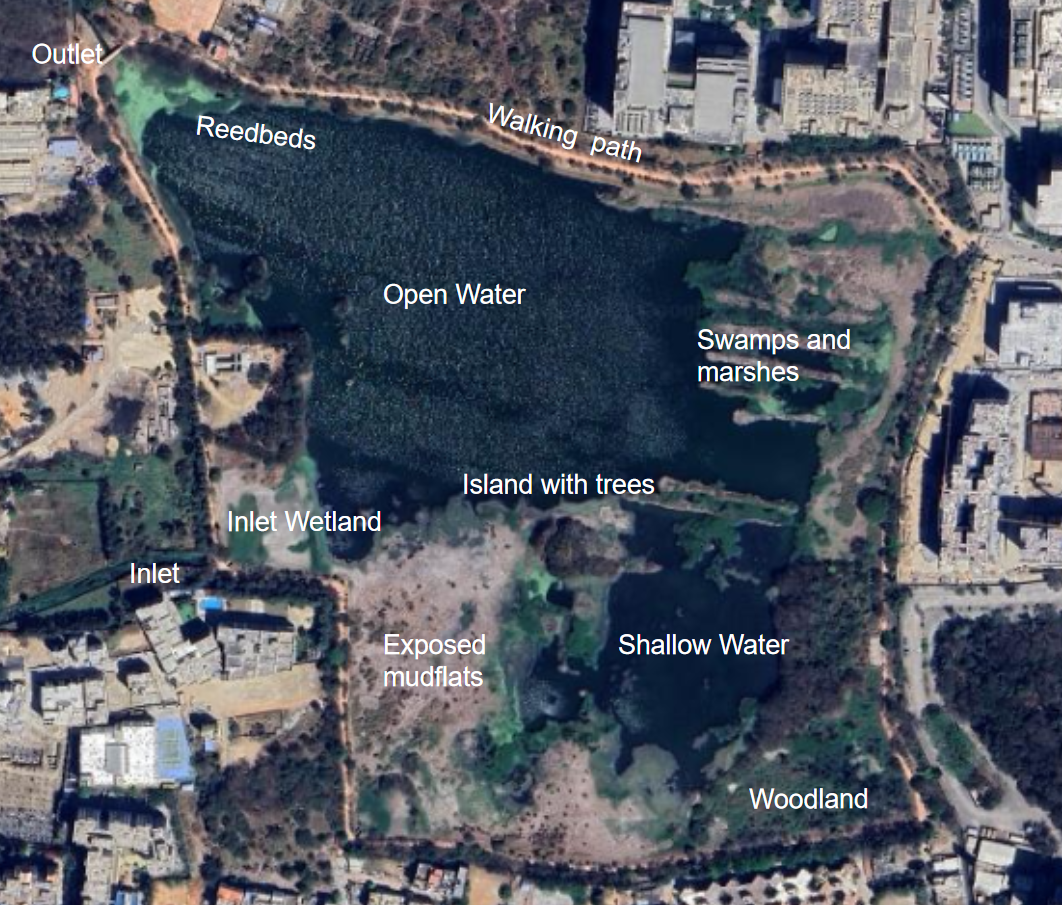
Since these microhabitats are inhabited by specific bird guilds, tracking guild-level trends can provide insights into the ecological health of the microhabitats themselves. This is an established practice in ecology. We used the guild-based grouping of Bengaluru’s waterbirds in Krishna et al. (1996) as the baseline and grouped bird species into the following guilds and microhabitats:
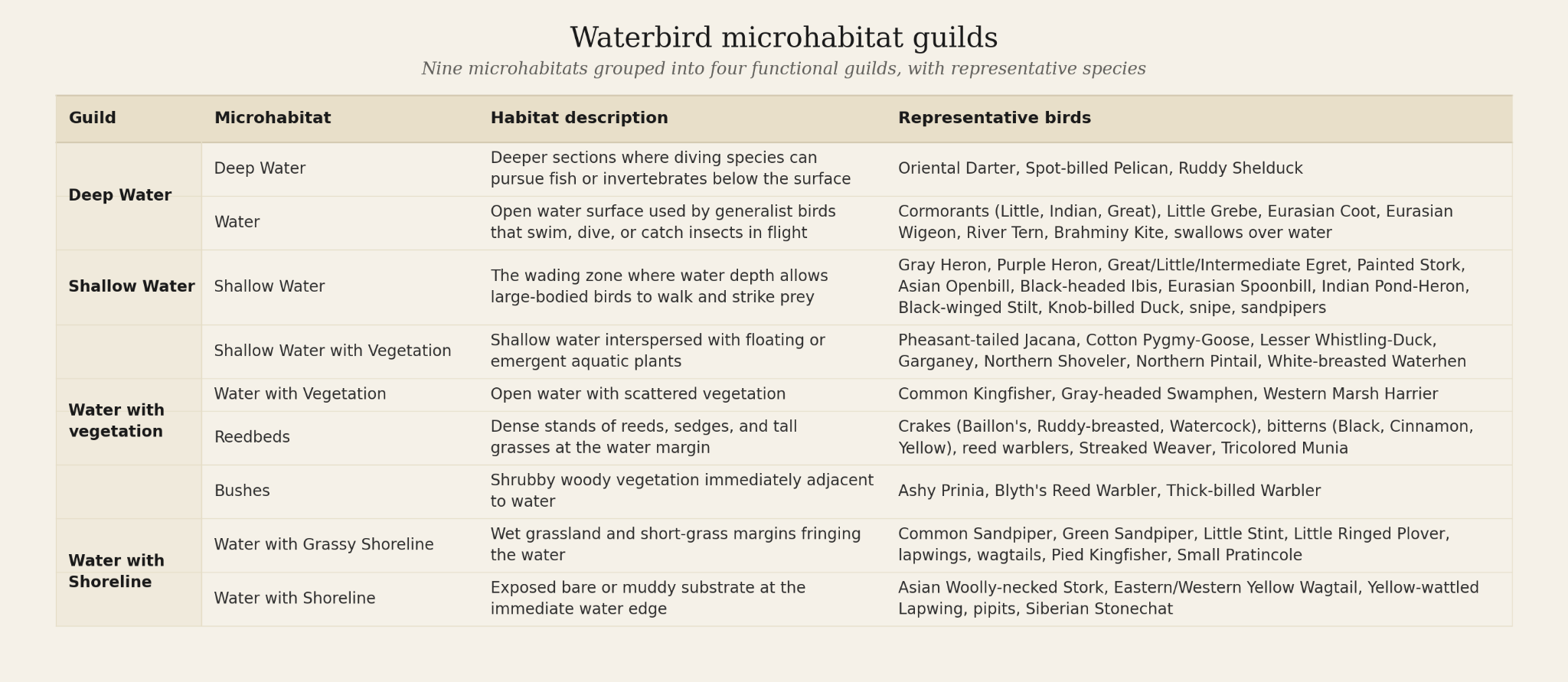
The complete list of microhabitat categories with their individual species assignments is described here.
For every waterbird observation, we recorded the lake where it was observed along with the corresponding guild, microhabitat, and resident/migrant status.
Habitat specific trends
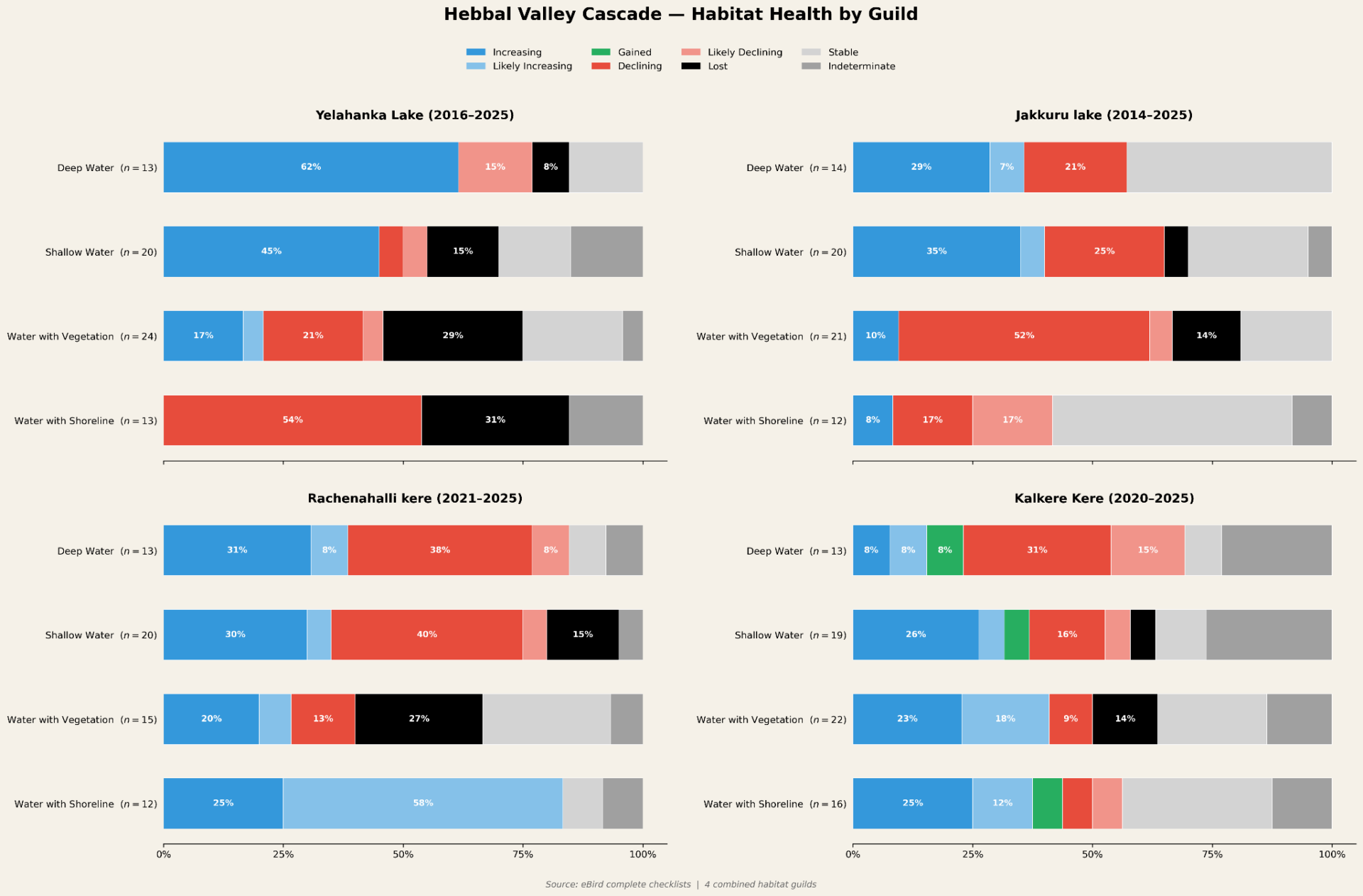
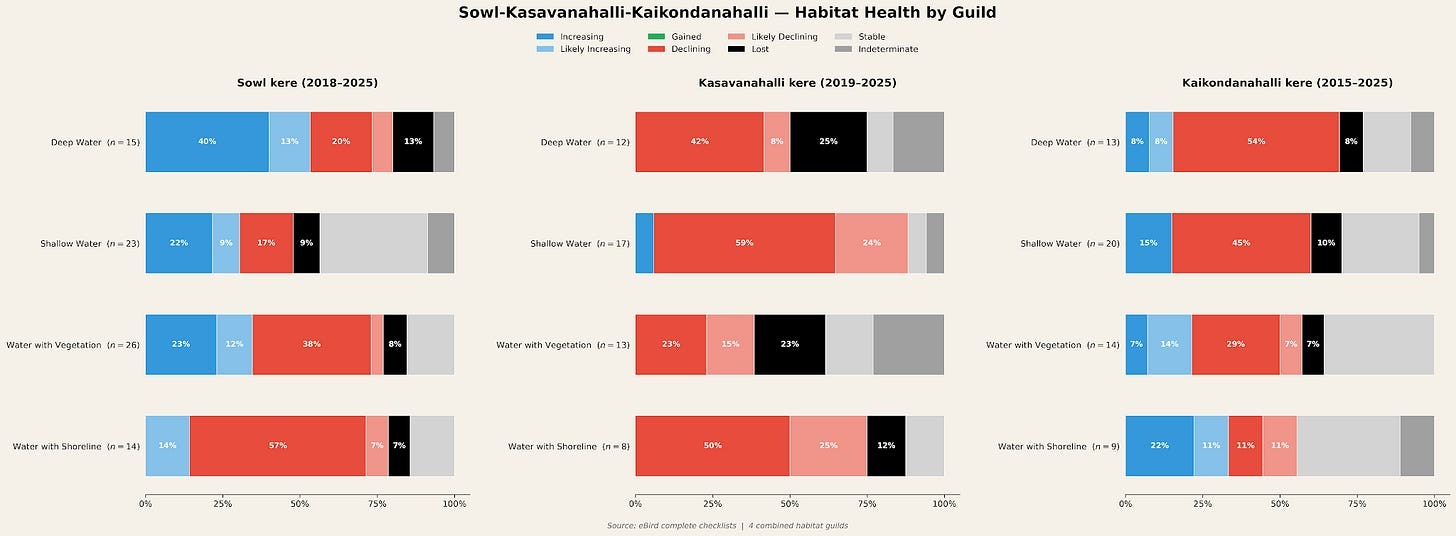
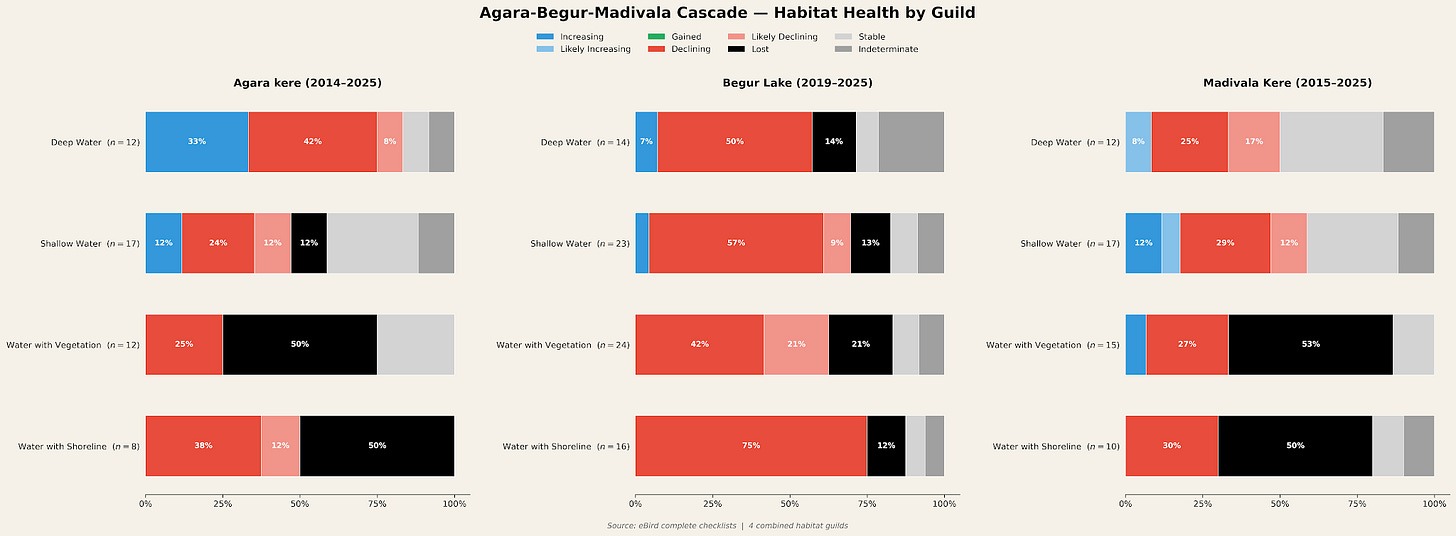
Across cascades, Water with Shoreline and Water with Vegetation emerge as the most stressed habitats. But the story within each cascade is different.
In Yelahanka kere, the biggest lake in the Hebbal cascade, over a third of shoreline birds have already been lost while the rest are in decline. Shoreline vegetation dependent birds also show signs of severe stress.The performance of shoreline birds improves as we move downstream. The only other guild-level signal in the Hebbal cascade was vegetation birds showing signs of stress at Jakkur.
In the Sowl cascade, Water with Shoreline is the most stressed guild. At both Sowl and Kasavanahalli, over half the shoreline birds are declining or lost.
Results for South Bengaluru lakes are the starkest.
Read more: Bengaluru’s Saul Kere: From biodiversity haven to construction zone
All of Agara’s shoreline birds have either been lost or are declining; at Madivala, over 50% of the shoreline birds have been lost. Vegetation-dependent birds too show a similar pattern, with over half lost from Agara and Madivala in the past decade.
To check if these were lake-specific trends or a part of a city-wide pattern, we analysed the trend scores. We rolled up the mean scores in two stages — first by guilds, then splitting between residents and migrants within each guild. The mean trend score comparison is in the figure below:
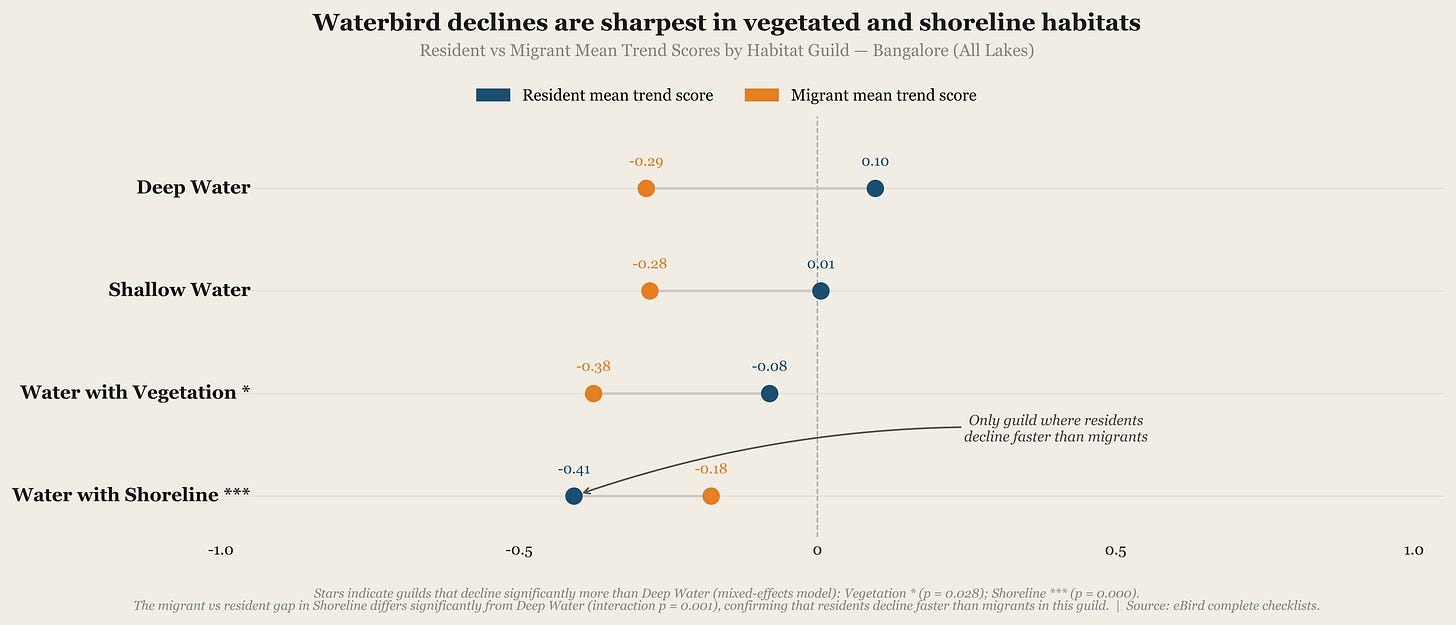
- Water with Shoreline shows the steepest decline, followed by Water with Vegetation. Both guilds are worse off than Deep Water birds.
- With a mean trend score of -0.41, shoreline residents are the worst-performing group in the dataset.
- Migrants are declining faster than residents in three of the four guilds. Shoreline is the exception, where residents are declining faster.
To confirm that these patterns aren’t data artefacts, we ran a mixed-effects model. The details of the implementation are provided here. The model establishes two things:
- Deep Water and Shallow Water were statistically indistinguishable in their trends, suggesting the citywide decline is concentrated at the vegetated and shoreline margins of lakes.
- The faster decline of shoreline residents vis-à-vis migrants is statistically significant, suggesting that these birds are not adapting to the rapidly changing shorelines of Bengaluru’s lakes.
Bengaluru’s birding community has long flagged the catastrophic effects of the “soup bowl” model on shoreline habitats . The gentle and vegetated slopes, critical for waders and other shoreline birds, have been replaced by permanently inundated concrete and stone bowls. The bunds are typically stone-paved, with a walking path running along the lake circumference. Parks and other recreational facilities often encroach into reedbeds and vegetated areas.
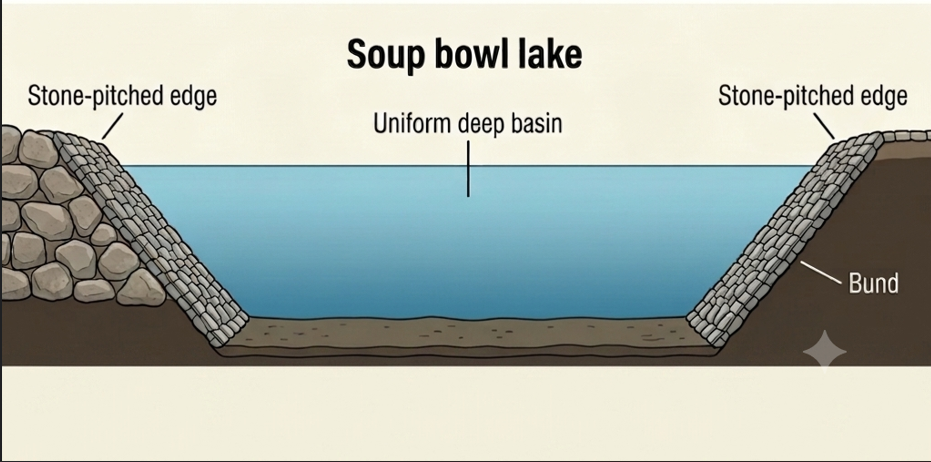
Constant desilting is also needed to maintain the storage capacity of the soup bowl. With fewer agricultural areas to use the silt, mud islands have been set up in most lakes to dispose of the dredged silt. It is no surprise that Deep Water residents like Darters and Coots, which thrive on constant availability of water, fish and roosting sites, are doing relatively well.
The 2011 Justice N.K. Patil Committee report set out clear ecological guidelines for lake rejuvenation. It recommended a gently sloping lakebed for adequate zonation, a 30-metre buffer around each lake, walking paths not exceeding three metres in width and located well beyond the high-water mark, and desilting only when required.
The results from our analysis of 14 lakes lay out the consequences of not adhering to these recommendations.
Winners and losers
With habitat specific declines established, we looked at how individual species were faring. Which species have adapted well to the changing ecology of lakes? Which ones are losing out across all 14 lakes?
To answer this, we summed up the trend scores of birds across the 14 lakes to arrive at a Severity Score. Ranking species based on this score helped us arrive at the list of winners and losers.
We assigned the following labels for an easier interpretation of Severity Score:
| Severity Score | ≤ −7.0 | −7.0 to −5.0 | > −5.0 | ≥ 7.0 | 5.0 to 7.0 | < 5.0 |
| Label | Critical | Declining | Concerning | Thriving | Increasing | Recovering |
Unsurprisingly, there were more losers than winners.
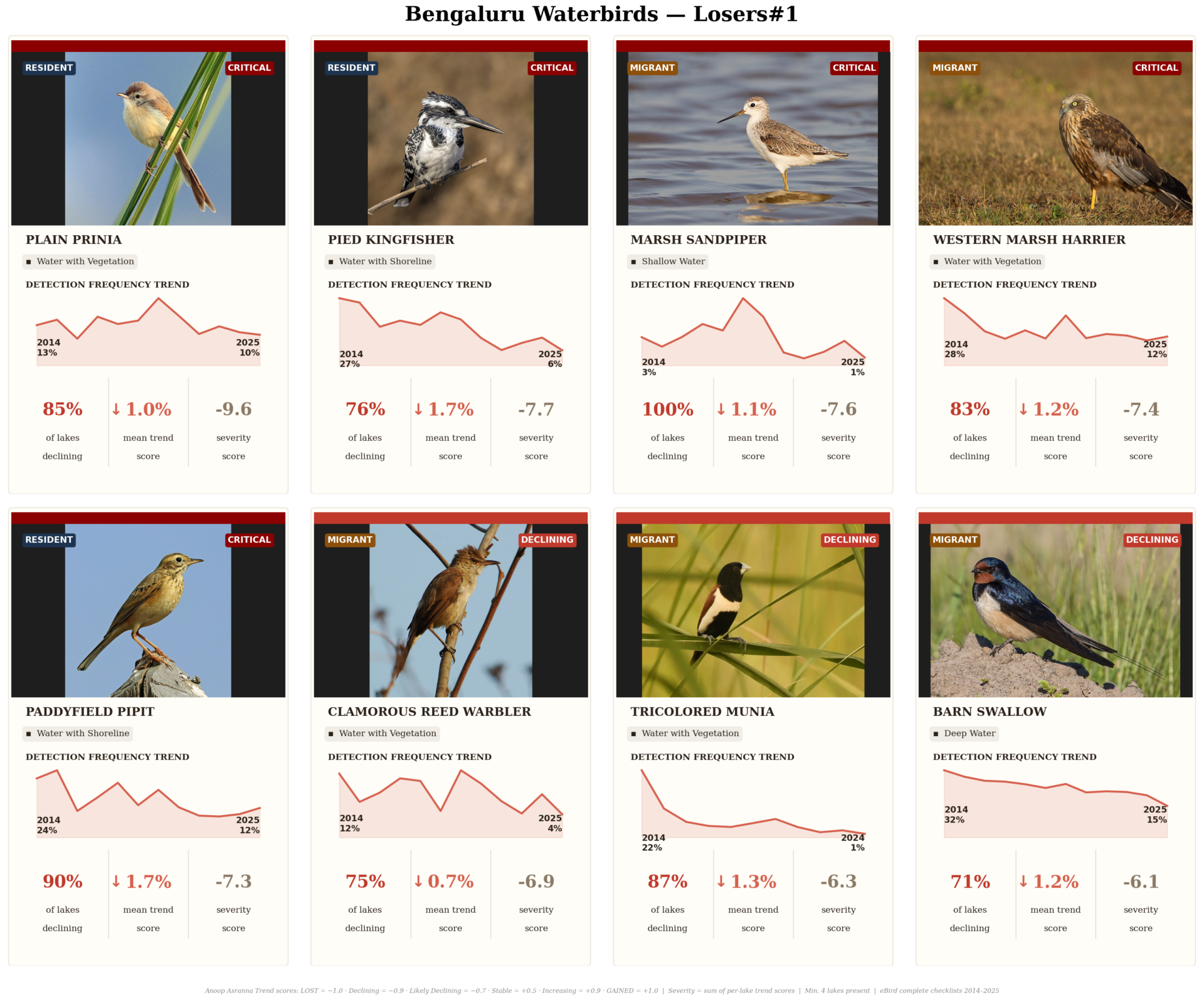
One limitation of this approach is that birds which have already disappeared from a majority of lakes will be missing from our analysis. Hence, for the losers, the results are better interpreted as birds in a state of current decline.
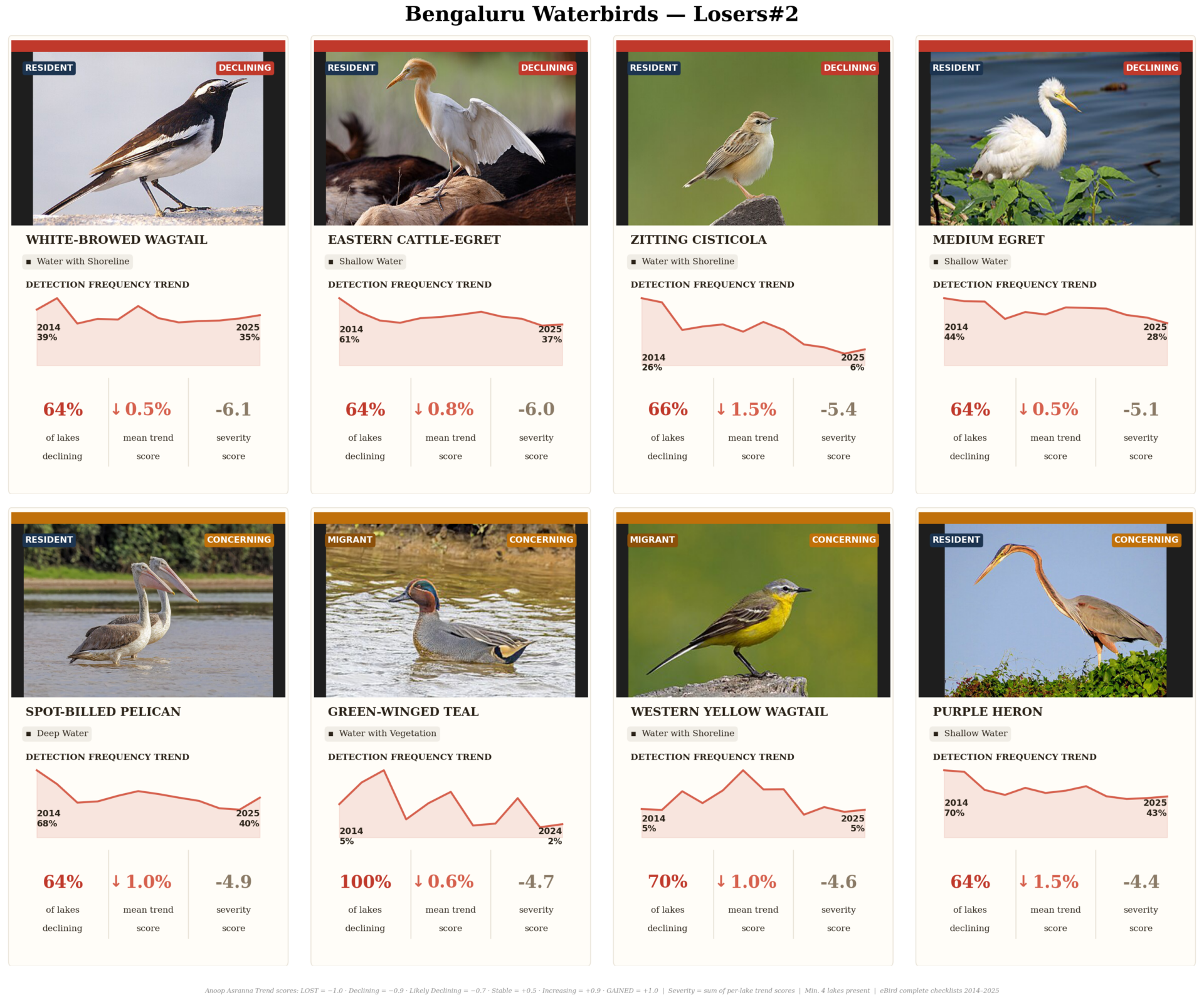
- The Pied Kingfisher, once a year-round resident, has been reduced to an occasional forager. The replacement of soft-earth embankments — its primary nesting site — with stone is likely driving this decline.
- Plain Prinia populations are declining, likely due to the loss of tall grass and scrub edges around lakes. Being ground-level nesters, they are also vulnerable to habitat clearance and free-ranging cats and dogs.
- Harriers across India are declining due to the loss of open grasslands. Within the city too, rapid urbanization around wetlands and the loss of reedbeds have driven the decline of the Western Marsh Harrier, an apex predator of marsh ecosystems.
- The Tricolored Munia has been lost from all four Hebbal Valley lakes and is confined to a declining presence in Sowl and Begur lakes. It typically feeds on the seeds of wild grasses and reeds. The loss of reedbeds and agricultural fields around wetlands has potentially contributed to its crash. Habitat loss is also likely driving the decline of other reedbed and vegetation specialists like Paddyfield Pipit, Zitting Cisticola, Paddyfield Warbler, and Clamorous Reed Warbler.
- The Marsh Sandpiper, a rare winter migrant, uses its needle-thin bill to probe for food in water (1–5 cm depth). Permanently inundated lakes may have eliminated the exposed mudflats it depends upon, leaving it confined to a declining presence at Begur.
- Once ubiquitous to Bengaluru’s lakes, Spot-billed Pelicans are declining, likely due to water-quality issues. A parasitic infection driving down global populations too could be driving this decline.
Moving on to birds which are doing well:
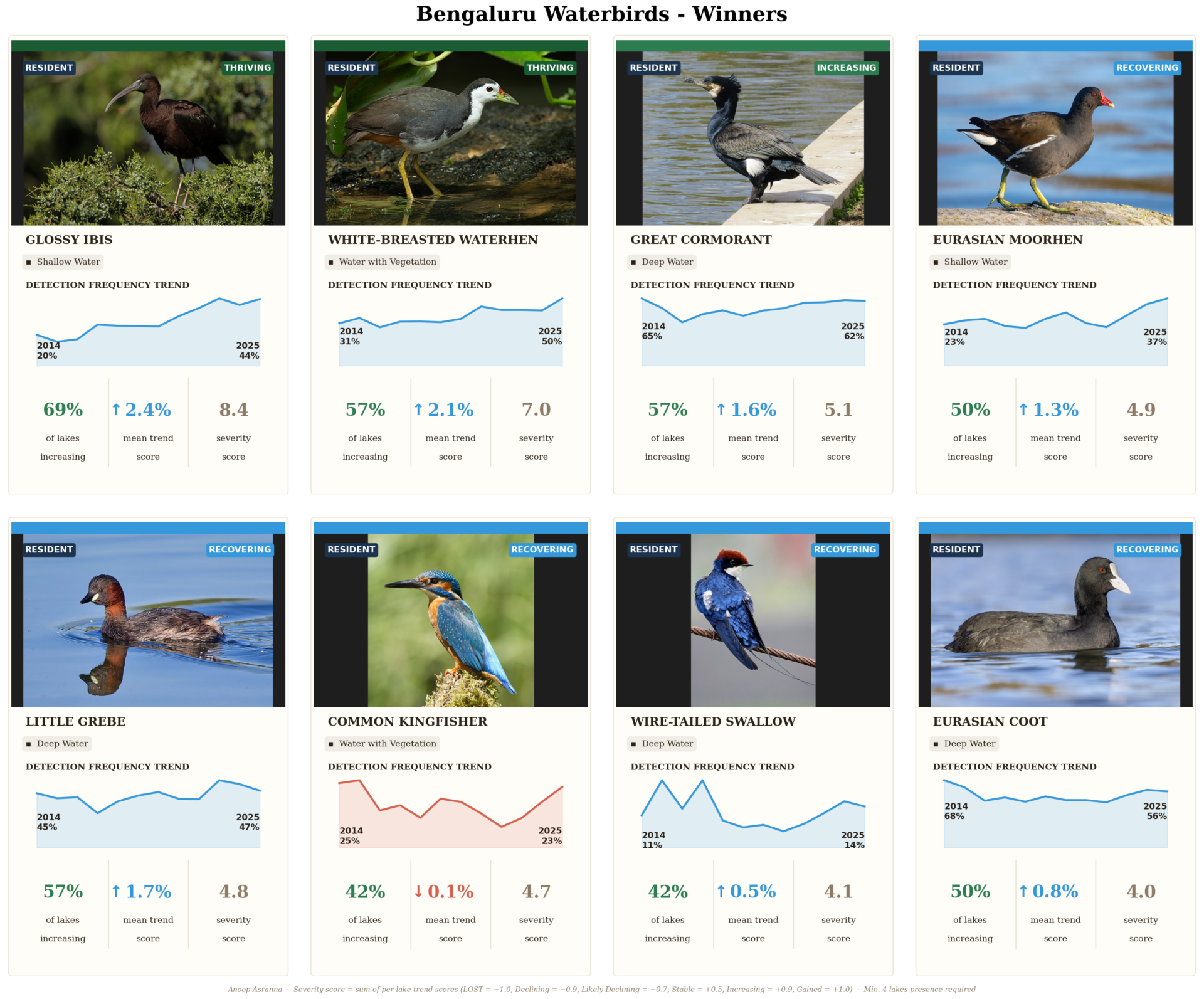
- The Glossy Ibis is mirroring the national trend and is now a common sight across Bengaluru’s lakes. Its longer legs and deeper bill allow it to access depths up to 15–20 cm. Being a tactile forager, it can feed in murky, polluted waters.
- The White-breasted Waterhen, a generalist with a flexible diet and nesting habits, is showing stable detection rates in all but one lake. Its long, unwebbed toes allow it to walk over carpets of invasive aquatic vegetation (like water hyacinth). It also shows a high tolerance for human presence. The Eurasian Coot and Common Moorhen are other generalists faring well across lakes.
- The increased availability of fish and roosting sites on restoration-built islands has contributed to the success of the Great Cormorant, which is positive or stable at most lakes.
Our results suggest that an ecological gentrification is playing out in most of Bengaluru’s lakes. Specialist species dependent on edge habitats like reedbeds, shorelines and bushes are making way for open-water generalists.
Is this gentrification uniform across all lakes, or are some bucking the trend? We explore this in the next article.
[The team acknowledges:
- Rashmi Kulranjan, Hydrologist at WELL Labs, for sharing datasets related to cascade connectivity and pointing out the pertinent ecological issues associated with Bengaluru lakes today.
- Ashwin Viswanathan, Scientist at Nature Conservation Foundation, for advising us on waterbird guild classification and interpreting eBird data analysis results.]