From the medieval bazaars of Baghdad to the intellectual debates of Paris, to the warmth found in Delhi’s winters, poets, artists, writers, and aficionados have long captured what it means to be in a city, amid thousands of people, synchronising their lives to a rhythm entirely different from their rural counterparts.
Life in the city is distinct. It is hard, exciting, liberating, and fast. Regimes are born in cities. Revolutions are ignited in them. India’s history, too, has played out against the backdrop of her many urban centres: Prayagraj, Gangaikondacholapuram, Pataliputra, Hampi, Shahjahanabad, Surat, Meerut, Kolkata, New Delhi, Navi Mumbai, and Gurugram.
Cities had (and continue to have) an inbuilt excitement within them. But,
- Can we understand and celebrate cities without understanding what happens outside them?
- Can any celebration of Delhi happen without the vital ecological support provided by the Aravallis?
- Did the bazaars of medieval Baghdad exist without the farmers, producers and artisans who came from thousands of hamlets and towns across the region?
- Can the gastronomical landscape of Paris be detached from the surrounding French countryside where produce is grown?
Bengaluru: India’s urban imagination
In India, perhaps no city captures the imagination of what it means to be urban quite like Bengaluru. It is a city of sharp contradictions:
- It simultaneously grapples with severe traffic congestion, water scarcity, urban heat stress, and unaffordable rents.
- Yet, it remains at the absolute centre of India’s economic growth story.
Bengaluru’s trajectory began with the establishment of public sector undertakings in the early years of independence. The tech boom at the turn of the century and the startup boom of the last decade are simply the latest milestones in its rapid evolution. As the city continues to swell, it demands complex planning and policy responses.
Urban expansion cannot sidestep the vital links between a city and its surrounding areas. Cities are economic and cultural powerhouses, and they will continue to grow, but they cannot do so in isolation.
The conventional response: Land acquisition
The conventional plan and policy response to Bengaluru’s growth has been to acquire land in the city’s peripheral rural areas for townships or layouts. The development of these so-called ‘new areas’, however, is fraught with land contentions, many of which end in a legal quagmire.
The logic is simple: the city will continue to grow, absorbing the surrounding green zones, agricultural belts and villages. We can ‘plan’ for this growth by acquiring land from farmers and villagers, and be ready for the anticipated future growth. Industries, housing and commercial development can then be carried out in these new areas. SK Layout, Bidadi, Devanahalli. “There is the urban, and there is the rural”. The rural can be made into the urban. This process can be reiteratively carried out. The urbanisation premium mandated by the 16th Finance Commission is also in this direction.
However, human settlements do not work that way. Cities are not islands. They are components of a larger ecosystem. There is an inherent interconnectedness between the city and the areas that adjoin it. The field of regional planning understands both the scale and the interconnections.
Read more: Peripheral Ring Road: Bengaluru farmers allege unfair payouts threaten their future
Agricultural belts ensure cities are provisioned with food and raw materials. Adjoining forests and green spaces buffer cities from the worst of climate change, while grasslands recharge vital groundwater aquifers.
To compartmentalise the urban and the non-urban into separate systems is a disservice to both. It is impossible to make blanket distinctions between rural and urban areas because their webs of interconnection are so complex; what affects one invariably impacts the other. Urban informality, for instance, can be directly linked to agrarian distress.
What would such a response mean in Bengaluru’s context?
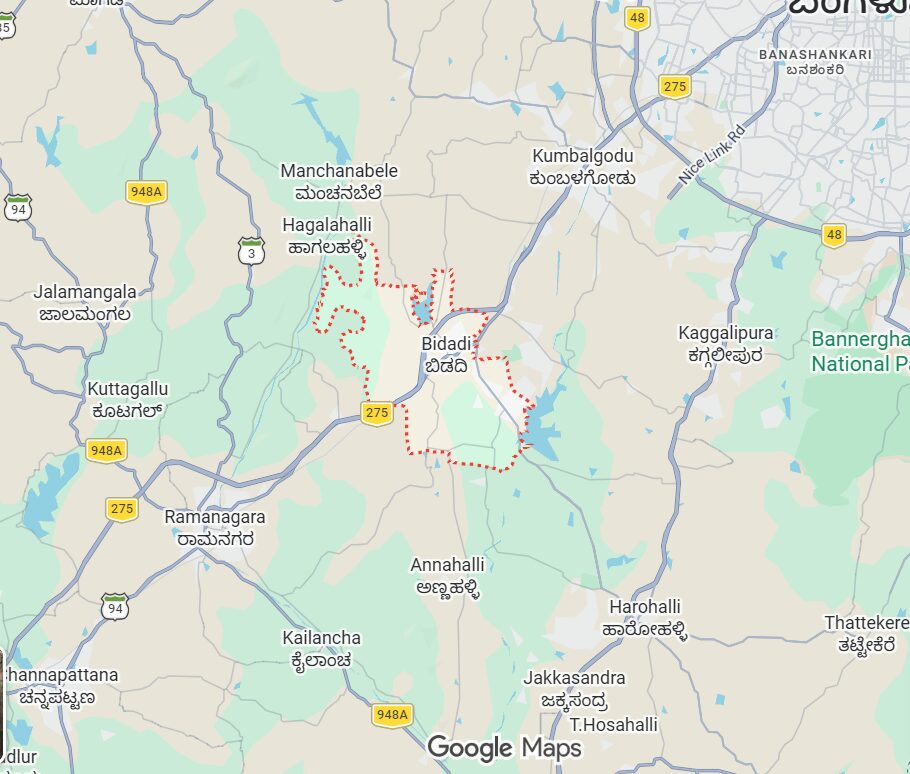
Bengaluru is surrounded by existing and emergent towns — Bidadi, Magadi, Hoskote, Kanakapura, Devanahalli, Chikkaballapura, Ramanagara amongst others — interspersed with the rural that hosts agriculture, forests and hamlets. To simply designate these fertile tracts of land as future extensions of the city would have two major ramifications:
- Green belts and ecologically important zones would gradually disappear.
- Conflicts over land will inevitably emerge.
Instead, a policy response that comprehends the strength of each of these settlements in themselves, inclusive of locational advantages, merits thought as against pitting these in relation to Bengaluru. These are not mere “satellites” to the megapolis.
The current model of unfettered urban expansion through land acquisition sidesteps the historical inherent advantage that these settlements have garnered as these evolved. Leveraging these advantages would require investments in education, public health and social infrastructure. Development goals for these settlements should prioritise locally suited economies, distributing development across the region. To achieve this:
- The state must take the lead, and private capital will follow.
- Employment opportunities can be created locally, without disrupting existing livelihoods.
- Hope does not need to be concentrated in the megapolis alone.
Sustainability and inclusion
Sustainability and inclusion goals seek to enhance the quality of living for all residents of the city. Protecting ecosystems that enable our cities to thrive is the first step towards achieving these goals. A celebration of Bengaluru’s triumphs and vitality cannot ignore the systems that enable it.
- The mango and jackfruit mela celebrated at Lal Bagh in the heart of Bengaluru cannot happen without the support of farmers in Ramanagara.
- The renowned Kadelkai Pareshai in Basavanagudi is tied to the groundnut harvests in several villages across the region.
- Bengaluru’s status as a city with good weather is sustained by green belts, forests and grasslands surrounding it.
- Its water supply is dependent on the Hesaraghatta Grassland adjacent to the city.
- The ritual of grinding coconuts in our homes every morning would be an expensive affair without coconut harvests in Bidadi.
- And of course, our beloved filter coffee would simply not be possible without the thousands of dairy farmers across the region – who supply fresh milk to the city.
The case against large-scale land acquisition projects that disrupt any component of this eco-system is quite straightforward. Cities cannot thrive by themselves. Solving the urban cannot be at the cost of the non-urban. Any attempt to do so will lead to disruptions in both systems.
This article is first of a four-part series that closely examines the consequences of indiscriminate urban expansion and land acquisition, and the impact this has on communities, in the backdrop of farmers’ protest against the Greater Bengaluru Integrated Township (GBIT) project in Bidadi.