Ten years back, Kamlaben Chavda was a stay-at-home mother of two children in the Gomtipur ward, at the far eastern end of Ahmedabad. Till one day, a neighbour and relative asked Kamlaben to accompany her to where she worked, the Saundarya Safai Utkarsh Mahila Sewa Sahakari Mandali Ltd. Today, thanks to that visit and the work she eventually found through Saundarya, Kamlaben says, “Now I have this experience where I can confidently go to any workplace and perform. And I can definitely say that I am standing where I am because of the support of my mandali (cooperative).”
Kamlaben is just one among the many women who have carved a place and professional identity for themselves thanks to Saundarya, the women-led cooperative that provides sanitation, hygiene and maintenance services in schools, colleges, hospitals, offices, eateries, and housing societies across the city. Kamlaben herself has worked for several employers, including the Darpana Art Academy, C N Vidyalaya and the SEWA cooperative Federation.
Ahmedabad already has an enormous demand for professional housekeeping services, which is only expected to increase with the city gearing up to host the Commonwealth Games in 2030. The Saundarya Mandali thus steps in to fill a key demand, and in the process bridges informal women workers and formal clients through collective contract negotiation and transparent wage allocation.
Emergence of Saundarya Women’s Cooperative
Saundarya was established in 1986, not as an organised entity, but in a silent rebellion against the injustices that informal women workers faced regularly. Women waste workers in particular, most of whom belonged to socially marginalised communities and were often migrants to the city, united to fight against the difficulties of unsafe work environment, unstable income, and lack of social security. They approached the municipal corporation demanding recognition and better working conditions.
Initially, they were allowed to collect waste from selected areas. Then, in 1987, women waste pickers were formally granted the task of door-to-door waste collection under the overall municipal solid waste management system.
In one instance, 31 women gained stable work with assured pay, at the National Institute of Design (NID). The Institute gave them a dedicated space for their work and they were also permitted to collect and sell waste from the entire institutional campus. With more stability and exposure, the workers began to organise themselves and demand better wages and working conditions.
The group eventually registered as a cooperative with 105 members. They transformed the adversity and limited resources into a cooperative built out of united willpower. Today, Saundarya markets its services directly and is promoted by the Self-Employed Women’s Association (SEWA), founded by Ela Bhatt. Its members work at institutions such as Anubhuti Clinic, C N College, Gujarat Power Corporation, Darpana Arts Academy, Friends of Women’s World Banking, and BSNL offices, among many others.
Currently, fifty-five members operate across twenty-two locations to earn their livelihood. 10 supervisors mobilise women across different areas and form sangathans. The cooperative enters contracts with clients, places proposals before the executive committee (karobaari samiti), deducts a service charge (usually 10–18 percent), and allocates the remaining amount as wages.
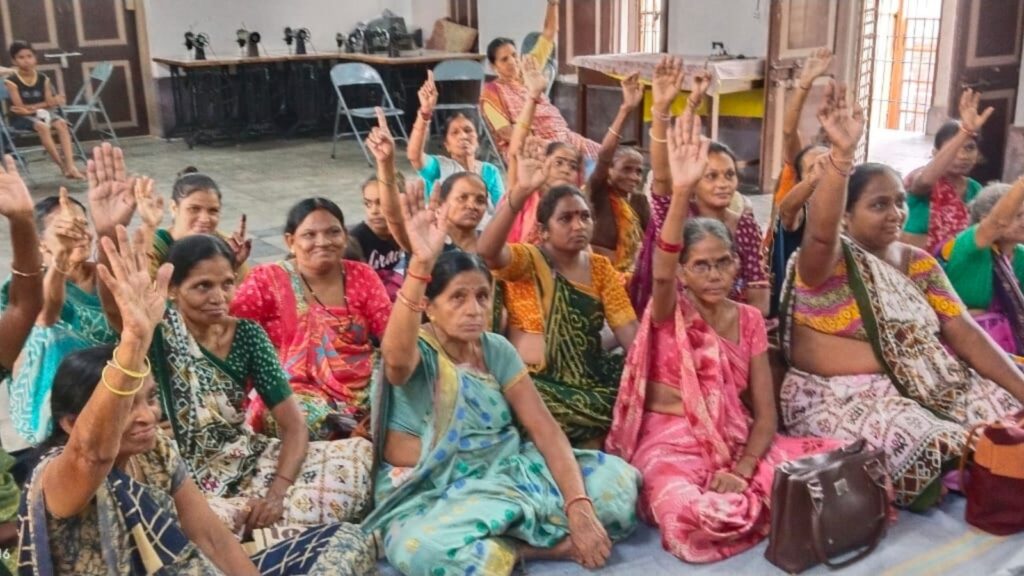
Selection depends on physical suitability for different types of work. The cooperative follows a rotational policy every three to six months, to ensure equitable wage distribution and exposure to different workplaces. On average, members earn between ₹12,000 to ₹15,000 per month. Workplace issues are resolved through supervisors’ intervention.
The board meets monthly to deliberate on operations and review accounts. An Annual General Meeting is held each year where financial reports are presented and shareholders can raise queries. Women become shareholder-members by purchasing shares valued at ₹101 or ₹151.
The cooperative is financially independent and achieved a surplus of ₹1,97,361 in 2024–25.
Stories of growth, change, and sisterhood
Nearly four decades after its founding, Saundarya has gone beyond being merely a source of livelihood. Rooted in the idea of women’s collective strength and shared growth, Saundarya Cooperative reflects how collective work can create empowering and sustainable opportunities for women. The cooperative structure enables women to become shareholders, participate in decision-making, and shape business strategies. During crises, it functions as a social protection mechanism while preserving dignity and collective control, as the COVID pandemic proved.
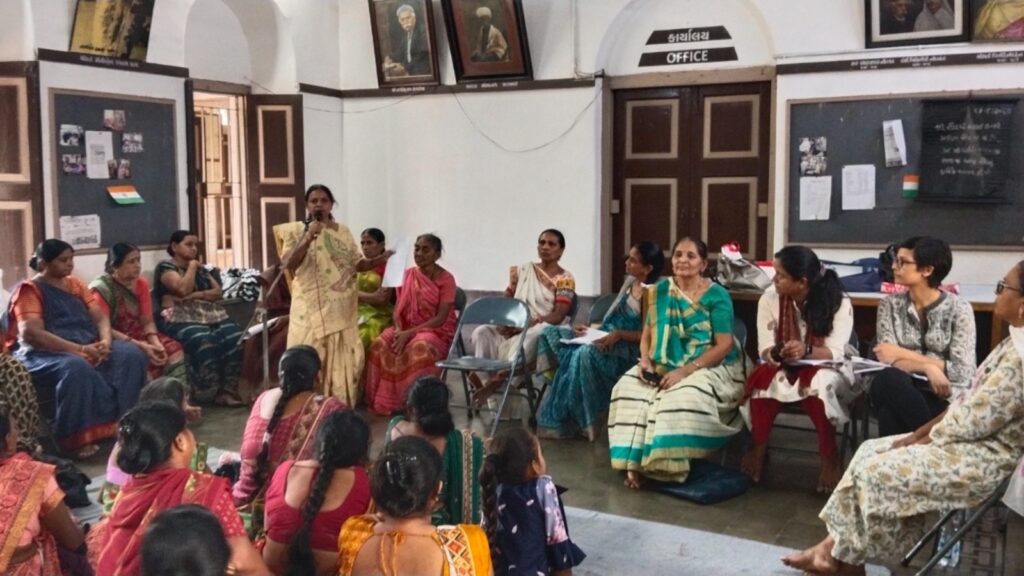
Hemangini Vala, Manager at Saundarya, entered this sector after she had just completed her B.Com and MBA in Finance. In a podcast, she relates how her family supported her choice since Saundarya was a women-run organisation.
Hemangini manages financial affairs, HR, and compliance-related matters in the organisation. She disputes the notion that there is no scope for growth in cooperatives. “Cooperatives should be seen as business entities,” she says, “While there may be some initial entry barriers, just like in any organisation, once women overcome them, they gain opportunities to network, increase their income, access sustainable work, build new skills, and benefit from capacity-building training.”
How does Saundarya live up to the needs and expectations of its members? “Members’ specific financial and livelihood concerns must be respected,” says Hemangini, “We keep learning from our members about how best we can assist them. While the younger generation is willing to join the cooperative, they need mentorship and guidance too. In addition, higher education institutions must offer courses related to cooperative management, marketing and governance.”
Evolution and impact
Talking about digitalisation and compliance at Saundarya, Hemangini says, “All the transactions, internal as well as external, are being carried out digitally now, including UPI-based transactions. Employees’ salaries are directly credited to their bank accounts using either cheques or RTGS services. Likewise, work contracts and appointment letters are prepared and issued digitally now, too. However, there has been no reduction in compliance audits at all. Saundarya ensures total financial transparency internally as well as externally.”
Cooperatives like Saundarya have proved that they can be a form of social protection, especially for women from marginalised communities. In India, sanitary service collectives such as SWaCH (Pune), Hasiru Dala (Bengaluru), and others under SEWA Federation have organised informal labour into formalised service systems. But many of them remain largely confined to municipal solid-waste systems.
Saundarya, however, has transitioned into a women-owned service enterprise providing professional housekeeping and facility-maintenance services to a wide network of institutional clients. It thus demonstrates how marginalised workers can move up the value chain — from waste collection to more structured and diverse service delivery within formal institutions.
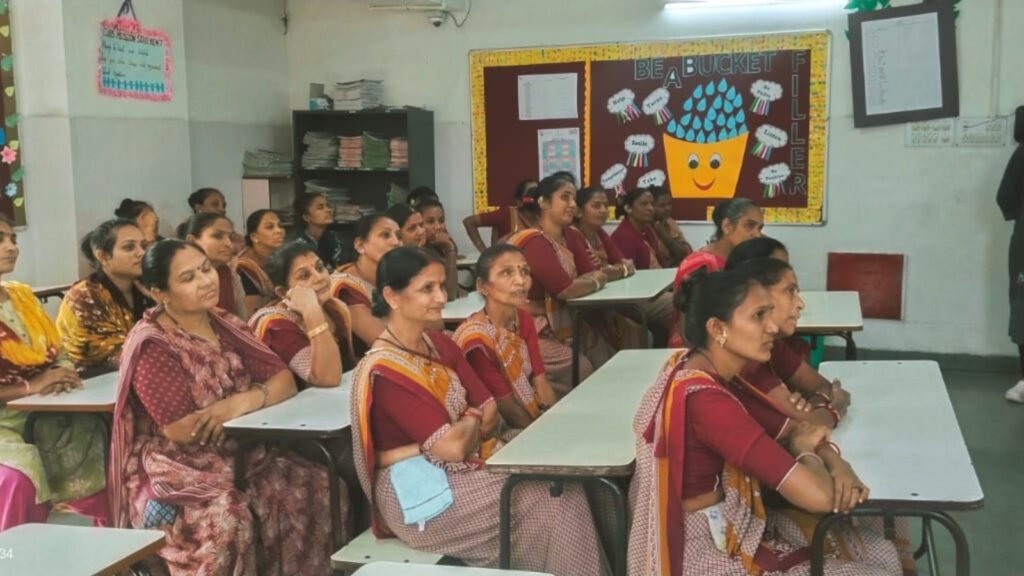
Its uniqueness lies in combining cooperative ownership with business-oriented operations: members collectively negotiate contracts, allocate work through democratic processes, deduct a transparent service charge for sustainability, and distribute the remaining earnings as wages. There is regular capacity building through training, supervision and purchase of modern equipment.
Saundarya Safai Utkarsh Mahila Sewa Sahakari Mandali is thus a perfect example showcasing the importance of collective efforts. Besides providing the means to earn a living, the collective has helped its members develop new skills and financial independence. On one hand, it has made significant contributions towards sanitation and cleanliness in the city’s institutions; on the other hand, it has created a replicable model for the empowerment of women in the margins.