Two decades ago, Gandhi Nagar in south Chennai was a shaded green canopy, recalls Meera Ravikumar, a resident. “Now, in the name of development, many incidents of tree felling have occurred in the past 15 years on avenues and across private properties. In highly populated and polluted urban areas, green lung spaces are important,” says the member of Swacch Gandhi Nagar, a citizens group.
Since 2000, India has lost 2.33 million hectares of tree cover, according to the 2024 Global Forest Watch. Tamil Nadu has fared better than most states — its forest cover has remained “largely stable” since 2000, with an increase in green cover of nearly 2,794 sq km in the past decade, reveal news reports. However, residents like Meera note that cities have gotten hotter and more concretised.
For instance, 100 trees were recently axed to widen Sardar Patel Road. In 2025, Panagal Park lost over 30 per cent of its green cover following Chennai Metro Rail construction. Earlier, around 2,000 trees were granted permission to be axed for the Port-Maduravoyal Expressway. As unabated ‘development’ rages on, green cover is crucial in the fight for a better air quality index, the Supreme Court noted recently.
In an attempt to enhance the city’s green cover, the Greater Chennai Corporation (GCC) announced that citizens will be fined ₹1 lakh for cutting trees in public spaces without approval. Additionally, there would be penalties of ₹15,000 for unauthorised cutting of branches, fixing advertisement boards with nails, installing decorative lighting around trees, and concretising the tree’s base.
In January alone, the GCC imposed a total fine of ₹1.75 lakh on six persons for illegally cutting trees and branches in public places. The GCC has also digitised the application process for the removal of trees and pruning of branches on the official website and the Namma Chennai mobile application. These requests are approved by the District Green Committees (DGC), operational from 2022.
What are district green committees?
DGCs were constituted, by the direction of the High Court, to prevent unnecessary tree felling to protect existing trees, says TD Babu, trustee of NGO Nizhal, a member of the Green Committee in Chennai. The committee is represented by all government departments and two civil societies that are tree specialists. This committee’s approval is mandatory for the removal of any tree in public places, including those inside government premises
How do citizens apply for tree felling permits?
Earlier, residents reached out to the forest department in person, with letters or via call. But now they may access the official website or download the Namma Chennai mobile application to directly fill out the form. “This allows for a more streamlined process with the applicant receiving an acknowledgement and a serial number. It would also allow for a way to document complaints,” says a GCC official, who preferred to remain anonymous.
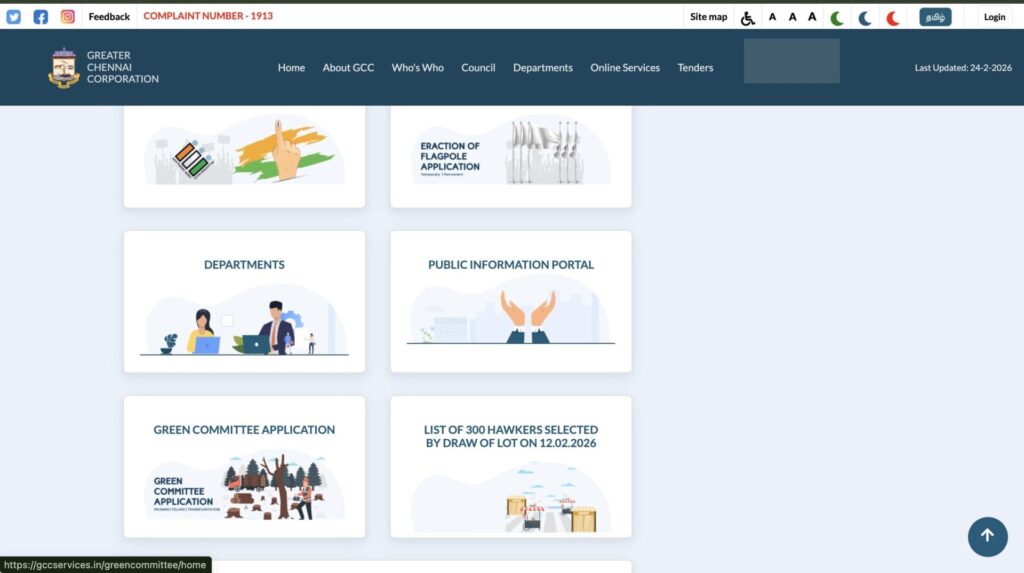
On the website, residents and government departments can scroll to the bottom and click on the ‘Green Committee Application’ option to request the felling or pruning of a tree in a public area.
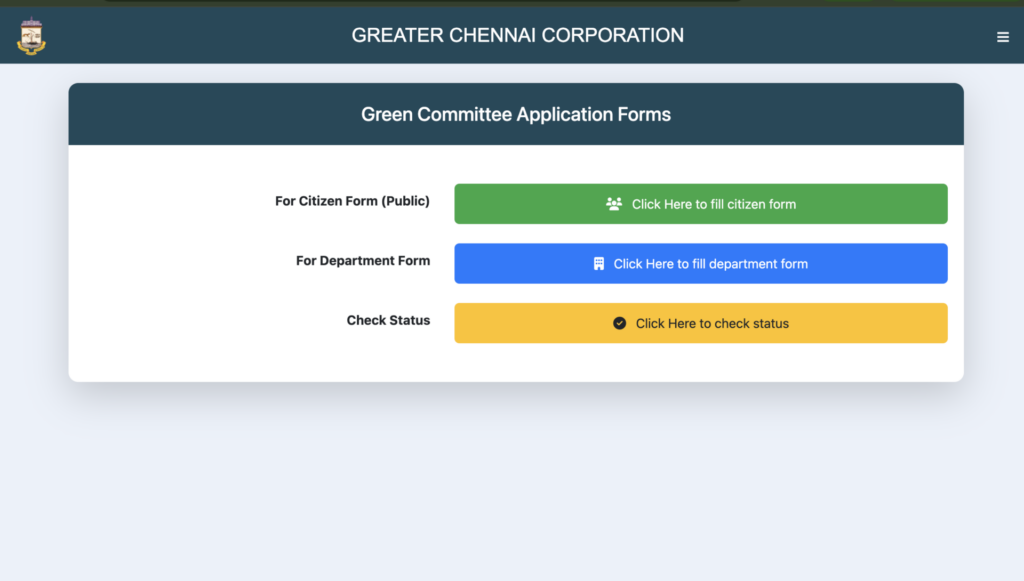
Residents must click on the citizen form, while government agencies will need to fill out the department form.
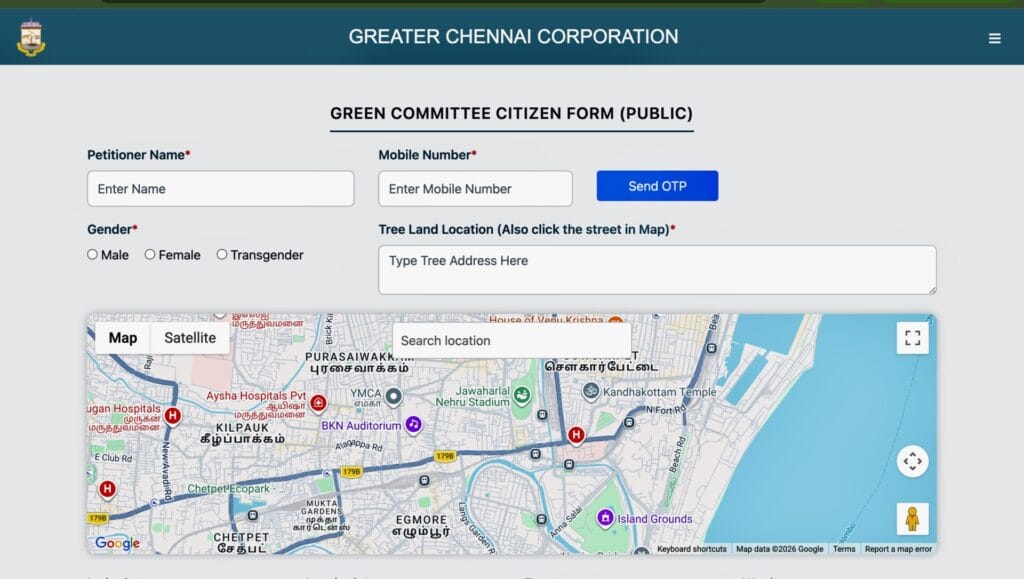
For the application, petitioners must fill in:
- Name, gender, and mobile number
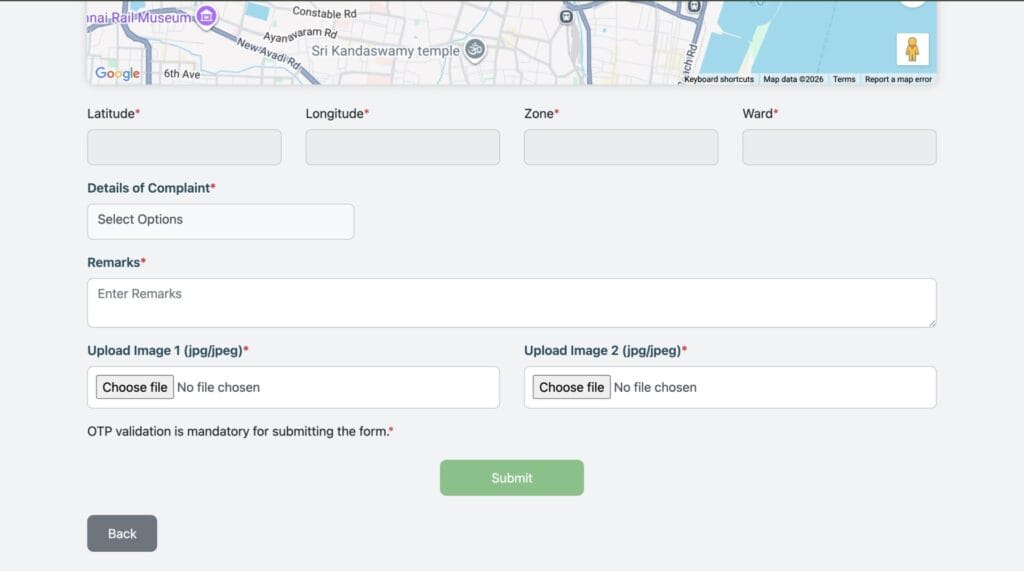
- Latitude, longitude, zone, and ward of the specified tree, along with marking it on a map
- Two photographs of the tree/branch, along with complaint details
- OTP validation from a mobile phone while filling the form
Residents may also check the status of their application on this portal, and will receive information on the status through SMS alerts.
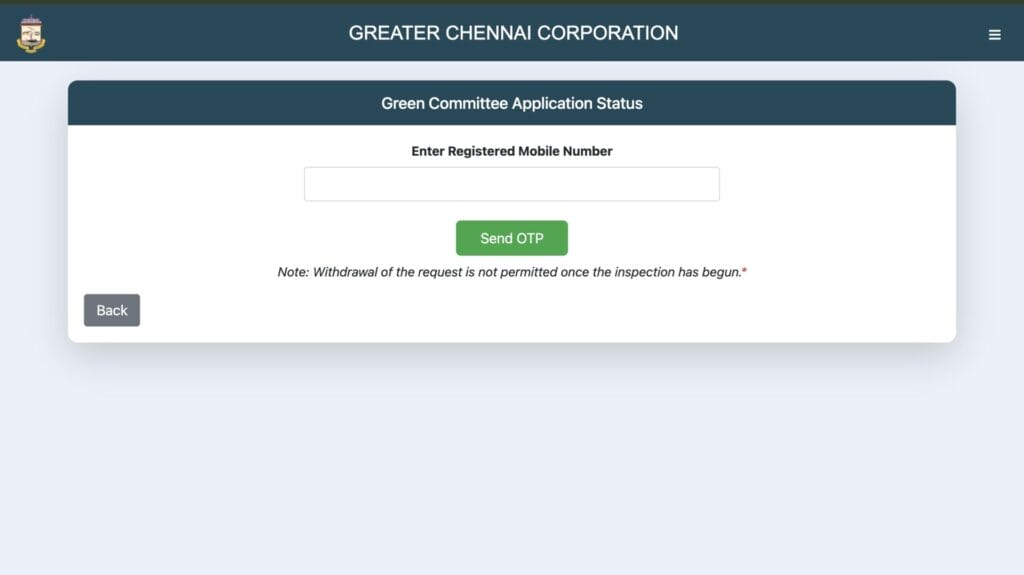
Residents can follow the same method on the Namma Chennai mobile application, after signing up. “Once the request has been filed, a three-member team including a corporation park superintendent, forest official, and civil society member will inspect the concerned tree and look for any threat to the building or to life,” explains Babu.
At the monthly DGC meeting, a report will be submitted to the chairperson, and the complaint will be discussed. “In case of no threat, the proposal for removal will be rejected. Otherwise, the tree will either be removed or transplanted based on the species,” he adds.
Also Read: Chennai’s trees lack protection despite presence of District Green Committee
This process takes 30 days, but in cases of threats or damage, the action will be initiated earlier, he adds. Till now, the cell has received over 180 applications online, says the GCC official.
If a resident notices a tree being felled or pruned without permission?
Residents may also use this website or the Namma Chennai app to report violators and the tree in question. In these cases, the inspection will be done on the same day or the next day, but the investigation and penalty process may take two to three weeks.
In cases where digital access may prove to be an issue, citizens may also report illegal tree felling by calling the GCC helpline number 1913. “Now, this allows us to have every request and record in one place,” says the official.
Protected area and tree laws
While the website and app cover neighbourhoods within the Chennai corporation limits, the law changes in cases beyond these limits, or within forest sites.
If the area is within a protected area like a sanctuary, national park, or conservation reserve, then the felling of trees will fall under the Central Forest (Conservation) Act, 1980, says a GO from 2025. In these cases, a No Objection Certificate for tree felling in these areas will be issued by the Ministry of Environment, Forests, and Climate Change.
The order points out that rosewood trees cannot be removed from private land unless they are dead or windfallen. These trees — on government, revenue, or private lands —will fall under the purview of the Tamil Nadu Rosewood Trees (Conservation) Act, 1994. Meanwhile, in the case of sandalwood trees, outside the forested land and eco-sensitive zones, permissions must be granted by the concerned District Forest Officer. Here, the forest department will inspect and give a unique code to the tree while approving the felling of such a tree, points out Babu.
According to a question answered in the Parliament, the government plans to stop illegal felling of trees in forest areas by including regular patrolling, check posts at strategic and vulnerable locations, anti-poaching camps, and awareness campaigns.
No comprehensive law for trees in cities, private land
The cutting of trees in urban landscapes is often unregulated, and trees require a comprehensive central and state law, say conservationists. “Urban trees must be protected by law irrespective of whether they belong to public space or private property. In our area, people cut trees just because dry leaves fall on their properties,” Meera points out.
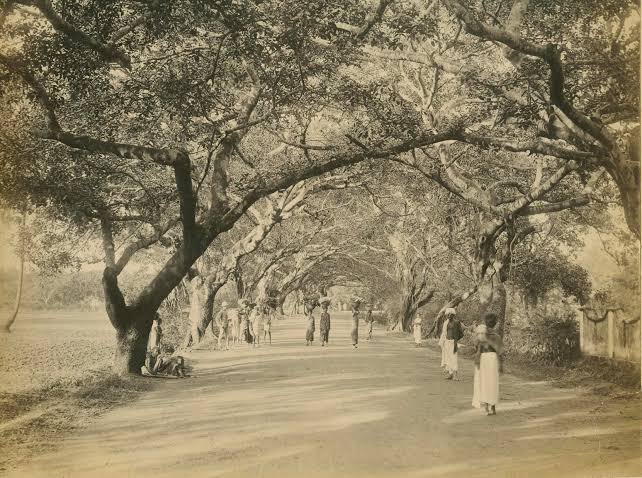
From widening roads, carving out highways, or issuing development permits for old buildings, trees are in the line of fire, points out Nanditha Krishna, historian and environmentalist. “Local municipalities decide rules for a city, but there is nothing to really prevent people from cutting down trees on their private property,” she says.
The laws have limitations as well. It may be noted that the applicant — whether a citizen or government department — needs to plant 10 trees for the felling of one in the nearby area to balance the greenery. “There was no way to follow up on this, but now the online system can possibly allow for this,” the official adds.
Read more: Here’s what you must know before you plant another tree in Chennai
Beyond legislation, the idea of a responsible citizen needs to be instilled in the larger mission towards the protection of trees, highlights Shobha Menon of Nizhal. “Citizens need to become stakeholders; they need to know that there are rules and laws to care for their tree guardian wards and stand up for them,” she says.
“Many Acts might be on paper, unless every individual realises the importance of the tree, which is the lifeline for all living communities on earth, the greenery of the city can neither be protected nor increased,” signs off Babu.
What can residents do:
- Apply for permissions for tree felling or pruning in public spaces.
- Report illegal tree fellings, prunings, or other violations online on the GCC website or Namma Chennai app.
- Spread awareness and learn more about trees in your area.
Also read:
- How the residents of Adyar banded together to save a tree
- Bengaluru’s tree census: Flawed data undermines efforts to protect city’s green cover