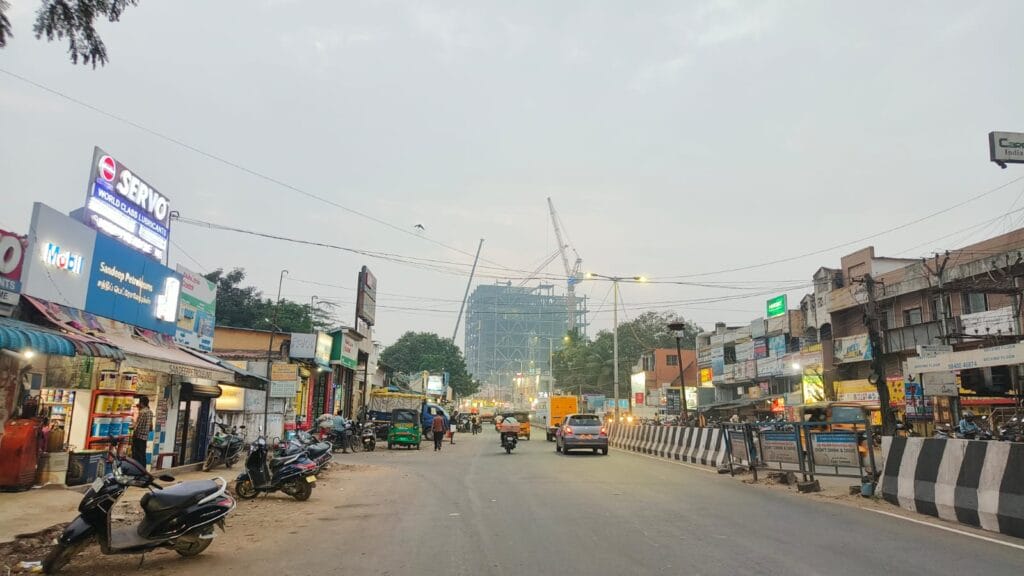
Commuters passing through Ambattur Industrial Estate inevitably find a layer of dust coating their vehicles, faces, and hands. For Lalitha*, a domestic worker employed at a high-rise apartment near Padi flyover’s Saravana Stores, the last two weeks of December have been especially unbearable. “Dust, dust, dust everywhere,” she says, coughing through a persistent cold. At 6 pm, when the rush hour begins, it takes her nearly 30 minutes by bus to cover the 5 km journey home. The ride to the Dunlop area is punctuated by pollution, blaring horns, and endless traffic snarls.
“It should take 15 minutes usually, but this is Ambattur Estate,” she says. Cars never seem to cease at this section of the Chennai-Tiruvallur High Road (CTH Road) during peak hours. Other residents, like 48-year-old Jayanthi*, a street vendor selling spinach nearby, recall a history of quiet roads and forests of thick, thorny bushes and trees, where manufacturing units now stand.
Ambattur Industrial Estate, established in the 1960s, was once home to 400 units manufacturing locomotives and automobile accessories. Now, it accommodates over 2,000 industrial units in the manufacturing and service sectors, while Ambit Park has become a hub for IT professionals. With this expansion, dust and traffic have become part of its everyday life.
Industrial areas and flyovers in this locality show higher PM2.5 (particulate matter) levels than residential and lakeside regions, according to a study by the Indian Institute of Technology Madras (IIT-M). The study is part of IIT-M’s Project Kaatru, which aims to provide a low-cost, mobile solution for capturing hyperlocal air pollution data across different areas in Chennai. In an earlier article, we examined the spike in PM 2.5 levels at Koyambedu market, which coincided with truck movements. Here, we take a trip through Ambattur Industrial Estate, the Padi flyover and surrounding regions, emphasising how air pollution affects residents and commuters.
Read more: Explained: How air pollution levels are monitored in Chennai and what the data implies
High PM2.5 levels at Padi Bridge, Ambattur Estate
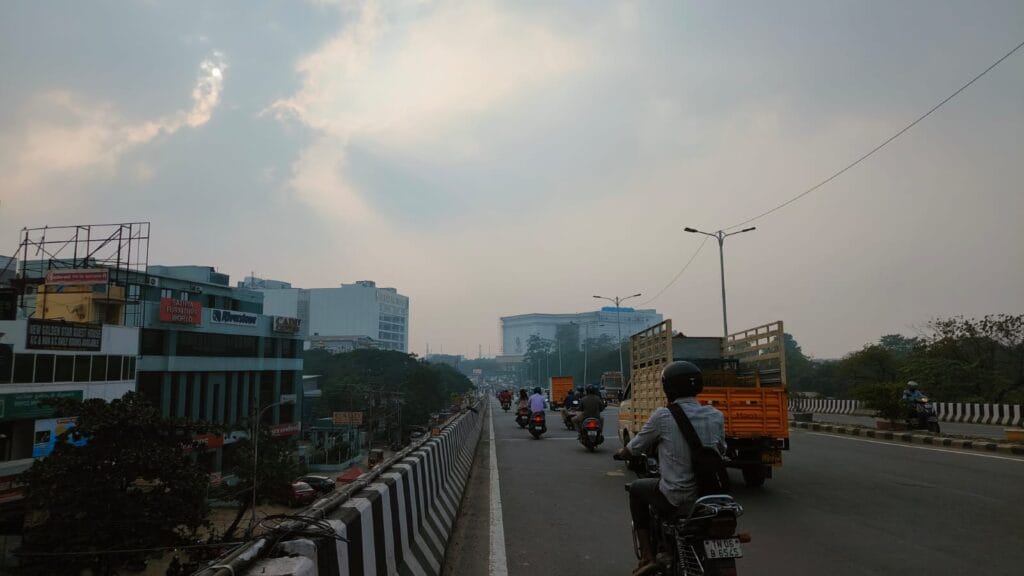
In the past year, Mohan D, a security guard at a bank, has noted the rise in two-wheelers, cars and buses. It takes him a little less than ₹20 to get around Ambattur Estate in an overly crowded bus. “During this time, I think about how the real problem is greed. In our days, we could get around this city on a cycle, bought after months of hard-earned money. Now, every household wants two cars and two bikes. Meanwhile, Deluxe buses get more expensive while free buses are fewer in number,” he says.
Data points to a similar trend, with 21.18 lakh vehicles being registered in Tamil Nadu last year. Around 40% of the total registrations were concentrated in Chennai, Chengalpattu, and Tiruvallur.
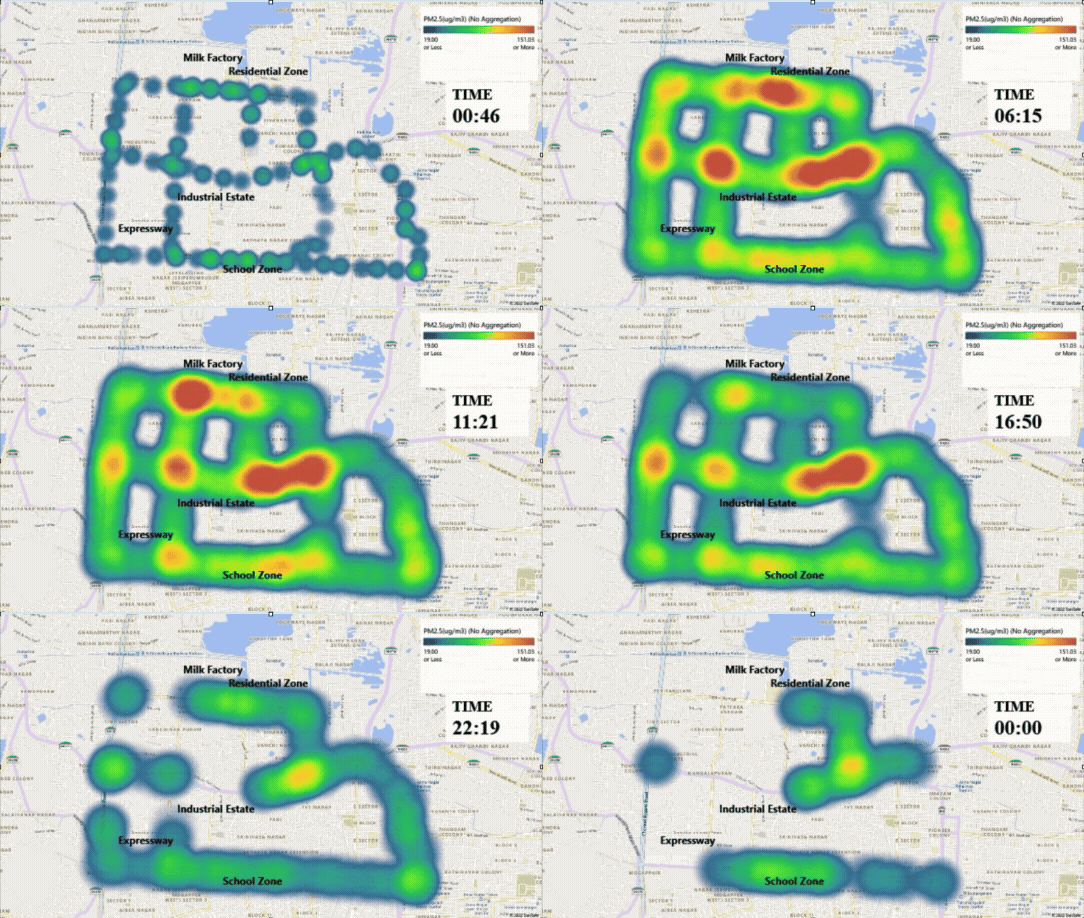
Vehicular traffic, idling trucks, and emissions lead to spikes in PM2.5 levels, says Professor Raghunathan Rengaswamy, Dean (Global Engagement) and Faculty, Department of Chemical Engineering, who heads the IIT-M team. The study found hotspots at Ambattur’s Dairy Road, Padi flyover, and School Road. The team collected data using a vehicle fitted with an air-quality device covering key roads in the region for 30 days from April to May 2019.
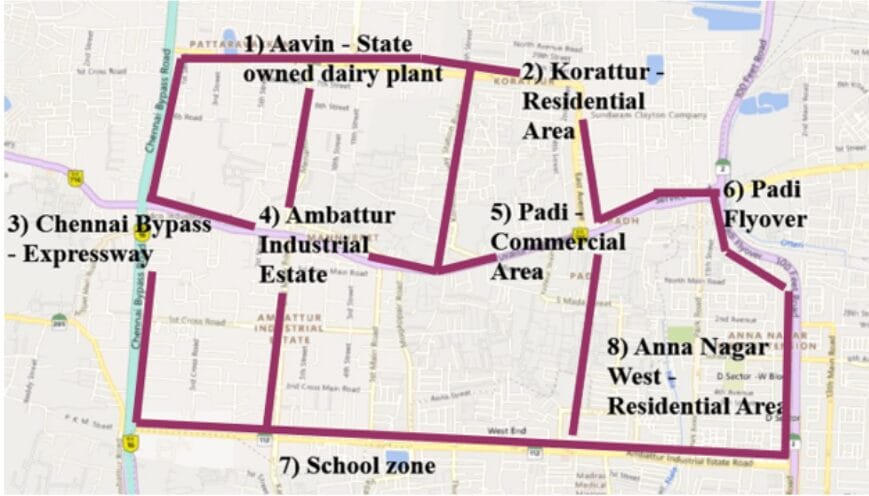
Thirumangalam Signal, Ambattur Industrial Estate Road, and School Road saw spikes in pollution coinciding with the travel of office-goers and school children. Ambattur Estate saw PM2.5 levels of over 134 micrograms per cubic meter (µg/m³) and PM-10 levels of 148 µg/m³, at 1 pm in April. Apart from school areas, the newly-rennovated Ambattur Estate bus stand area saw scores of commuters, mini buses, shareautos, and traffic.
School areas have always seen traffic during peak hours, say residents. With DAV, Bhaktavatsalam Vidyashram, Velamammal and other schools in this area, emissions and dust spike early mornings and noons. “Areas near Anna Nagar West, JJ Nagar, and Ambattur have seen bustling crowds due to schools,” says Lakshmi M, who has lived in this area for over 40 years. She adds that dust, mosquitoes and potholes have increased through the years.
Thirumangalam recorded a mid-year spike in PM2.5 at 170 µg/m³ and PM10 at 195 µg/m³, exceeding the National Ambient Air Quality Standard (NAAQS) for PM2.5 as per CPCB guidelines.
Meanwhile, the Padi flyover sees hundreds of vehicles a day as it is an entry point to Ambattur Estate, Villikavam, Korattur, Redhills, and surrounding regions, say citizens’ groups and residents. Most street vendors we spoke to, who spend over 12 hours on this stretch, were afflicted with colds, fever and headaches. Some attribute this to the virus of winter months, while others relate this to dust allergies due to the Anna Nagar West metro construction and traffic at Padi flyover.
Mannurpet, Chennai–Thiruvallur High Road (CTH Road), Padi flyovers are chokepoints in this area with several vehicles, says M Dinakaran, a traffic police constable stationed near Estate bus stand. Arterial roads such as Ambattur-Red Hills Road are also a link to Puzhal, Mahadvaram and other areas.
Dairy Road, major polluted hotspot
According to the device, PM2.5 levels on Ambattur’s Dairy Road were between 54 and 315 µg/m³, and PM10 levels were between 55 and 390 µg/m³. The team attributes this to the frequent movement of trucks from the state-owned dairy hub. “No matter how much sanitation workers or machines clean this Aavin stretch, the dust always accumulates,” says Jyothi*, who works at a lens manufacturing company near the hub. Others employed at different units here point out that there have been improvements to road conditions this year.
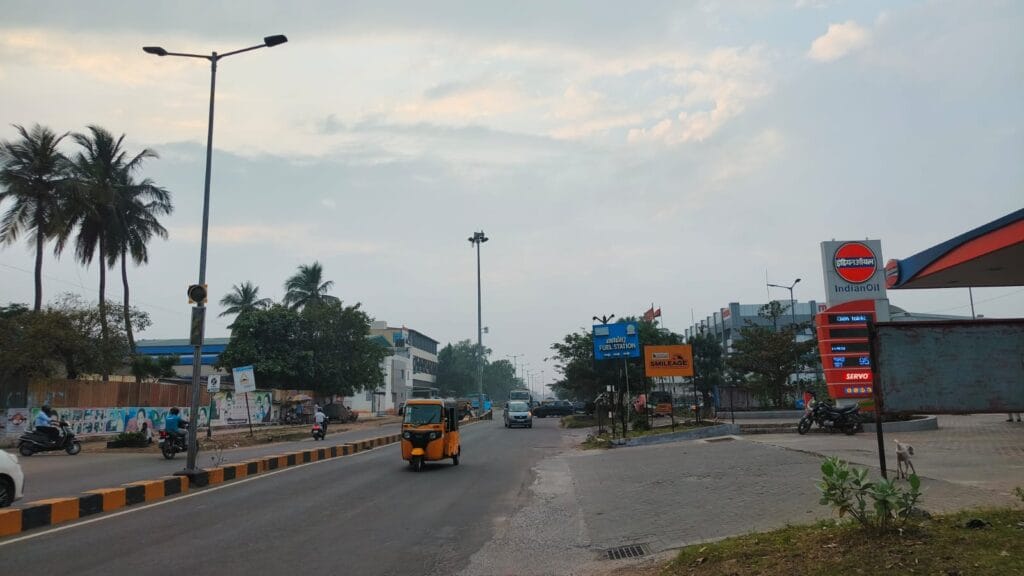
Large vehicles pass near the Aavin hub between 2–3 am, while regular traffic continues throughout the day. According to Ravi and Vinayakamoorthy from the Aavin petrol bunk, the main source of pollution at Aavin junction is Karukku Main Road, now a busy link road to Puzhal and Madhavaram. “Karukku Main Road used to be a mud road, but now it has changed into a link road, which causes traffic jams.” They added that truck movement was unavoidable for industrial areas, with about 30 trucks refuelling at their bunk daily.
”If roads are not properly laid or are muddy, dust contributes to the PM2.5 spikes. If there is a PM10 spike, that could potentially be due to civil works going around construction sites,” adds an IIT-M team member.
However, Ravi counters that there was more traffic four years ago when the bunk opened. “Earlier, road conditions were bad, causing more dust. Now, mechanised sweepers are being used to clean the area.”
Residential neighbourhoods, lake-adjacent areas rank better
Residential zones like Anna Nagar displayed moderate and stable PM2.5 compared to industrial areas, found the study. Residents and experts link this to green cover, but point out that vehicular dust is on the rise.
“At Thiruvengada Nagar, our street has at least 200 trees. There is tranquillity, lots of greenery, and pure oxygen in the air,” says S Suresh, General Secretary of United Welfare Association of Ambattur. However, he flags issues of poor road conditions and the persistent demand to widen the CTH road.
Areas in Korattur experienced fewer spikes in PM2.5 levels due to the presence of the Korattur Eri and better natural ventilation. However, water pollution and the discharge of effluents into the lake remain rampant, according to Anbazhagan K B, former treasurer of the citizens’ group Ooruni Maiyam. “Water contamination is a serious issue here, caused by surrounding industries. Sewage, oil, and other pollutants have accumulated in the lake over the years,” he adds.
Also, earlier this year, the TNPCB had imposed a ₹510 crore penalty on Ambattur’s Aavin Dairy factory for environmental violations, according to news reports.
Read more: When eri restoration is just another name for eviction of the working classes
Recording AQI is not enough to map pollution
In the debate of good air vs bad air, Prabhakaran Veeraarasu, an environmental activist, notes the importance of mapping parameters, weather conditions and temperature along with peak hours and non-peak hours to identify pollution sources. Beyond vehicular pollution, he adds, “There are several red category industries near Padi, and in Ambattur. Thermal power plant emissions can travel from Ennore and Kodungaiyur to this area.” Prabhakaran points to the need to revise the annual air quality standards, which were last notified in 2009.
Adding to this, public health expert and researcher Vishvaja Sambath points out, “Ambattur Estate is a hub and has multiple small and medium-scale factories on every street. We have to understand what kind of particles and heavy metals are polluting the air here. In this context, heavy metals could cause serious neurological problems, headaches. Only if we know details can we relate it to a public health crisis in a place otherwise, it remains as a number.”
To curb pollution in the Ambattur Industrial Estate area, citizens demand:
- Widening of narrow roads in Ambattur Estate and fixing of SWDs.
- Extending metro facilities and running electric buses that cover more routes.
- Widening of the Padi flyover to reduce the idling time of vehicles.
- Restriction of heavy-load vehicles in industrial areas.
- Traffic constables posted at chokepoints to ease traffic. Install more signals at junctions.
- Compliance with NHAI rules, such as ramps and service roads on expressways, national highways.
*Names changed to protect identity
This post covers the topic nicely. Appreciate the effort you put into explaining it.
Great perspective on the limits of AQI data.
Great post! The article clearly explains how rising air pollution in Chennai’s Ambattur is impacting commuters and vendors, highlighting an important issue for the community.
https://www.gradsiren.co.in/state-cities/Andhra-Pradesh-state-AP?type=Jobs
Very well written and insightful! The content is easy to follow and useful for anyone starting their career. Thanks for sharing this. You can also explore fresher job opportunities in Telangana here: https://www.gradsiren.co.in/state-cities/Telangana-state-TS?type=Fresher%20Jobs