A massive demonstration was organised on Wednesday, December 12, 2018, on the premises of the BBMP Head Office at Corporation Circle by the BBMP Guttige Pourakarmikara Sangha, affiliated to AICCTU, where over 1,000 pourakarmikas took part. They protested against the callous attitude of the BBMP Officials towards the workers.
After years of determined struggle by the pourakarmikas, the BBMP was compelled to abolish the contract system and take the contract pourakarmikas on their rolls, and make out direct payment to them. Despite this, at today’s protest, the workers highlighted the fact that the contractors were still working behind the scenes to somehow reverse the decision of their abolition. They are doing this in collusion with some officials and are creating huge hurdles in the implementation of this decision of direct payment.
Consequently, the workers are not being paid their due wages on time and in some areas workers have not been paid for two-three months. “The workers must be paid wages regularly before the 7th of every month and wage slips must be issued every month as statutorily mandated,” said Nirmala M, general secretary of the union. The other demands raised in the protest included the provision of weekly holidays and other holidays, provision of toilets, drinking water, push carts, brooms, safety equipment, etc. which are still being denied to the workers.
It can be recall that a few months ago, Subramani, a worker, had committed suicide on account of the BBMP not paying wages to him for several months, and on the ground that he had worked for less than one year. The union had organised a huge protest on 12-07-2018, before the BBMP and the then Mayor Sampath Raj and Commissioner Manjunath Prasad had addressed the gathering and publicly announced that no worker will be retrenched, despite the same, workers in several wards are being denied employment on the same grounds and have not been paid wages for six months.
At the protest, this issue was raised along with the arbitrary retrenchment of several pourakarmikas on the grounds that they had crossed 60 years of age. “Several workers are being dismissed from employment due to their age. They have worked for several years now under the contract system. If they are not provided monetary benefits at their retirement, they’ll all be rendered homeless,” said Maitreyi Krishnan, general secretary, AICCTU.
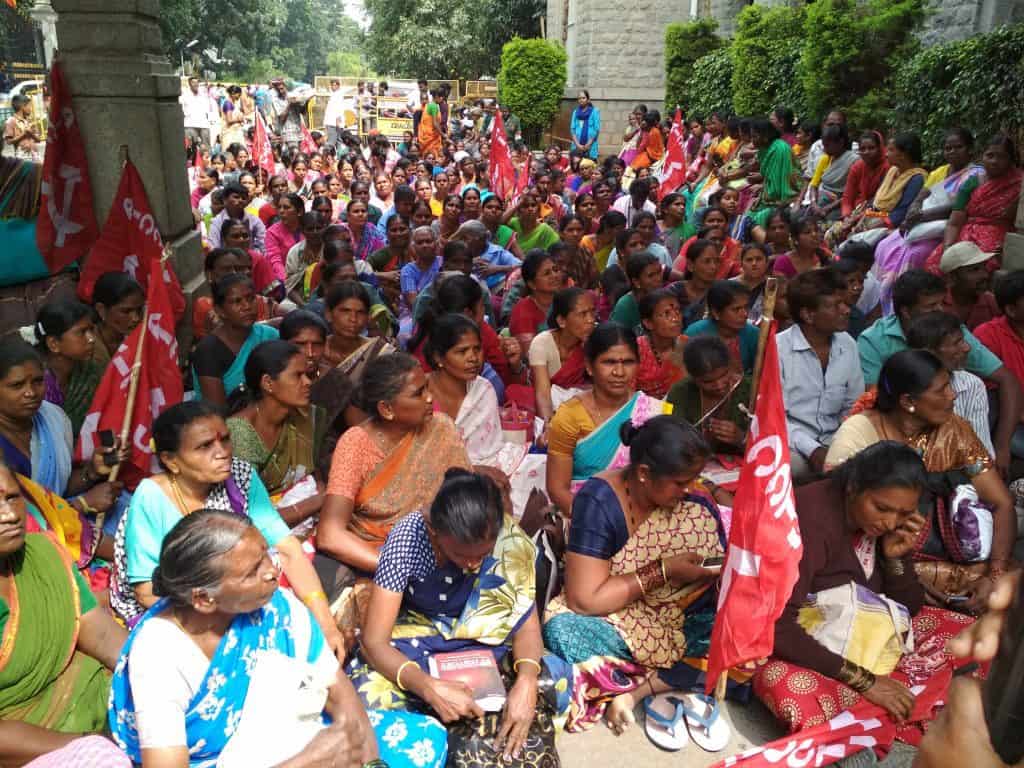
Contract civic workers protesting in BBMP premises. Pic: BBMP Guttige Pourkarmikara Sangha
Sarfaraz Khan, Joint Commissioner (Health and SWM), BBMP, came out and addressed issues raised by the union. After hearing all issues, he admitted that though things have changed considerably after the abolition of the contract system, there were still serious problems that had to be dealt with. He assured the workers that all due wages will be paid in the next week and henceforth, wages would be dispersed before the 7th of every month along with wage slips.
With regard to weekly off and other holidays, he said that the BBMP commissioner, has already issued a circular mandating the same, and despite this, officials at the zonal level have failed to comply with it. Clifton D’ Rozario, Secretary, CPI(ML) Liberation said, “The contract system must be abolished in toto and drivers, helpers and loading-unloading workers must also be taken on the rolls of the BBMP.”
During the discussion held publicly with the workers at the demonstration, the union highlighted that supervisors and heath inspectors in certain wards were forcing pourakarmikas to do the job of loading and unloading garbage into the vehicles in addition to the sweeping work. In this regard, he clarified that the work of pourakarmikas was only to sweep and that disciplinary action would be taken against any supervisor or health inspector who forces workers to do the loading and unloading work.
With regard to drinking water and toilets, the Joint Commissioner said steps were already being taken towards setting up toilets and restrooms at each mustering points across the city, but the same required establishment of infrastructure with considerable financial implications and permissions were being sought for the same. He reiterated that the BBMP intends to retain the services of pourakarmikas, irrespective of their work experience, and all dues to these workers will be immediately paid.
The demand of complete abolition of contract labour has been placed before the commissioner for necessary decisions. He also assured that a meeting with the union would be called shortly, to sort out any issues faced by the workers.
Note: This note was shared by BBMP Guttige Pourakarmikara Sangha and published here with minimal edits.