431 candidates in 27 constituencies: Which ones are yours?

Elections are a great time to analyse many issues that go unexplored otherwise. Take a look at the data compiled, to see the trends and patterns. Go through what we have compiled, to make an informed choice!

Citizen Matters and Open City, our open data initiative has been sharing information and data about incumbent MLAs with their track record, candidates and details of past elections. This map gives you an easy way to check your constituency and candidates contesting elections. 

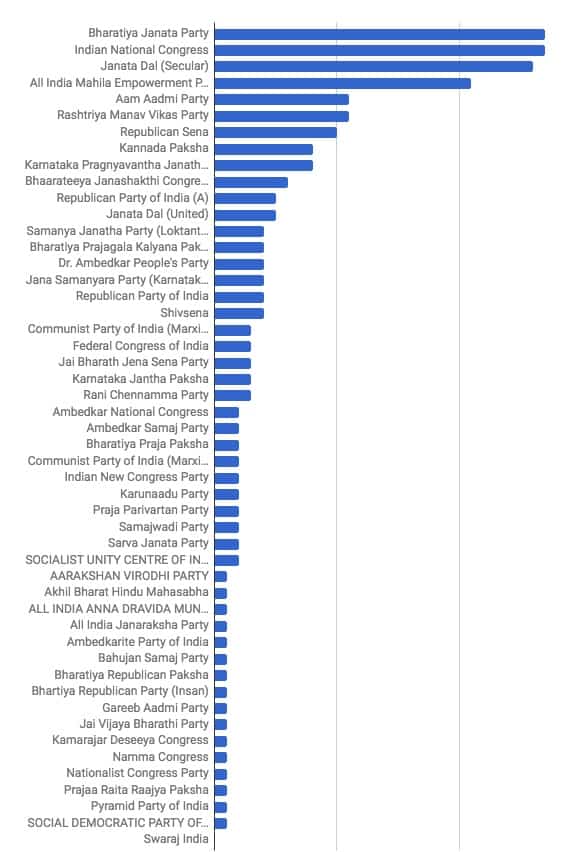
A quick analysis of Bengaluru Assembly Constituencies Candidates shows:

  • Total 431 candidates in Bengaluru
  • Hebbal has 28 contestants, and an average of 16 candidates per Bengaluru constituency
  • 51 parties and 191 independents contesting.
  • Bharatiya Janata Party and Indian National Congress contesting all seats, JDS in all but Anekal
  • One of the newest parties All India Mahila Empowerment Party is contesting in 21 constituencies!! But only 2 women – BTM Layout’s Kum. Jayalakshmi B V, Jeelani Fathima from Byatarayanapura
  • Communist parties are contesting just 2-3 seats each – CPI(M), CPI(ML) and SUCI(M)
  • Shiv Sena is contesting Yeshvanthapura, Hebbal, Chamrajpet and Bommanahalli
  • Aam Aadmi Party has 11 candidates
  • 5 candidates from Ambedkar National Congress, Ambedkar Samaj Party, Ambedkarite Party of India
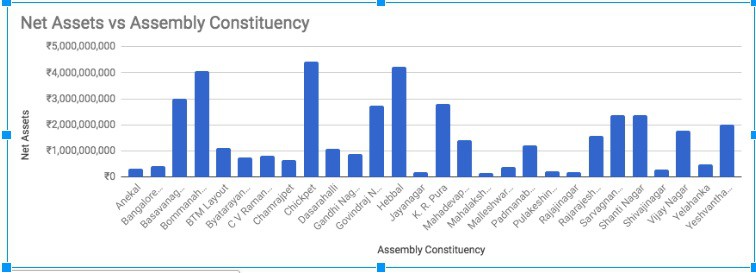
Where are the rich candidates in Bengaluru?

We added all the wealth declared by all candidates in a constituency, and divided it by the number of candidates. Chikpet emerges to be the most wealthy constituency, followed by Hebbal and Bommanahalli. [Data source]
 

Check the complete information on the constituency of your choice, here: citizenmatters.in/may12.  More voter information for all constituencies of Bengaluru can be checked here: bengaluru.citizenmatters.in/author/poll-desk

Voter guide: https://citizenmatters.in/voters-guide-karnataka-assembly-elections-2018-faq-24980

Leave a Reply

Your email address will not be published. Required fields are marked *

Similar Story

PG collapse in Delhi’s Satya Niketan: Who is responsible?

A DU PG collapse exposes the gap between Delhi's planning rules and real building safety. Watch this video to know more.

On September 6, a five-storey boys' Paying Guest (PG) accommodation collapsed in Satya Niketan, near Delhi University's South Campus, leaving seven people dead. This video looks beyond the single building to ask how the neighbourhood reached this point. Delhi has had a formal planning system since the DDA was set up in 1957 and the first Master Plan followed in 1962. Yet Satya Niketan has grown into a dense student housing hub. Officials say the collapsed building had permission for only the ground plus first floors. Ayush Anilal, an architect, studied the area for his thesis. He explains how intensely…

Similar Story

The real estate shift: How Karnataka’s proposed apartment law shortchanges homeowners

Karnataka apartment owners may not get a fair share of their land as the KAOMA 2026 replaces value-based UDI with an area-only formula.

The Karnataka Apartment (Ownership and Management) Bill, 2026 (KAOMA) changes how a homeowner's share of the land is calculated — and the new formula gives the individual less than what the old law, that is the Karnataka Apartment Ownership Act, 1972 (KAOA), promised. The KAOMA Bill was passed by the Karnataka legislature in August, but is yet to receive assent from the Governor, who has sought clarifications on certain provisions. What is UDI and why does it matter? When you buy an apartment, you buy two things: The flat — a depreciating asset (buildings lose value over time). Your Undivided…