Encouraging higher voter turnout, increasing civic engagement and fostering young leaders are challenges many democratic governments face around the world. These topics were discussed among a panel of Bangalore and Australian elected officials to compare and contrast the two decentralized governments and the problems each face.

Pic: Bangalore’s Political Action Committee (B.PAC)
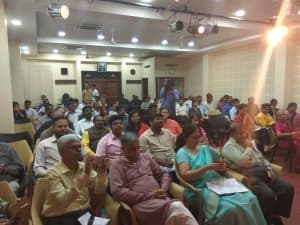
On Thursday June 29th Bangalore’s Political Action Committee (B.PAC) hosted ‘Roles, Responsibilities and Decision Making Processes in a Decentralized Set Up’ a panel that focused on citizen participation in the electoral process, developing young leaders, decentralization of power, local self-governance and the general election process in both India and Australia.
The panel explored the importance of citizens and local groups in the civic space, a keystone in B.PAC’s mission for citizen engagement and better governance. Panelists from Bangalore included Rajya Sabha MP Prof. Rajeev Gowda, MLA N.A. Haris, MLA Dr. C.N. Ashwathnarayan and national spokesperson of JD-S Tanveer Ahmed. Australian delegates included Deputy Convener of Multicultural Labor Palani Thevar, MLC Dr. Sally Talbot WA State Parliamentary Secretary to the Minister for the Environment and Climate Change, Member of Saderson Kate Worden, Director of Aboriginal Catholic Ministry Vicky Burrows and others.
The panel, which focused largely on Bangalore’s local government, did not include anyone from the BBMP, the city corporation.
Civic involvement and voter turnout in a decentralized system
The participants discussed how a decentralized government system helps delegate decision making power on issues directly concerning each tier of government. The panel pointed out civic engagement is key to encouraging elected officials to make decisions based on citizen priorities. Involving local organizations and civic bodies better communicates the needs of citizens to decision makers.
In reality authority is not completely delegated to the local level and the state government is also involved in local issues. “In local bodies there is more devolution of responsibilities and not power. There is always a question and doubts on the ability of the Council to manage the system,” said MLA Dr. Ashwathnaraya as stated in the press release. “To go for transparency and accountability, there is a need to devolve more power to local self government.”
Voting turnout is an essential part of civic engagement. According to statistics stated during the panel the average voting rate in Australia is 88 percent, while in Bangalore the voting turnout for the 2015 general elections was 54 percent and less than 50 percent for the BBMP elections that same year.
Australia employs a compulsory or enforced voting system that requires citizens to participate in the democratic election process, whereas voting in India is optional. In response to Australia’s compulsory voting method, N A Haris commented that the compulsory voting can be effective if voters are given benefits for voting. In Australia, eligible citizens are required to register to vote and are given a penalty if they do not vote in an official election.
Pic: Bangalore’s Political Action Committee (B.PAC)
Although the voting turnout is higher, Australian panelists discussed the difficulty of encouraging young voters to cast a ballot, something that candidates focus on improving every election year.
Panelists from both countries agreed that encouraging young people to vote is essential and a continued effort to improve their turnout rates. Bangalore’s officials too discussed how to encourage the younger generation to take an interest in local government and foster future leaders.
It’s no surprise that developing the next generation of leaders is a priority. Efforts to increase engagement among all sectors of the city, increase voter turnout and political participation are important steps to creating a more comprehensive decentralized system in Bangalore and a blueprint for future leaders. One has to see how Bengaluru can achieve this?