Sex worker unions codemned the step taken by the Karnataka State government for forming Jayamala Committee to conduct a survey of sex workers by making false promises of free housing and loans.
Karnataka Sex workers Union organized a protest in Townhall recently, against the exclusion of Sex workers organisations by Jayamala Committee. Sex workers and Human Rights activists participated in this protest.
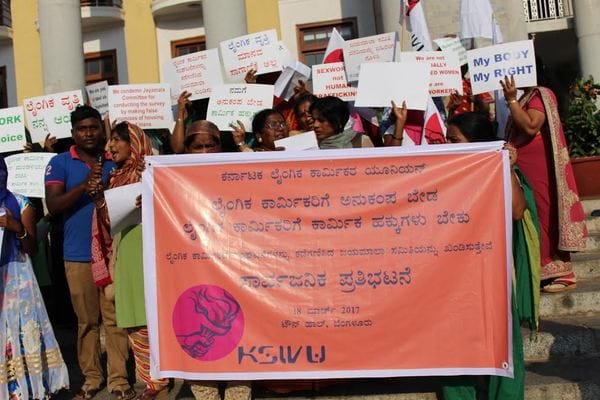
Sex workers protested near Town Hall recently. Pic: Manohar Elavarthi
The General Secretary of the Karnataka Sex Workers Union Bharathi said: “The Government of Karnataka formed a committee headed by Smt. Jayamala to study the situation of Sex workers in the state. In the 22 member committee only three members are sex workers. A questionnaire with 169 questions was prepared by the committee. They conducted the survey by coercing Government-funded sex workers community based organisations working for prevention of HIV. This survey was conducted by offering false promises of free housing and loans.
In this survey respondents’ right to privacy has been violated in the by questions about residential address, phone number, HIV status etc. This is a serious attack on the privacy of sex workers, besides the possible misuse of this information.
When the questionnaire came to the notice of Karnataka Sex workers Union, a consultation was organised in Bengaluru with various women’s/human/health/Sex workers’ rights activists, researchers and progressive thinkers. The key points of concerns that emerged from this consultation are :
1.The title of the survey says that it is about “the women who face sexual violence”. This shows the prejudice and false assumption that all sex workers are victims of sexual abuse.
2.The survey is unscientific, riddled with irrelevant questions and is of inferior quality
3.It violates research methodologies, research ethics and several national and international protocols/ guidelines
4.This committee did not consult sex workers organistaions regarding the survey questionnaire
5.In this survey a few questions are insensitive and rude, reflecting a patriarchal standpoint and a narrow-mindedness
These kinds of unscientific surveys using public resources are totally unacceptable.”
The president of National Network of Sex Workers (NNSW) and the Treasurer of Karnataka Sex Workers Union Nisha Gulur said: “After the consultation, in a meeting with the chairperson of the Jayamala committee, Smt Jayamala we shared the shortcomings of the survey and requested for a consultation with Sex workers organisations before submitting the report. In spite of which the committee submitted this shabby report to the government.
After the submission of this report to the government, a few newspapers had published a recommendation in the report that hereafter the usage of the term ‘sex workers’ is to be banned and instead they should be referred as “Oppressed”. Who are they to label sex workers as sexually exploited women?
Decriminalistion of sex work is the key expectation of most of the sex workers but it finds no mention in the report. We will not allow non-sex workers and anti-sex workers to decide policies or make decisions about us. We will ensure that we are in the forefront of any process of policy formations.”
The organising secretary of Karnataka Sex Workers Union, Dharani demanded the following:
•Make the Jayamala Committee Report Public and start a dialogue with Sex workers organisations
•Decrimanalise sex work by repealing Immoral Traffic (Prevention) Act
•Constitute a Sex Workers Welfare Board in the lines of Construction Workers Welfare Board
Dharani also asserted that the fight will continue against the spreading of prejudice and misconceptions about sex workers.
[embeddoc url=”https://citizenmatters.in/wp-content/uploads/2017/03/Critique-of-the-Sex-Workers-Study-Submitted-to-Jayamala.pdf” download=”all”]
[embeddoc url=”https://citizenmatters.in/wp-content/uploads/2017/03/Memorandum-Submitted-to-Jayamala.pdf” download=”all”]
Note: This is an edited excerpt of the press note sent by Karnataka Sex Workers Union, published on Citizen Matters in Message Forward section.
Related Articles