In the previous story on athletics for kids, we dealt with what Bengaluru city lacks when it comes to training budding athletes or athlete enthusiasts. Here is the second part of the series on the private and government facilities that are available for young athletic talents.
The government does allocate funds for the sports activities. In the financial year 2015-16, Rs 118 crore was sanctioned (State and Central) for initiating various works in the Sports and Youth Services Department. The department officials say that of the grants allocated, 70 per cent was earmarked for sports-related works and the rest is for youth service.
The government has established sports schools to nurture budding sports talents. There are 32 residential sports schools in Karnataka, of which one is located in Bengaluru. But not all of these schools have athletic coaches and synthetic tracks. The total number of synthetic tracks across the State is 13.
Scholarships and incentives
1. Rs 1,000 annual sports scholarship for middle/higher primary student:
This scheme from the State Government is to encourage talented student athletes in middle / high school by offering them a scholarship of Rs 10,000. Applicant has to apply for the scholarship if he/she meets a set of qualifications. Application should be submitted through Director, Youth Empowerment and Sports Department.
2. Cash incentive:
In order to honour the athletes, the State government gives cash incentives to offer a single type of award for sportspersons who won the medal by representing the state at the national level and represented India in international level sports in different sports. Incentive amount ranges from Rs 10,000 (sub-junior national level) to Rs 1 crore (Olympic gold medal).
3. Encouragement fund for SC/ST parents:
The encouragement fund to the parents of medal winners is provided under 2015 – 2016 special center program and Schedule Cast/Schedule tribe subprogram, in state, National, International sports.
Source:
Admission to sports schools is done annually, through a series of tests like endurance, speed, reaction time, strength etc. Once selected, the government offers them training free of cost. According to the department official, they spend Rs 175 on a junior trainee and Rs 200 on a senior trainee per day, in these sports hostels.Each school offers two or three specialisations such as athletics, hockey, football, volley-ball, wrestling etc. Free boarding, lodging, medical facilities, sports kits are provided.
Chandrashekhar Rai, General Secretary of the Karnataka Athletics Association, says training offered to budding athletic enthusiasts is very crucial, because they get better facilities and training once they are nationally recognised. “Once an athlete wins a national medal, he/she will then be absorbed by the Sports Authority of India (SAI) which has top coaches and facilities. But reaching that stage is the challenge. That is where the Stategovernment should concentrate on,” he says.
To prove his point, he says the output of the government run sports schools is bad due to lack of quality training. Most of the national-international medalists are trained under private coaches.
Veteran Coach Vishwanath Rao Beedu too says that whatever athletic achievements have been recorded so far has been because of private coaches affiliated to various clubs. “We work hard to bring out the best,” he says.
Government facilities to train athletes
For budding athletic enthusiasts, there are primarily two options to pursue their dream to make it big. Either they have to apply to secure a seat in any of the sports schools run by the State government, where they are provided free training, or they should be trained under private coaches. In Bengaluru alone, there is only one State government appointed athletic coach at Kanteerava Stadium – B G Manjunath. Then there are various private coaches who train budding athletes at Kanteerava Stadium and at Kitturu Rani Chennamma Stadium.
Some of the private athletic clubs that provide coaching to budding athletics are:
Apart from the regular training, summer camps are organised to train kids. Sports Authority of India organises athletic training for kids in summer in its Bengaluru campus at Bangalore University. A senior coach from SAI told Citizen Mattersthat the objective behind organising the camp is to encourage children to develop an inclination towards physical activities. “It’s not just about training them to win medals, but to develop an interest towards athletics,” he said.
Even a private club, Star Track Athletic Club organises summer camps for athletic enthusiasts.
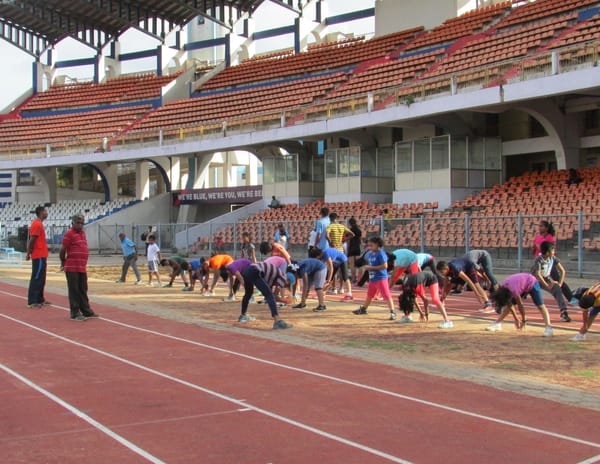
Warm up session prior to the training at Kanteerava Stadium. Pic: Akshatha M
Other facilities
On the government’s part, an official from the Department of Sports and Youth Services says that the department has been taking steps to nurture athletics talent. “The Sports Excellence Scheme was introduced last year to identify talents and nurture them. We identified 31 sports talents including athletes from across the State and spent Rs 1.5 crore to help the budding talents financially. The money could be used to appoint a good coach, to spend on travel while participating in national level competitions and get necessary equipment,” he said.
Other government schemes include scholarships of Rs 10,000 each to student athletes studying in middle or high school, cash award for national level participation and an encouragement fund of Rs 1 lakh for the parents of sportsperson belonging to SC/ST communities.