If we are apathetic to Nature today, and view the natural world as being something separate from our daily existence, certainly there was a time when it was not so. Much of our rich mythology deals with rivers, trees, and other natural features, and indeed, our ancients imagined mythical beings which combined several features of living creatures. We all know Narasimha, the half-man, half-lion avatar of Vishnu, but Bangalore, and Kannada culture, in particular, has some interesting depictions of some other mythological beings.
As a woman who regularly uses Bangalore Metropolitan Transport Corporation (BMTC) buses, (which means that I travel in the front of the bus!) I always see the stencilled motto, “Kannada Kamadhenu, Karnataka Kalpavriksha”. This brings two mythical beings into our daily consciousness.
“Kamadhenu”, a mythical cow with the head of a woman, is held to be the mother of all cows, and was a miraculous creature of plenty, who could provide whatever her owner desired. She was supposed to belong to the sage Vasishta, providing for all his needs, for his worship and sacrificial rites.
“Kalpavriksha” is a mythological, wish-fulfilling tree that is often referred to in Sanskrit literature from the Rig Veda (1.75; 17.26) onwards. Along with Kamadhenu, the Kalpavriksha originated, according to legend, during the Samudra manthan or “churning of the ocean”. The King of the gods, Indra returned with it to his paradise. While there is no attested Sanskrit source conclusively identifying this mythological tree with any real, known tree, Kalpavriksha can figuratively refer to a source of bounty. The Parijata, Peepal and Banyan trees have all been identified as this tree, by various sources… but in essence, it is the embodiment of an ideal. Here’s a depiction of Kalpataru, from the Wiki Commons:
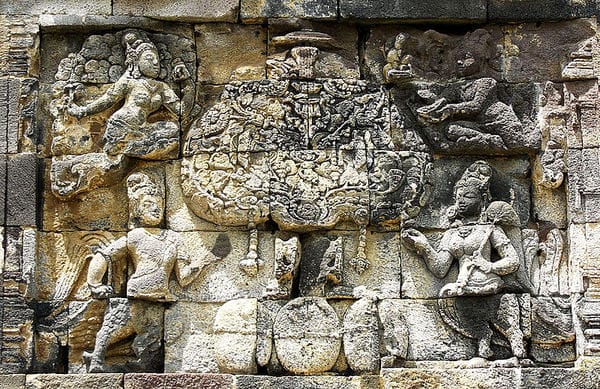
Kalpataru, the divine tree of life. Pic: Wikimedia commons
The “Gandaberunda” is a mythical creature, a two-headed eagle, that is very much a part of Karnataka’s heritage. It is held to be a physical form of Narasimha, the avatar of Vishnu that is half-man, half-lion.
Here it is, depicted in the Bangalore Fort, a picture that I clicked when visiting for a cultural event:
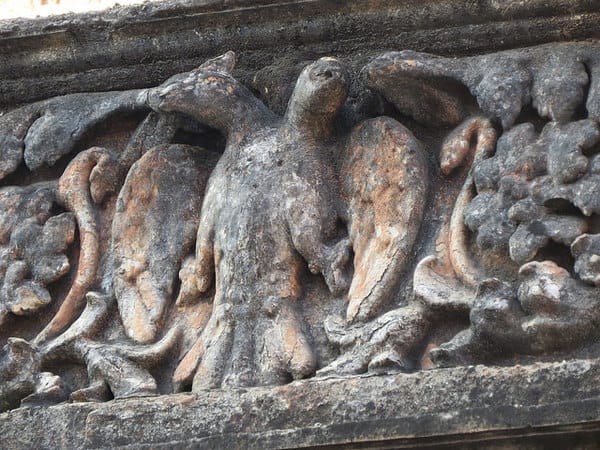
Gandaberunda, the two-headed eagle. Pic: Deepa Mohan
Indeed, in the Chennakeshava temple of Belur, the Gandaberunda depiction is a carved scene of “chain of destruction”. Initially, a deer is prey to a large python, which is lifted by an elephant; a lion attacks the elephant, and the lion shown as being devoured by Sharabha, another creature that is part lion, part bird. The last scene depicted is of Gandaberunda destroying Sharabha….a depiction of the food chain, in its own way. This double-headed bird icon is used as the official emblem of the Karnatka government.
Here is another mythical animal, which I noticed on the inside wall of the Bangalore Fort:
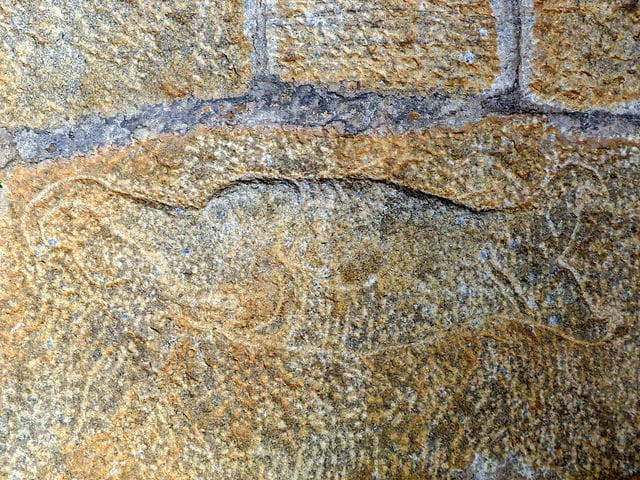
A fish with the trunk of an elephant. Pic: Deepa Mohan
It is a fish with an elephant’s trunk; I was not able to get any information on this unique combination of creatures!
So, as you go about your daily routine in this city of ours, let your mind dwell on these mythical combinations of creatures that our forefathers conceived of, and depicted in their literature and architecture. The natural world was a part of daily life to them…and as they exercised their imaginations, so can we beguile our hours thinking of the various creatures that we can summon up in our own minds! Let’s learn to see Nature around us, and as part of us.
Aditya R Nayak has informed me that the “elefish” (lovely name!) is a “Makara”:
https://en.wikipedia.org/wiki/Makara_(Hindu_mythology)
Prem Prakash Garg sent me this video of an actual “elephant nose fish feeding”
https://youtu.be/S985DqLXhSA