Roll on/Roll off services between Vasai and Bhayandar
Mumbai’s water ways are expanding, albeit slowly. A new RoRo boat service started between Vasai and Bhayander from 20th February. The ferry service which covers 1.89 nautical miles or 3.50 kilometres has been started on a pilot basis. It will take 15 minutes to cover the distance one-way and will accommodate 100 passengers and 33 vehicles in a single journey. The name RoRo comes from the term roll on/roll off which means that vehicles can also be ferried across in the boat.
Suvarnadurg Shipping and Marine Services Private Limited will be running the services on behalf of the Maharashtra Maritime Board (MMB) for a period of three months. The ferry service will make eight trips daily with a gap of ninety minutes in between. The first ferry from Vasai will leave at 6.45 am and the first ferry from Bhayander will start at 7.45 am.
Passengers over 12 years of age will be charged Rs 30 and those below 12 will pay Rs 15. A bike can be ferried across for Rs 60, an autorickshaw for Rs 100, and a car for Rs 180. The purpose of setting up the Ro-Ro is said to be to reduce road traffic, but some residents say that it will have no effect on the congestion in trains.
Source: The Times of India, Hindustan Times, The Indian Express
BMC served notice for putting lights on trees
The beautification plans that are underway in Mumbai have already come under criticism. But now the BMC has been served a notice by activist Rohit Joshi asking them to remove the lighting, which has been wrapped around trees for decorative purposes. The notice states that while in some places the lighting seems to be a temporary feature, put up for a special occasion such as a festival, in other places it has become a permanent fixture. To drive home this point the notice gives the example of Walkeshwar, Breach Candy, and Malabar Hill, where on certain stretches the lights have been hung on trees for months.
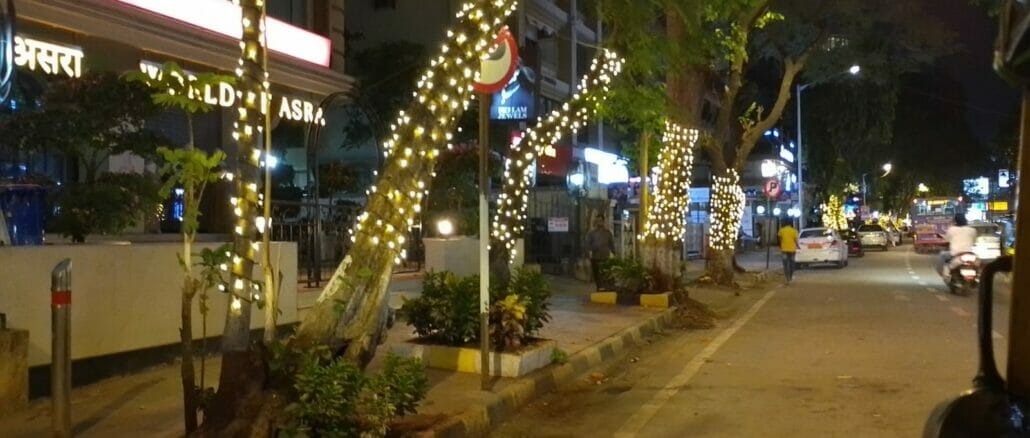
The notice reasons that the lights are harmful for the health of the trees and also affect the nesting and roosting of birds who take shelter in them. This in turn will affect the population of rodents and insects, says the activist. The bright lights also adversely affect migratory birds, who may use the trees. Besides, they also disturb the sleep of residents living in the area.
Source: The Times of India
Read more: Deaths on Mumbai’s suburban rail call for action by Railways, commuters and planners
15.49 lakh litres of water to wash Mumbai streets
Even as Mumbai stares at a water cut from next month, the BMC is using an average of 15.49 lakh litres of water daily, to clean the streets to reduce pollution. The BMC’s hydraulic department uses 211 tankers to wash 422 roads which make up 659.09 kms. For this purpose water from bore wells and sewage treatment plants is used.
Besides this, the BMC also makes use of 18 misting machines to sprinkle water on 59.5 kms of road in an effort to reduce dust pollution. What was started as a weekly practice in early December to control air pollution has been turned into a daily ritual from February.
The maximum amount of water is used in the K-West Ward which includes Andheri and Juhu at 1.20 lakh litres. This is followed by 1.14 lakh litres in the K-East ward which includes Andheri east, Jogeshawri east and Vile Parle east. Hindustan Times quoted Prashant Tayshetye, the chief engineer in-charge of solid waste management as saying, “There are at least 100 locations in 25 wards from where we draw water from borewells and sewage treatment plants every day for misting machines to combat air pollution.”
Source: Hindustan Times
Mumbai-Pune-Mumbai via MTHL in state buses
The Maharashtra State Road Transport Corporation (MSRTC) has started plying four air-conditioned Shivneri buses between Mumbai and Pune via the Mumbai Trans Harbour Link (MTHL) or Atal Setu. MSRTC has said that taking the MTHL will reduce the travel time by an hour.
Buses will run along two routes: Mantralaya to Pune Railway station and Dadar to Swargate, the tickets for which will cost Rs 555 and Rs 515 respectively. MSRTC has said that no change has been made in the fares. In order to reach MTHL, the buses will go via Panvel, Nhava-Sheva, and Sewri. The Dadar-Swargate bus will leave at 1.00 pm with the return bus starting at 7.00 am. The Mantralaya-Pune station bus will go via Dadar, and will leave at 11.00 am and the return bus will be at 6.30 am.
Source: The Times of India, The Print
Flight cancellations from Mumbai; prices soar
After nearly 200 flights, connecting to 12 different cities were cancelled from Mumbai airport, ticket prices have nearly doubled on those routes in the past few days.
“Flights from Mumbai have been reduced to 12 destinations — Bengaluru, Chennai, Thiruvananthapuram, Hyderabad, Aurangabad, Goa, Kolkata, Mangaluru, Tiruchirappalli, Durgapur, Kannur, and Darbhanga. The Mumbai airport, which was handling a total of 6,417 flights per week until last week, is handling 6,217 flights per week right now, according to the data,” Business Standard reported.
The report also quoted the civil aviation ministry as saying, “While Mumbai airport is running at its full capacity, it was found that the persistent congestion was caused due to (i) excessive slot distribution with limited time margins on behalf of the airport operator, (ii) non-adherence of the slots on behalf of the airlines, and (iii) non-scheduled operations during peak hours.
The city also does not have a direct flight to Hubli and Jabalpur after the number of flights were reduced after the intervention of the ministry.
Source: Business Standard