A few months ago, I was going through the ‘Bangalore District Gazetteer.’ The ‘oldness’ and the ‘dustiness’ of the Gazetteer just seemed to add to the authenticity of a ‘gazetteer.’ The stories were mostly likeable, bringing in a sense of wonder and revealing a past that I did not know.
I looked for ‘markets’ and ‘bazaars’ on its index page. I’m sharing here some excerpts from it. The ones that I found most interesting were the ones with names of localities in the city that we know today but are so completely transformed from the old days. For instance, it talks of Sarjapur as being “noted for Muslin cloth” and so on. So, here we go!
Various Petes for various things
“Bangalore grew in importance after its development by the Kempegowda family who made it their capital by strengthening it with a fort and providing for various streets meant for the craftsmen and various groups of traders. Chikkadevaraj Wodeyar of Mysore (1672-1704) after getting Bangalore as ‘jahgir’ from Mughals, encouraged trading activity by introducing uniform weights and measures and postal services for the first time. By then, separate markets were built for different trades viz. Aralepete for weavers and sari merchants, Akkipete for rice merchants, Nagarthapete for goldsmiths, Doddapete for wholesale, Chickpete for retail, etc.”
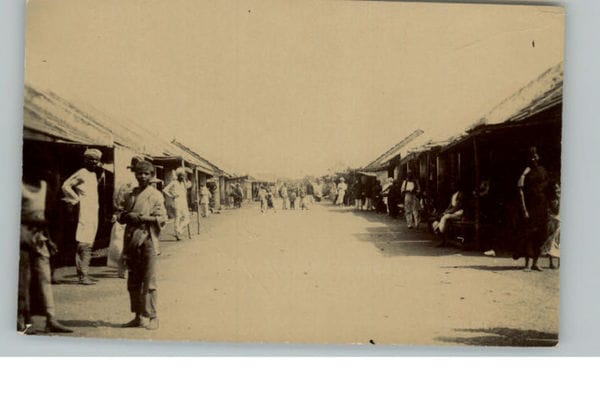
A street in Bangalore, during 1910’s. Pic courtesy: http://oldindianphotos.in Source: ebay
Muslin cloth sold at Sarjapur!
“The travel account of Buchanan who visited Bangalore in 1800 gives an exhaustive account of trading and commercial activities of Bangalore. According to him, apart from Bangalore, neighbouring villages like Agara, Halasur, Hesaraghatta, Varthur and Kengeri were centres of brisk wholesale trade. Sarjapur near Anekal was noted for Muslin cloth. Saries manufactured at Aralepete were famous throughout the state and were exported to far off places like Mangalore, Bellary, Bombay and other places near sea ports.”
Trading with Madras, Tanjore
“From other sources (a missionary’s chronicle) it is learnt that in the days of Haider and Tipu, salt, sulphur, indigo, tamarind, caustic soda, alum, zinc, lac, wax, gum and arsenic were brought from Madras. Flower and betel leaves came from Attibele. Betel leaves also came from Mysore and Harihar. Indigo came from Anekal and Bommasandra, kamblis (country blankets) from Kamblipura in Anekal taluk. Salem and Pondicherry had regular trade connections with Bangalore during 18th century. Tanjore merchants sold pearls in Bangalore and took back cash.”
“During the period of Bowring (1862-67) important roads connecting Bangalore with Kadur, Hassan, Hoskote, Kadapa, Hosur and Bellary were constructed, railway links were established with Madras (1864) with Channapatna (1881) with Tumkur (1884) and finally connecting with Bombay promoting rail-road traffic of goods and passengers.”
Sandalwood exported to London!
“During 1934-35, sandalwood oil from Bangalore was exported to London, Japan and Australia. By 1934-35, the local tobacco company (Tobacco Manufacturers India) used to export cigars valued at Rs. 1 ½ crore to Bombay, Calcutta and Delhi. A record of 1940 reveals that cattle shows were held at Bangalore and this was usually at Sampangi tank. Conducting annual market shows was a regular feature, where exhibits of good products were appreciated and rewarded. Mutton shows were organised in January every year, at the Russell market.”
Now, a bit of the curiosity is satiated but some other questions… ‘Tanjore merchants sold pearls in Bangalore and took back cash.’ What is the pearl trade like now? Or ‘cattle shows at Sampangi tank’ – would someone still have pictures of that?