Goodbye Bengaluru, thanks for reading!

Ten weeks have flown by and my internship with Citizen Matters has come to a quick end. Tomorrow, I will board a flight, but I will not be leaving India just yet. I am looking forward to three weeks of travel around the subcontinent to see what else this country has to offer.
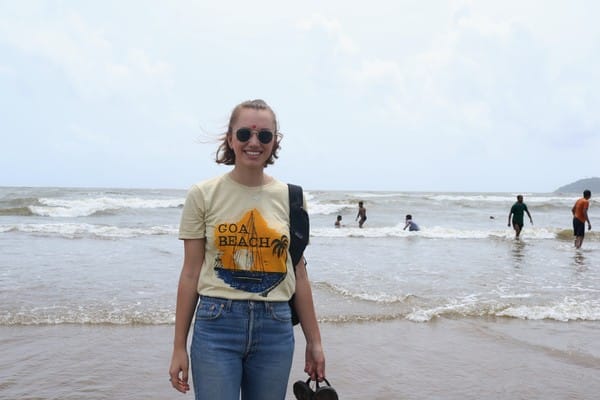
The author on the beach in Goa. Pic: Kate Clark

But soon enough, I will be struggling to nap on 16-hour flight back to Dallas, Texas.

When I picture exiting the Dallas Fort-Worth airport, driving a few miles toward my parent’s house in suburban Texas, I can already feel the culture shock.

I’ll see cows grouped behind wooden fences on the Texas country side and I’ll think of Bengaluru’s cows, so autonomous, though quite cumbersome. I’ll see Americans gripping their venti Starbucks cups and I’ll think of my roommates in Bengaluru, who subtly mocked my large coffee intake. I’ll see cars moving at an appropriate pace (as in not at a constant standstill) and drivers staying in their lane. I won’t hear a constant stream of honking – that I look forward to most. The “Indian food” will consist of naan and tandoori chicken, I’ll have to hunt for some decent South Indian grub. I will walk down empty streets and think of Bengaluru’s packed, excited, alive alleys.

I’ll miss Bengaluru.

Moving to a foreign country is one thing, but moving to a city 10 times the size you are used to makes the experience feel even more foreign. I’ve adjusted to the hustle and bustle, to omnipresent noise, to people everywhere, all the time.

I know I will come back to India, I don’t know when, but I can guarantee it will happen.

To all who have read my stories and blogs this summer, thanks. I hope you enjoyed them as much as I enjoyed writing them.

Comments:

  1. Srinivas Alavilli says:

    I certainly enjoyed your stories. Best wishes

Leave a Reply

Your email address will not be published. Required fields are marked *

Similar Story

Why concrete lakes are pushing away Bengaluru’s waterbirds

As natural shorelines vanish and extensive restoration destroys habitats, city lakes see a sharp decline in special wetland bird species.

Since Bengaluru’s lakes were formed by damming water flowing down valleys, they are typically wedge-shaped, with a gentle slope and a deep basin towards the embankment. This promotes the growth of diverse vegetation and animals, each adapted to a particular water depth. The result is a natural zonation – reedbeds and shoreline vegetation at the edges, floating and submerged vegetation in the middle, and open water at the deepest end. During the Open City biodiversity datajam held in December 2025, our group examined the ecological trends around Bengaluru’s lakes. In an earlier article, we examined how migrant and resident waterbirds…

Similar Story

Can cool roofs beat Chennai’s heatwaves? A look inside the state’s Green Schools push

Amid heatwaves, the cool roof initiative is being implemented across Chennai schools. But experts warn that it cannot be the single solution for urban heat.

Over the past few years, maths teacher Usha found her classroom sweltering during her usual 12.50–1.50 pm period, on the second floor of Perunthalaivar Kamarajar Government Girls Higher Secondary School. “It was so difficult to take class during the peak hours,” she says. But this year, she mentions that it feels slightly bearable, and attributes this to the shade of the trees, the wind blowing through the building, and the latest addition — solar-reflective paint on the roof. Data from a state government and UNEP Cooling pilot project at the Ambattur school shows that reflective coating brought the classroom’s internal…