Dance at Dusk

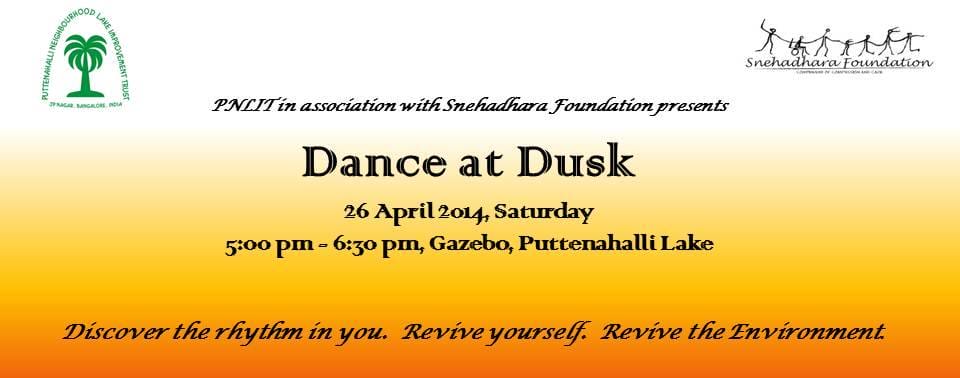
To celebrate Earth Day (that is observed all over the world on 22nd April), PNLIT is happy to host an event called Dance at Dusk in association with the Snehadhara Foundation. The programme is being held on a Saturday to enable adults to participate along with their children. 

Date: 26th April 2014 (Saturday)
Time: 5:00 p.m. to 6:30 p.m.
Place: Puttenahalli Lake, at the gazebo


What is Dance at Dusk? Here’s a brief note on the event from Snehadhara:

Dance at Dusk
We at Snehadhara believe that movements have inner meanings and purposes along with their outer expressive and communicative qualities. Synchronizing this mind-body relation is essential for healing and growth. To build this synchrony, it becomes necessary that we hone a body that is awake- a sensing, emoting and thinking body.
Presenting ‘Dance at Dusk’, an evening of dance and movements, that explores the innate interdependence, rhythm and interconnection that exist within us through the metaphors of nature.
The session will involve a community dance with adults and children and will explore synchrony, expression, rhythm and cohesion.
 
Discover the rhythm in you. Revive yourself. Revive the Environment. 
Please register by 4.45 p.m. Suitable for all ages. Carry a drinking water bottle to combat the heat. Entry is free. Donations are welcome. 


Leave a Reply

Your email address will not be published. Required fields are marked *

Similar Story

Can cool roofs beat Chennai’s heatwaves? A look inside the state’s Green Schools push

Amid heatwaves, the cool roof initiative is being implemented across Chennai schools. But experts warn that it cannot be the single solution for urban heat.

Over the past few years, maths teacher Usha found her classroom sweltering during her usual 12.50–1.50 pm period, on the second floor of Perunthalaivar Kamarajar Government Girls Higher Secondary School. “It was so difficult to take class during the peak hours,” she says. But this year, she mentions that it feels slightly bearable, and attributes this to the shade of the trees, the wind blowing through the building, and the latest addition — solar-reflective paint on the roof. Data from a state government and UNEP Cooling pilot project at the Ambattur school shows that reflective coating brought the classroom’s internal…

Similar Story

The ecological burden: Bidadi township debate highlights growing threat to wildlife movement

The proposed GBIT project could affect elephant habitats between Bengaluru and Ramanagara, worsening human–wildlife conflict.

The proposed GBIT project has generated considerable debate regarding its potential ecological impacts on the Bengaluru–Ramanagara landscape. Two overarching concerns include the loss of highly productive agricultural land, and the transformation of the region's existing natural ecosystems. In particular, the large-scale loss of tree cover and waterbodies has attracted significant public attention. However, another key ecological dimension is wildlife habitats and animal mobility. Unlike agricultural fields or trees, wildlife movement is dynamic and spans diverse landscapes. The area between Bengaluru and Ramanagara is marked by recurring human–wildlife conflicts, particularly human–elephant. Understanding these elephant movements is crucial  for addressing broader ecological…