Dance at Dusk

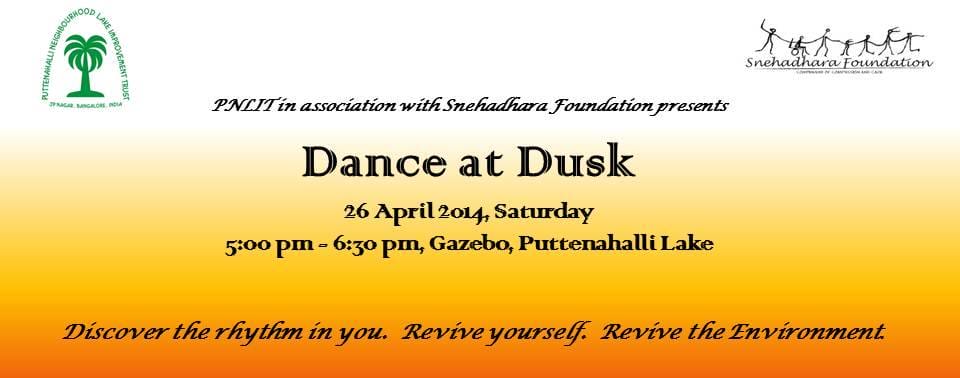
To celebrate Earth Day (that is observed all over the world on 22nd April), PNLIT is happy to host an event called Dance at Dusk in association with the Snehadhara Foundation. The programme is being held on a Saturday to enable adults to participate along with their children. 

Date: 26th April 2014 (Saturday)
Time: 5:00 p.m. to 6:30 p.m.
Place: Puttenahalli Lake, at the gazebo


What is Dance at Dusk? Here’s a brief note on the event from Snehadhara:

Dance at Dusk
We at Snehadhara believe that movements have inner meanings and purposes along with their outer expressive and communicative qualities. Synchronizing this mind-body relation is essential for healing and growth. To build this synchrony, it becomes necessary that we hone a body that is awake- a sensing, emoting and thinking body.
Presenting ‘Dance at Dusk’, an evening of dance and movements, that explores the innate interdependence, rhythm and interconnection that exist within us through the metaphors of nature.
The session will involve a community dance with adults and children and will explore synchrony, expression, rhythm and cohesion.
 
Discover the rhythm in you. Revive yourself. Revive the Environment. 
Please register by 4.45 p.m. Suitable for all ages. Carry a drinking water bottle to combat the heat. Entry is free. Donations are welcome. 


Leave a Reply

Your email address will not be published. Required fields are marked *

Similar Story

The trees we forget: What a city loses when the canopy disappears

Bengaluru's trees are more than shade; they are memory, identity, and resistance. Their loss leaves the city harsher and emptier.

Summer in India has been merciless this year, with many states recording temperatures above 42 degrees Celsius and rising reports of fatalities. Despite these harsh conditions, urban support continues for development projects that clear trees, wetlands, mangroves, and forests near cities. A recent Article 14 report provides data on thousands of trees that will soon be sacrificed nationally for infrastructure projects. Those opposing such unscientific large-scale tree felling are often labelled 'tree-huggers', 'anti-development' and 'anti-nationals'. While capitalism accelerates environmental degradation and the world faces a growing climate crisis, societal divisions deepen.  Yet, we give trees too little credit: Beings necessary…

Similar Story

Bengaluru’s flowering Tabebuia Rosea trees: Think green, not just pink

Cities must not confuse beauty with ecology; Bengaluru’s pink weeks are lovely, but unchecked ornamental planting could make the city prettier but less alive.

Late each winter, Bengaluru briefly transforms into an Indian Kyoto, as roads blush pink, office parks turn photogenic, and social media buzzes with claims of a local “cherry blossom” season. But the star of this spectacle is not cherry at all. It is Tabebuia rosea, the pink trumpet tree, a neotropical ornamental whose native range runs from Mexico to Ecuador. What seems like a harmless aesthetic win is, ecologically, far more complex. The history Bengaluru’s pink canopy is not new. Much of it can be traced back to the 1980s under forester S G Neginhal, who drove a major greening…