The starry showers that light up the night sky during Deepavali or other celebrations are a sight that has brought us joy since time immemorial. Whether in their use as firecrackers, or as missiles during wars, rockets have a history that dates back to the earliest days of human civilization. And even though we have references to similar missiles in India as far back as the age of the epics, scientists and historians trace the origin of rockets to another ancient civilisation, in China.

Mysore Rockets used in a battle at Guntur in 1780. Pic: http://grin.hq.nasa.gov
In a talk titled "Tipu’s Rockets, the Iron Duke and modern Rocketry" at Bangalore’s Visvesvaraya Technological Museum on the 18th of January, Dr Roddam Narasimha, well known aerospace scientist and former chief of NAL, revealed that the earliest use of rockets was in China. These were sometimes erroneously called ‘fire arrows’ and there are records of their use as early as 1232 AD, he explained.
Dr. Narasimha’s talk brought out many interesting facts related to rockets. They were also used in Europe in the 14th and 15th centuries but with the invention of cannon, the use of rockets as a weapon of war gradually waned away. The technology must have found its way to India, though one does not have any chronicled evidence of when or how that happened, he said. What we do know is that rockets were used in Indian warfare, especially during the Mysore and Maratha wars; the chief aim, however, of such use was more to scare the enemy rather than effect heavy casualties.
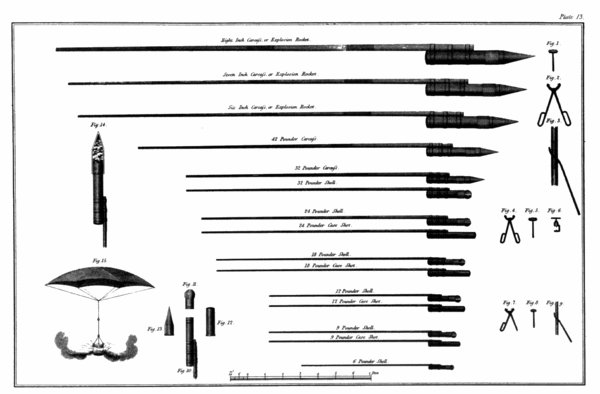
Rocket designs by Sir William Congreve. Pic: wikimedia commons
However, by the late 1700s, this weapon had become very effective, thanks chiefly due to experiments by Hyder Ali of Mysore and his son Tipu Sultan. The rocket boys, as the English called them, caused heavy casualties and in one war (at Polilur), destroyed the ammunition of the English. These rockets were not very big – the pictures that one gets to see in Tipu’s Summer Palace make them look almost like long metal versions of the normal Deepavali rockets. These rockets consisted of a tube, 60 mm in diameter, tied to a wooden pole or sometimes a sword and had a range of 1-2 km.
In fact, a journal from the Society of Army Historical Research describes that the largest Indian war rocket itself was not more than one fourth of a 32 pounder (8 lb) and its range not more than 1500 yards.
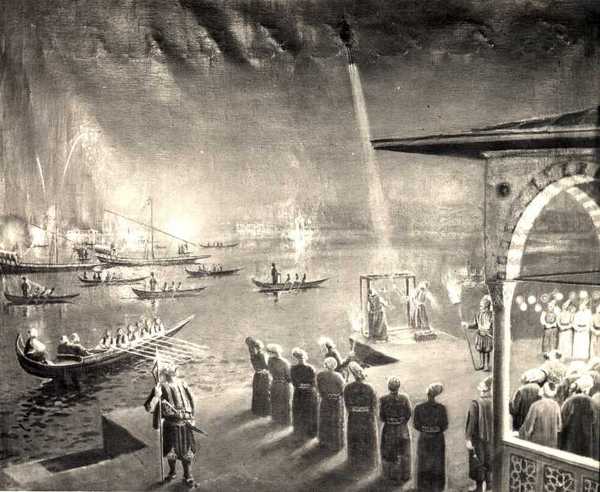
Lagâri Hasan Çelebi’s rocket flight depicted in a 17th-century engraving. Pic: wikimedia commons
So, how did these seemingly innocuous missiles cause so much havoc? The three basic factors that determine the power of a good rocket are its aerodynamics, propellant and the material used. Dr Narasimha stated emphatically that the key to the success of these rockets was the use of soft iron. He goes on to say that iron was used in India as far back as 1400 BC and hence the use of iron came very naturally to the armies of Mysore. However after the wars, rocket technology took off in a big way in Europe while in India it faced a setback. One of the key reasons, he said, was the link or rather the lack of it between the science of rockets and their application by the craftsmen.
A noted historian who shares the same name, Dr A L Narasimhan, agrees with the theory. He says that though the craftsmen were talented, they used more of a trial-and- error method instead of applying scientific principles when they devised these weapons.
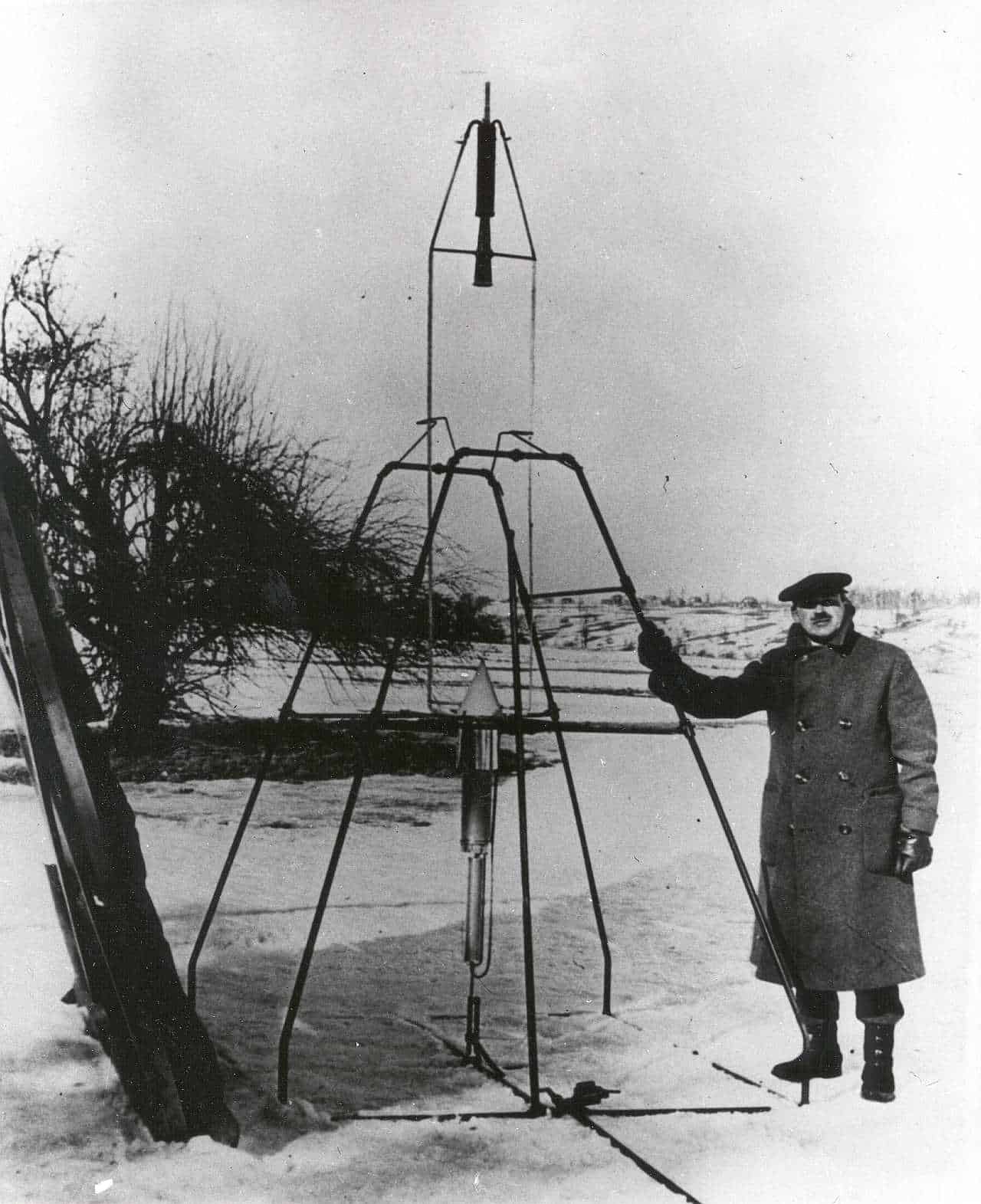
Robert Goddard and his first liquid fuelled rocket. Pic http://grin.hq.nasa.gov
Dr Narasimhan has yet another interesting tale about the use of the rockets. In Golur, near Tumkur, during the immersion of Lord Ganesha, villagers create a network of fire works that goes around the village and finally ends at a huge structure called maddina mane (literally means ‘house of fireworks’; this includes rockets of different colours and sizes). At the end of the puja, the priest ignites the starting point at the temple; they burst along the network, finally culminating at the huge structure. Dr Narasimhan describes the entire show as spectacular and goes on to say that earlier the rockets for the fireworks were earlier manufactured by a Muslim community in Tarapur Pete in Bangalore. He feels that they might be traditionally linked to the rocket manufacturers of Srirangapatna.
The Mysore rockets made such an impact on the English that after the Anglo-Mysore wars, a research programme was set up to study this science. Sir William Congreve made a systematic study, improved upon the technology by applying Newtonian principles and released the first solid fuel rockets, named Congreve rockets after him. These were used in the wars against Napolean and the US in 1812. Thereafter, rocket technology saw a lull in development until it was revived by one Robert Goddard from the US who designed the first liquid fuel rockets in 1936.
The story of rockets and how they have evolved over the ages is engrossing. What intrigues me particularly is the fact that a technology which travelled through countries and continents in the 19th century, had its origins in the small town of Srirangapatna. Perhaps, if the fourth Anglo-Mysore war had ended differently, we would have had defence and research organisations in Srirangapatna and this article might have been written in Persian or Kannada!⊕
Very informative. Crisp and well-written!
Tipu is rightly given credit by many in this field .Nice article about Mysore Missiles plus
Thank you both of appreciating the writing and the history.
Great article, very informative