Called Kalpavriksha (‘the wish-fulfilling tree’) in Sanskrit (and also Ashwattha Vriksha), the Banyan tree is given a holy status in our culture, with Lord Krishna himself declaring “Among trees, I am the Ashwattha” in the Bhagavad Gita. In India, it is revered as a holy tree that enhances fertility. The Banyan symbolises eternal life due to its ability to support the extending canopy by its prop roots.
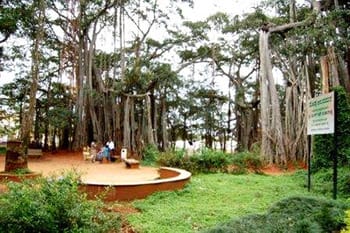
Big Banyan Tree (Pic: Poornima Dasharathi)
The word ‘Banyan’ is said to be derived from the word ‘Bania’, referring to the Indian traders who used to conduct their everyday business under the shade of this tree. The tree grows in size due to its numerous extended roots. Having always lived in a house on a small plot of land in the one of the countless middle-class colonies in the city, I was excited when I heard about Dodda Alada Mara (meaning ‘Big BanyanTree’) at Ramohalli that has grown over three acres and still growing! I just had to see it.
Dodda Alada Mara is a single Banyan tree that is 400 years old and has spread over three acres of land. The famous tree is in Ramohalli village, 25 kilometres from Bangalore. To reach the place, one has to drive on the Mysore Road and take a right turn at Ramohalli cross (next to Rajarajeshwari Dental College). Around six kilometres down this road leads us literally to the huge canopy.
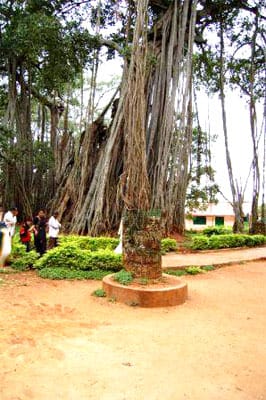
Extended roots of Big Banyan Tree. (Pic: Poornima Dasharathi)
The area is fenced and well-maintained, with cobbled pathways, bright cement seats and handy dustbins giving it a park-like look. At the entrance, vendors of corn jola and roasted groundnut make brisk business. But beware while eating anything in the vicinity; the tree is home to a lot of aggressive monkeys that just they might snatch your goodies.
The main trunk fell apart a few decades ago and the extended roots provide an illusion of many trees standing in a cluster. A Muneeshwara temple stands in the place of the fallen trunk. And just when I thought the ‘Muneeshwara’ meant Shiva, the temple had Vishnu’s Naama painted on the walls that left me quite confused!
Going around the tree’s many roots, one can see that the shorter roots that have not yet touched the ground are supported by man-made ‘earth bins’. These were probably put up to prevent mischievous monkeys and naughty kids from swinging on the prop roots. Many of the thicker branches subjected to innumerable graffiti reveal a sad tale of vandalism.
Rangayya, the staff who keeps a watchful eye on the visitors, nods in agreement but is positive that awareness has spread and it does not happen anymore now that the Horticulture Department has stepped in to maintain the place. I point to the ‘Maintained by Bank of Maharashtra’ board but he is vehement that it is a Horticulture Department’s initiative.
A board states that this is the second largest banyan tree in the country and stands on around 400-500 extended roots covering 4-5 acres of land.

Vandalism on the Big Banyan Tree (Pic: Poornima Dasharathi)
There were many visitors the day I visited the Dodda Alada Mara – families, couples and groups of young boys probably on biking trips. Some were sitting on the brightly coloured seats, some were walking around the tree’s myriad roots and some others enjoying a packed lunch. Walking towards the gate, I threw back a glance at the enveloping canopy with all the activities below it and the Banyan symbolising ‘eternal life’ just made sense.
If you plan a visit to the Dodda Alada Mara, the only good places for a family lunch would be the Ruppi’s resort (owned by cine star Upendra) or Kamat Lokaruchi (on Mysore Road near Ramanagaram). The Ruppi’s resort is around a kilometre from the Dodda Alada Mara and is an excellent place to relax. In the tree’s vicinity, there’s nothing much except for a few petty shops.
The other local attractions here are a Naaga temple and the Manchinabele Dam. You can reach the temple on the way back to Mysore Road. The temple is famous for a large monolithic statue of the Snake God. The Manchinabele reservoir is around 8 kilometres from here and is best visited in groups. ⊕