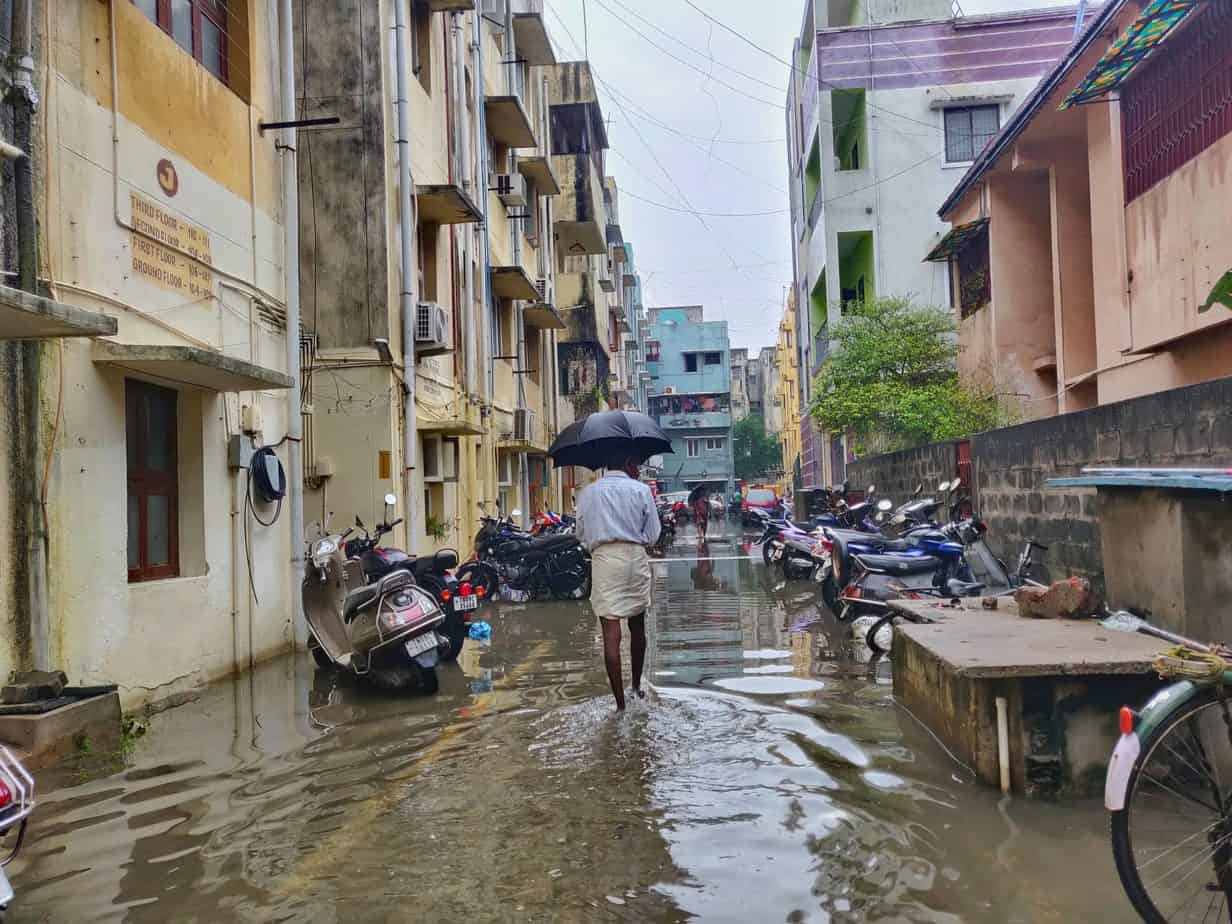
The torrential rains that hit Tamil Nadu’s state capital of Chennai in November this year is said to be the heaviest since the downpour in 2015 which caused massive floods in the city. The rains that lashed Chennai this time around following the festival of Diwali have also led to water logging and inundation in several areas such as T Nagar, Adyar, Velachery, Pulianthope and other places.
In the backdrop of the severe problems faced by residents of Chennai due to the heavy downpour, Citizen Matters Chennai organised an online panel discussion on November 17th (for full video, check below), with experts from various fields to discuss the root causes of flooding in Chennai, what the authorities are not doing and should be doing, and most importantly what needs to be done to make the city floodproof.
“We cannot say that nothing has changed between 2015 and now, because the key difference, in fact, is in actually seeing an administration that works and is out on the streets,” says Krupa Ge, Author of Rivers Remember**, a book that deals with the Chennai floods of 2015. She says that what was infuriating during the floods in 2015 was the total sense of abandonment that the people felt.
Krupa, however, also adds that this does not mean that things are going to automatically improve since the impact caused by the floods remains more or less the same and that the city is likely to witness the same phenomenon in the coming years as well. So what can be done to improve the situation?
1. Increase active citizen participation
Ganga Sridhar, a member of Mandaveli Raja Street Residents Welfare Association said that before the floods in 2015, many of the residents in her street weren’t aware of what stormwater drains were or the difference between stormwater drains and metro sewage drains. She says that in 2015, there were no stormwater drains in her street and that during the floods, residents were marooned for several days without power. It was after this that their RWA organised various citizen awareness programmes where they learnt about stormwater drains and its functioning, how to register online complaints with the Chennai Corporation and to persuade and ensure that the officials get their complaints solved.
“I feel that every resident should be responsible and should be aware of their locality the same way they are aware of their homes. Obviously, the authorities have a huge role to play but to bring issues to their attention, we must first know what’s wrong in our street,” says Ganga.
Following the floods in 2015, the residents of Mandaveli Raja Street took it upon themselves to ensure that new stormwater drains were laid in streets where these drains were missing and that already existing drains were desilted. And the results were visible during the recent rains when their locality didn’t experience much waterlogging despite the heavy rains.
Read more: All that’s wrong with stormwater drains in Chennai and how to fix them
2. Have more consultations and better coordination
B Kannan, Secretary of T Nagar RWA feels that there should be an umbrella body for various RWAs for a collective fight for their rights. “The Chennai Metropolitan Development Authority’s (CMDA) development rules are dangerous for the city and state and need to be challenged, but I do not know how many people are up for the fight!” he says.
In 2018, the Greater Chennai Corporation (GCC), under the Union Government’s Smart City Mission, invested Rs 200 crore in developing the storm water drains and for the improvement of the Mambalam canal, which passes through T Nagar, in an attempt to make the locality “flood-resilient”.
However, Kannan says that in the smart city project, there was no coordination between the Electricity Board, Chennai Metropolitan Water Supply and Sewerage Board (CMWSSB), telephone department and so on. This issue of lack of synchronisation between agencies was also raised by Ganga, who said that if a drain is said to be blocked, they first had to inform the CMWSSB who would come and remove the sewage with a jet trotter and later, they have to call the Assistant Engineer from the Corporation, all of which is tedious and time consuming.
Read more: Flooding in T Nagar raises a lot of questions for the smart city mission
David Manohar, an activist with NGO Arappor Iyakkam, accuses the CMDA of lacking expertise and foresight on how the city is going to grow. He also raised the need for authorities to consult with the residents regarding the problems they face and the need for a coordination officer in every ward or zone to ensure smooth functioning between the various agencies.
3. Ask hard questions
According to Krupa, citizens must start asking hard questions, to those in power and about where they choose to live.
“This (floods caused due to rain) was not a one-off event, and we are going to have to deal with this. It’s not something that you can just close your eyes and wish away. The administration has realised this and people have also come to realise that some hard questions need to be asked of those who are persisting in power. We can’t let things go as usual after 2015 because I don’t think we have it in us to handle one more of these incidents,” the author says.
Krupa also says that those who have the privilege of deciding to where to live must ask whether the area is prone to flooding or if the constructions are near water bodies or on top of wetlands, in which case we are reducing the spaces that allow for the absorption of rainwater, thus leading to inundation.
Read more: Illegal construction in Chennai: Where are the rules and whom can one report to?
4. Ensure accountability through a stronger democratic process
“Whatever your complaints may be about MLAs and counselors, still, at some point of time, they come back to you for votes and are hence accountable to the people,” says Raj Bhagat, Senior Manager, Geo Analytics, WRI India.
Raj feels that technical fixes are not happening in certain areas because bureaucrats, who are not accountable to the people, are in charge of various development agencies and are running a parallel government. “The thing is the government setup should be stronger and this applies for every city in India right now. They have created a number of parastatals which are run by bureaucrats outside the purview of the democratic process,” he adds.
While big budget investments for development projects are necessary, Raj also says that it should take into consideration the socio-economic conditions of those who will be affected by it and ensure that they are not affected. “But if this is not going to be done by a democratic process and in a more accountable manner, then there is no way that citizens are going to benefit from this.”
Catch the full discussion here:
Also read:
- Chennai rains: The real reasons why urban floods are a never-ending problem in city
- Chennai floods: How these Mandaveli streets averted waterlogging even as it poured
**Errata: The name of the book by Krupa Ge had been inaccurately mentioned in the first published version of this piece. The error has been corrected and we apologise for the earlier lapse.