COVID-19: Penalty targets for Corporation officials; fever camps to be scaled down
In order to ensure that citizens adhere to COVID safety norms, the Greater Chennai Corporation (GCC) has been imposing a penalty on citizens who have been found to violate those. A target has also been set for fine collection by various officials of the civic body.
As per the norms stated, an assistant engineer should collect a minimum of Rs 3,000 every day and other authorities should collect Rs 1,000 a day. Each zone in the city is tasked with collecting a minimum of Rs 1 lakh a day.
About 15-20 wards make up a zone. Each ward has an assistant engineer, a conservancy inspector, sanitary inspector, license inspector and tax collector.
Below are the penalty details:
| Violation | Fine |
|---|---|
| Quarantine norms flouted | Rs 500 |
| Not wearing masks | Rs 200 |
| Spitting | Rs 500 |
| Violation of SOPs in commercial establishments | Rs 5,000 |
| Not wearing masks in containment zones | Rs 500 |
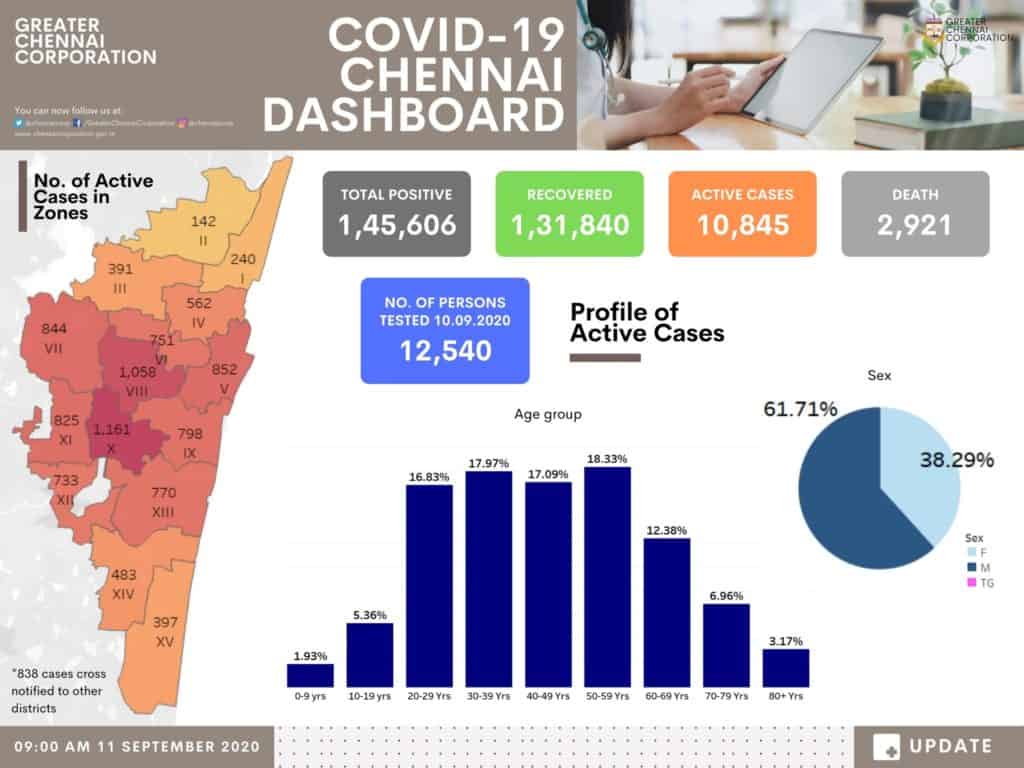
According to the bulletin, Chennai recorded 988 fresh COVID cases on September 10th. There are 10,845 active cases in the city.
The number of fever camps conducted by the Greater Chennai Corporation could be reduced in the coming days owing to low attendance. The number of people using the fever camps has fallen by 10% after the recent unlock measures came into effect on September 1st.
The civic body is also looking to scale down the frequency of fever surveys and tele-counselling of COVID-19 patients. There is no clarity on whether contact tracing will continue as rigorously or would be limited to family members of those affected by the virus.
Source: The Times of India
Madras HC directs CMDA to reopen fruits market on September 28th
While the work to reopen the Koyambedu Wholesale Vegetable Market is on, the Madras High Court has instructed the Chennai Metropolitan Development Authority (CMDA) to examine if the wholesale fruit market can be reopened on the same day (September 28th).
Meanwhile, beginning September 13th, the temporary fruit market at Madhavaram will be closed on Sundays until the vendors move back to the Koyambedu market. The temporary market at Thirumazhisai was the first to declare the weekly holiday.
About 200 tonnes of fruits are unloaded at the Madhavaram market every day and it attracts 16,000 visitors. Chennai Fruits Commission Agents’ Association appealed to the state government to regulate the 50-odd traders who function outside the Madhavaram market for smooth operations.
Source: The New Indian Express | The Hindu
SWD to be desilted by end of September
The civic body aims to desilt the stormwater drains (SWD) in Tondiarpet, Royapuram, Thiru Vi Ka Nagar, Anna Nagar, Teynampet, Kodambakkam and Adyar bus routes by the end of September. The task will be completed with sucker and recycler machines.
The announcement comes amid residents raising concerns about the chances of their localities being flooded in the upcoming monsoon season. The task is likely to face delays due to the lack of mechanisation.
GCC is also examining the risk of COVID infection for workers who will be roped in to clean the drains during the pandemic. The civic body has identified 72 waterbodies in the city to restore before the monsoon sets in, while 210 other water bodies are already under restoration.
Source: The Hindu
Consultant appointed for parking project
The civic body has commissioned a consultant to analyse and examine the parking system as part of the Integrated Chennai Parking Project. It is learnt that the GCC’s parking management system will be integrated with the earlier parking projects and other new proposals. The consultants will submit a report on the congested spots at busy junctions and commercial areas.
According to a GCC authorities, private landowners will be allowed to develop spaces for depositing the vehicles and collect charges in a bid to ease parking management.
Source: The Hindu
Phase-2 Metro line to connect suburbs
In a bid to connect to suburban Chennai, the Chennai Metro Rail Limited (CMRL) has begun work on Phase-2 of the project. The second phase is likely to be operational by 2025-2026. According to CMRL officials, the preparatory documentation work has begun and tenders for construction have been floated for a major portion of the project. The groundwork is anticipated to be started by 2021.
According to the detailed project report (DPR), about 19.2 lakh people are expected to use the metro services every day in the phase-2 line and the numbers are likely to go up to 43.5 lakh in 2055.
Source: The Times of India
[Compiled by Bhavani Prabhakar]
All the fines are only in paper.