The number of water bodies in Chennai has been on the decline, as they become victims of encroachment and negligence. Last year, the Chennai Smart City Mission, sought help from corporate organisations to restore these water bodies, especially ponds, within city corporation limits. With funds from the corporates and the civic body, a few environmental organisations collaborated with citizens to work on the restoration.
This collective effort has yielded some positive outcomes, as a few ponds were revived and the groundwater table has gone up in these areas. “Chennai is bestowed with hundreds of ponds that play a key role in increasing the groundwater table. As ponds are smaller in size, restoring them requires less time than the lakes,” says V Subramani, an environmentalist and founder of Sabari Green Trust.
Two such ponds are Puducherry Keni Kulam and Odaikeni Kulam — in Sholinganallur — both restored by Care Earth Trust, with financial aid from the Rotary Club of Madras, upon the recommendation of Chennai City Connect**.
The Sholinganallur success story
In the midst of busy residential establishments in Sholinganallur, these two ponds, separated by less than a kilometre are markedly different from others in the area. The four sides of their bunds were strengthened and these water bodies present a remarkable change from a year ago when they were filled with water hyacinth, solid waste and silt. The 10.5-hectare Puducherry Keni Kulam was covered by a bed of water hyacinth and polluted by solid waste, while Odaikeni Kulam required desilting.
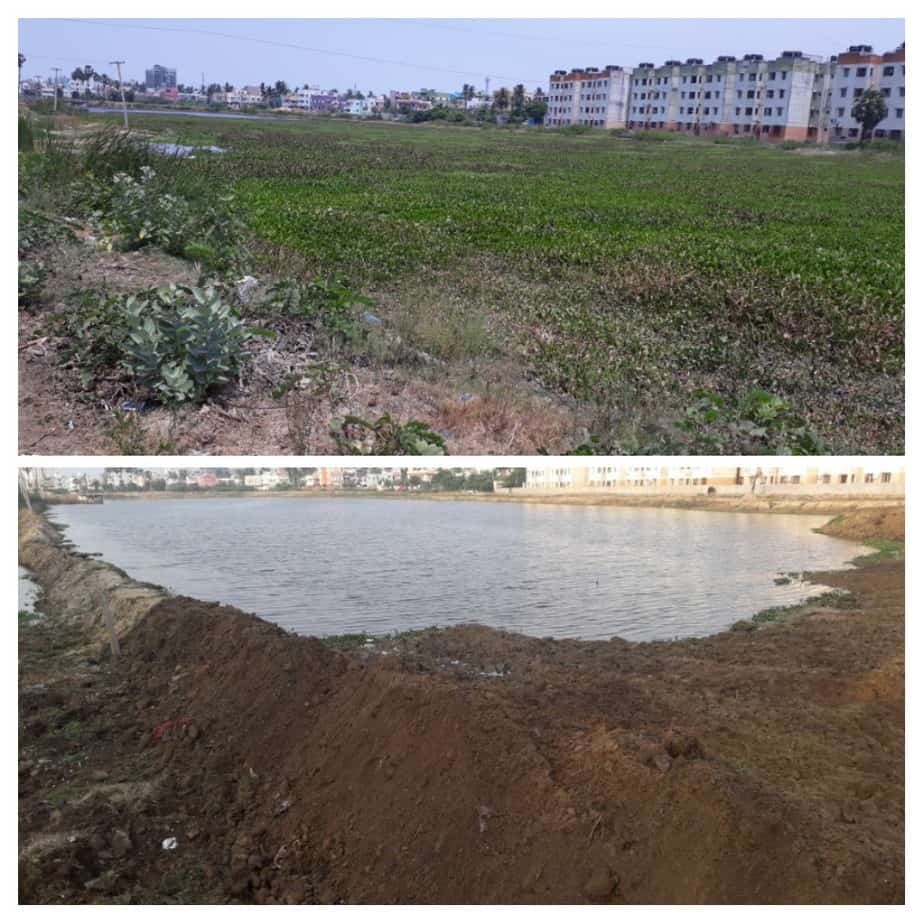
Before & After: Puducherry Keni Kulam In Sholinganallur was contaminated with Water Hyacinth a year ago. Thanks to Care Earth Trust and pro-active citizens, the pond gets a new look. Credits: Care Earth Trust
Behind this radical transformation has been an active citizenry guided by Care Eart Trust. As a first step, the organisation asked the members of resident welfare associations in the area to stop dumping garbage in the ponds. Later, a total of 180 tonnes of water hyacinth was removed from Puducherry Keni Kulam. It was also deepened to 1.5 metres** to increase the water holding capacity.
The 1.5-hectare Odaikeni Kulam demanded less work, as there was no hyacinth. The volunteers de-silted the pond to enable water storage.
“There has been significant transformation. Puducherry Keni Kulam now facilitates the growth of Typha, a wetland plant that indicates good health of the water body. Besides preventing the growth of hyacinth, Typha is used by the local communities for making mats,” says S Vasantharaja, project coordinator of Care Earth Trust.
However, the next step is even more crucial. These water bodies need to be continuously monitored. Care Earth Trust has joined hands with local volunteers who have taken it upon themselves to maintain these restored water bodies. “Whenever any encroachment, or dumping of garbage, or presence of anti-social elements is noticed, I complain to the Assistant Engineer of Sholinganallur zone and Care Earth officials. Protecting water bodies is a full-time job,” says Venkatesh, a local volunteer. During the restoration, Venkatesh played an effective role in motivating volunteers for the cause.
Sholinganallur, an IT hub, has been notorious for flooding, as several high rise buildings have come up on wetlands. By expanding the water holding capacity of the existing water bodies, conditions have been created that may lead to less flooding in the days to come. “Groundwater is available within 25 feet near these ponds now. By restoring the ponds, we have reduced the chances of flooding,” says Jitendra Prasad, a resident, who has set up a monitor by his open well.
Moovarasampet Pond awaits complete restoration
A similar story awaits to be told in South Chennai, where the Moovarasampet Pond never goes dry. Filled with lily and lotus plants, this pond is known for its scenic beauty. But apart from these plants, the one-acre pond was also sieged by perilous water hyacinth rooted deep into the soil.
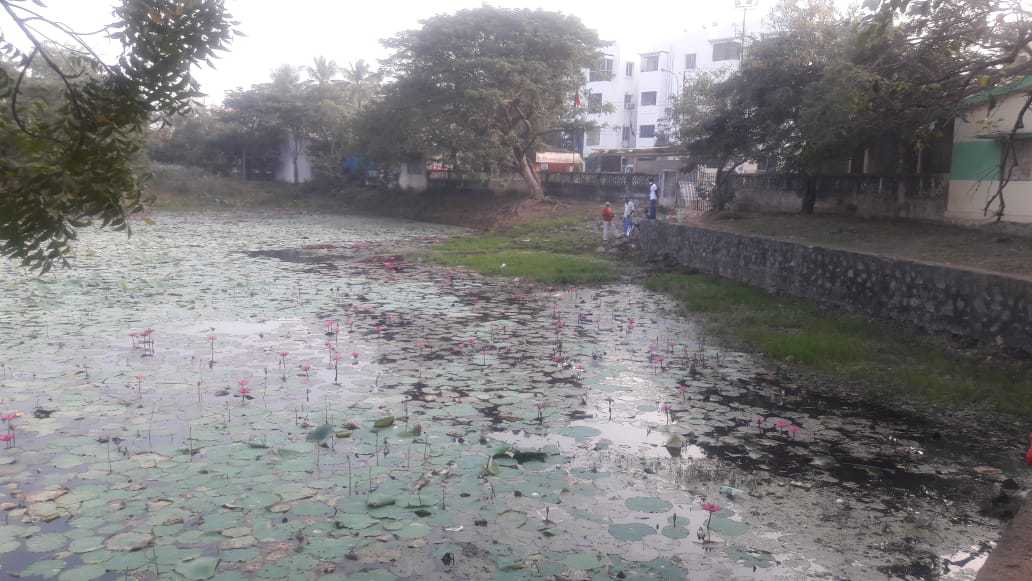
Water lilies add beauty to Moovarasampet Pond. Pic: V Ramarao
The Sabari Green Foundation gathered funds from citizens and cleared hyacinth from the pond. “We strengthened the broken compound wall and painted the walls. After clearing the hyacinth, groundwater levels have gone up,” says V Ramarao, a volunteer with Sabari Green Foundation. The Foundation received manpower from Gokul Nagar Resident Welfare Association in Moovarasampet. “It is our way of showing responsibility towards the water bodies. When we clean it ourselves, the message sent out on saving ponds and lakes is stronger,” said Gangadhar P, a resident.
“Water percolation has improved within a radius of three kilometres from the pond. As the groundwater stabilised, over 12,000 people in the locality benefit,” said V Ramarao, after the Sabari Foundation carried out a local impact assessment.
However, due to the shortage of funds, the organisation has had to halt the desilting and construction work on a walking path. Alandur MLA, T M Anbarasan assured Citizen Matters Chennai that funds and manpower would soon be arranged to ensure that the restoration work is completed. As more and more citizens get sensitised thus about the role of water bodies and the advantages they bring, one hopes that more such movements will emerge to save the lakes and ponds of Chennai.
**Errata: This information has been corrected since the story was first published, subsequent to clarification from sources.