The death of a 26-year-old intellectual disabled man in the city, two weeks ago, came as a rude shock to Chennaites, as it underlines two factors: absence of civic responsibility and apathy from the police department.
M Praveen Kumar, who was waiting with his mother at Adyar gate to board a bus to his work place in Savera hotel, went missing after he got into another bus. Praveen’s mother lodged a complaint at the Teynampet police station and informed his colleagues, family and the volunteers of Vidyasagar, an organisation that works with people with psycho-social disabilities in Kotturpuram, and also runs a school for special children, of which Praveen himself was an alumnus.
Not only was there a delay in filing the FIR from the police end, the missing persons list on the Tamil Nadu Police portal had also not been updated immediately with his details.
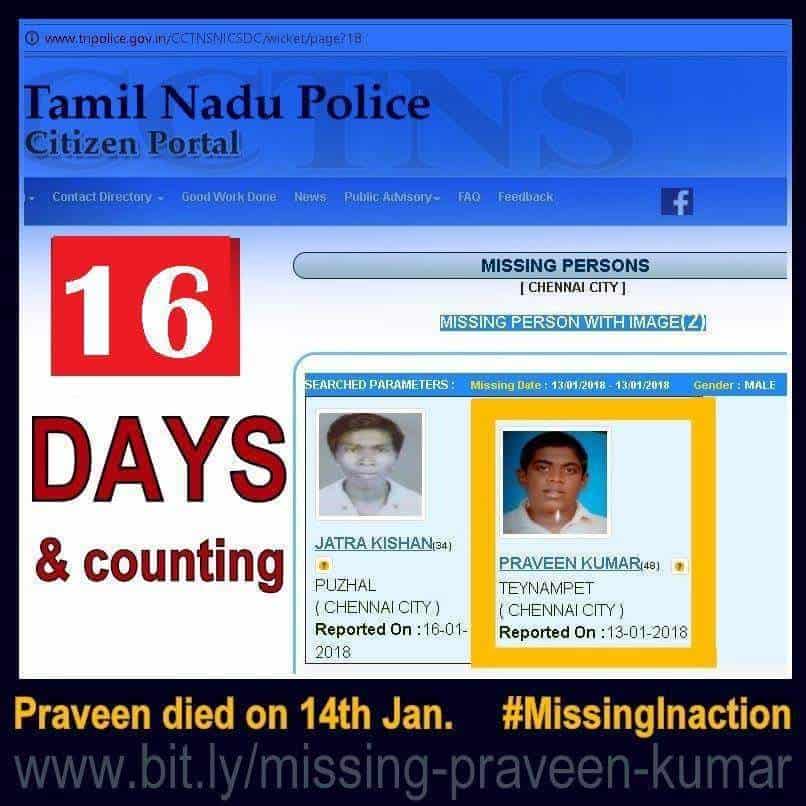
Even after Praveen’s death, his picture remains in the missing persons list maintained by TN police. Credits: Vaishnavi Jayakumar
Tragically, even as volunteers searched for him frantically, Praveen’s life was cut short after a vehicle mowed him down on Anna Salai, five kilometres away from where he went missing. If only one person among the hundreds on the busy Anna Salai Road had understood his behaviour and reported it to the police, he could have been alive today.
Praveen’s death is a clarion call for citizens, to be sensitive and responsible towards psycho-socially challenged people on the roads. There is a huge gap in awareness, which makes it imperative to educate and enable all to offer a helping hand to people like Praveen.
What can citizens do ?
Kanakavalli Bysani, a volunteer from the Prevention of Crime and Victim Care lists the suggested first steps when you spot a mentally-ill person on the street.
Kanakavalli’s journey as a social worker took off, after she was deeply disturbed by the sight of a semi-naked woman at Kilpauk. “I approached an organisation in the city who helped the woman,” she said. She emphasises a few points that every citizen should pay attention to:
- Developing a conversation would help in understanding the behaviour of the person. If the person is not aggressive, take him to the police station.
- It is always better to seek the help of organisations, if you are not trained to help. Kanakavalli recalled how a rag picker slapped her when she went to offer him food.
- Ensure that the nearest police station is informed. It is important to file a memo before shifting the person to any organisation.
- Do not spread false/ inappropriate news. Social media plays a major role in networking and tracing the missing people. We failed Praveen, despite taking up an aggressive social media campaign, as the circulation of fake news has killed a lot of volunteers’ time.
Citizens can also complain to the State Crime Records Bureau, which could help in reuniting the person with his family.
|
Whom to contact There are a handful of organisations in the city that are working towards the welfare of people with psycho-social challenges. Few of them are:
The State Crime Records Bureau, which helps trace and reunite missing people with families can be contacted at 044 2495 7878. |
Role of government agencies
There is a need for more systemic focus on helping people with dementia, persons with intellectual and speech communication disabilities and those with mental health issues.
Deepthi Bhatia, Deputy Director of Vidyasagar, says, “Collaboration between different agencies – both government and non governmental – is critical.”
Governmental agencies will have to strengthen their network and ensure the effective usage of the available systems. Some of the points that the organisation makes in this regard are as follows:
- Sensitivity to the urgency of the situation, better use of technology, speedy communication and prompt action by the police can make a difference. Cross departmental training modules should be conducted regularly for cops in order to sensitise them about these.
- Bilingual and easily readable versions of the current and revised standard operating protocol for missing vulnerable adults and disabled children should be made public as part of the TN police’s citizen chapter.
- Development of a standardised ‘This is me’ card and a priority system in commuting and public spaces for vulnerable people are essential and desirable. The card will have the details and the address of the person, thus facilitating speedy action by volunteers in any kind of situation.
Thanks to your sensitive and heartful journalism.