On April 24, 2023, 17-year-old, Shahrukh Zulfikar Shaikh, was killed in a truck accident at Malad, when he was cycling. The cyclist fell down after he lost control due when a rickshaw ahead swerved suddenly on his side. Last February, a 12-year-old cyclist was killed in a hit-and-run accident when he and his father were cycling in a group on the Jogeshwari-Vikhroli Link Road.
These deaths are a sad reminder of the dangers that await cyclists in the city. Professional cyclists say that cycling within the city roads is very unsafe and could be quite risky.
Urban transportation planner Zohra Mutabanna says that if infrastructure for cycling had been planned better, many more women and children would venture out to cycle. Unsafe roads unsafe prevent many from adopting this green mode of mobility that has zero carbon emissions, feels Zohra.
Why is cycling unsafe in the city?
Vipin Armugham of CycloFunatics, a Mumbai-based Cycling group, who leads teams on group cycling trails, says it is not so much the infrastructure in the city but the attitude of the heavy vehicles that tends to put the lives of cyclists at risk. “Often, it is how the heavy vehicles tend to bully the smaller vehicles especially the cyclists by cornering them towards the edge of the road,” says Vipin.
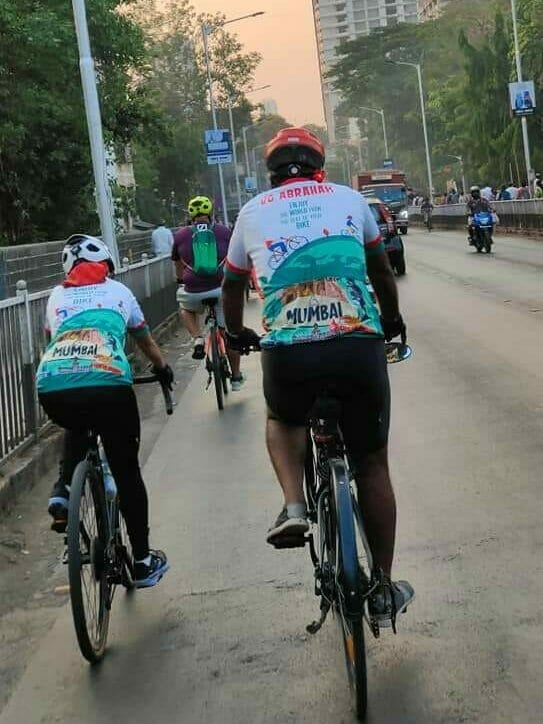
Vipin recommends that cyclists should go in groups and wear bright-coloured attire to stand out on the streets. A helmet torch, lights on front and back of the cycle besides wearing bright clothing with reflective jackets, would also be helpful. Armugham leads teams of cyclists on various routes ranging from 25-140 kms to pedal to places like Siddhi Vinayak to Madh Island, Aarey or even Palghar. He ensures that the teams follow these safety measures.
Cycling on highways, he says, can be quite risky due to speeding heavy vehicles that show no regard for cyclists. They instead prefer to navigate through dark shortcuts or inroads where traffic and pollution is low and less risky.
State of the cycling infrastructure in city
Currently, there is no separate infrastructure provision for cycling except in random patches like the cycling tracks at Bandra-Kurla Complex (BKC) and a few others. There is also, no policy, law, or rules that govern cycling. There is no provision for cycling even in the Development Plan -2034, that sets the pace for city’s planning for the next two decades.
“The problem of cycling infrastructure is a case of complete mismatch – they are located in commercial districts like BKC and not in residential suburbs, where they would have been helpful,” says Zohra. The Rs 331-crore project of having a 39- km cycling track from Mulund till Sion failed to take off. The project of having a cycling track around the Powai Lake too had to be shelved on court orders over environmental concerns. “There are a few discontinued patches. Hence, cyclists are not able to use them. Most cycling tracks are short distances with just the tracks and hence not preferred by cyclists,” explains Zohra.
Read More: Cycle Katta: Where cycling meets conversations
How many people cycle in Mumbai?
Though there are no clear figures available about the numbers of cyclists in Mumbai, the National Family Health Survey had found that 55% of Indian families owned bicycles.
According to Firoza D, founder of Smart Commute Foundation, there are two types of cyclists – the leisure riders and the professional users like vendors, dabbawallah’s or delivery service executives.
What could be done to support cycling?
Mumbai’s first bicycle mayor Firoza D recommends framing a non-motorised transportation policy and setting up an independent cell that would frame policy and have its own budget too. She feels that instead of patchworks of cycling tracks at different locations, Mumbai should have a comprehensive cycling network plan with seamless connectivity across different suburbs.
Firoza is currently pushing to set up cycle parking stands in each of the 24 wards in the city. She also would like the median patch around metro pillars to be allocated for cyclists.
“Building a city-wide coherent cycling facility rather than ad-hoc individual showcase projects, is the need of the hour,” says Zohra.
Vipin wants heavy vehicles to be legally barred from overtaking cyclists. “When heavy vehicles zoom past cyclists, their strong breeze causes them to lose control and balance, putting their lives at risk. Hence, heavy vehicles should not be allowed to swerve close to cycles especially on highways,” he emphasises.
Apart from laws and policies, cyclists will benefit greatly from a robust cycling culture, adequate infrastructure and supportive citizens, which will go a long way in ensuring their safety and growth.
Very well articulated article Ms Anthony