Missing: Public participation in lake development in Bengaluru

The event will focus on discussions on the opaque process in lake development and how citizens are being vigilant in protecting neighbourhood lakes

Across Bengaluru, lakes are being dug up, drained and desilted for development. BBMP is in the process of developing 67 lakes at the cost of Rs 200 crore. But the civic agency and the government have kept citizens out of the process.

Citizen groups, residents and environmentalists across the city have expressed concern. They fear their neighbourhood lakes are being encroached upon or turned into soup bowl- shaped lakes that are not as biodiverse. There are fears that limited public funds are being wasted on unnecessary works.

Lack of public consultation

Lakes in Bengaluru are essentially commons, meant to be shared and used by the community. But the public is never fully consulted and they also do not have complete access to plans and financial information before lake development happens.


Read more: Govt claims 47 lakes developed and 17 underway, but this is not quite true


Citizen Matters, Bengaluru, has organised a panel discussion, Missing: Public participation in lake development in Bengaluru, we will discuss how lake development became such an opaque process and how this impacts the lakes and the well-being of citizens. We will also talk about the best practices for lake development, and how citizens are trying to stay informed and vigilant about their neighbourhood lakes.
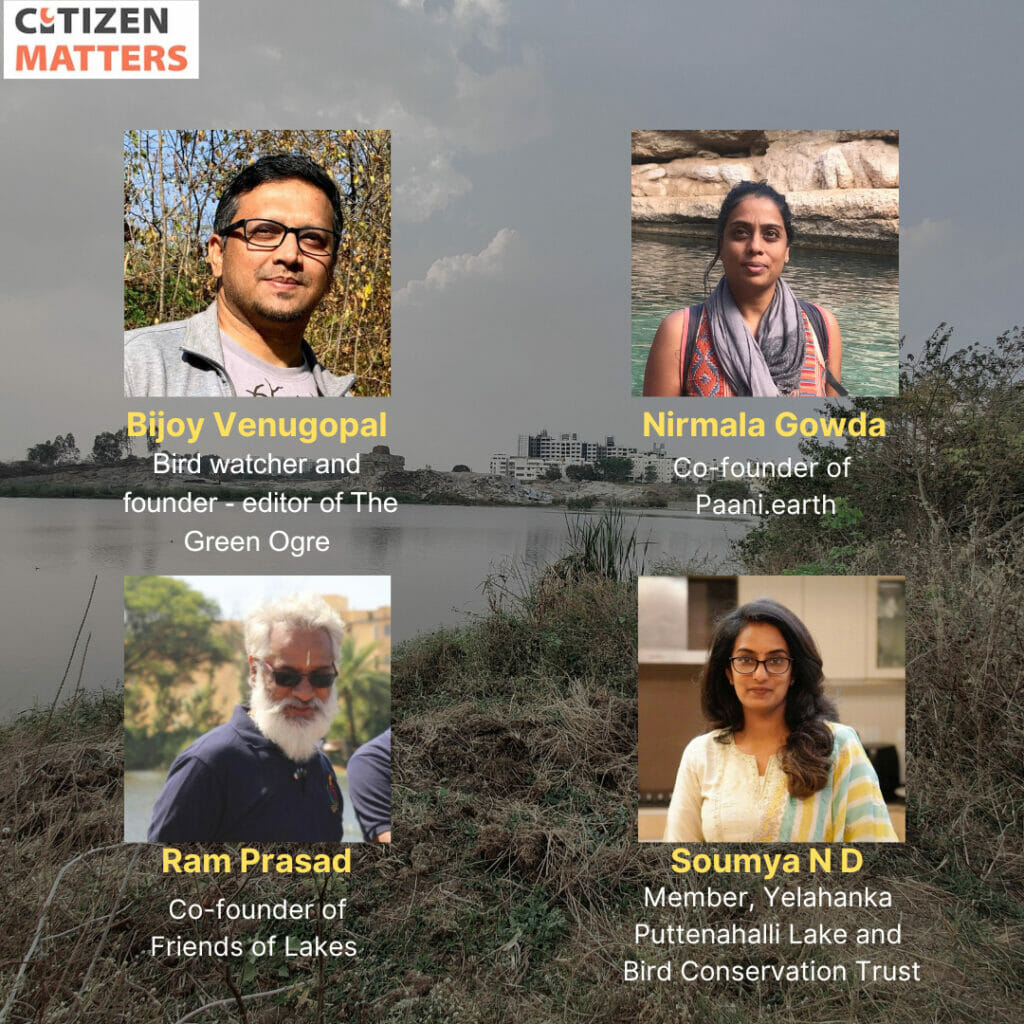
poster for webinar on lake development with panelists' information.
Event poster with panelists. Poster: Citizen Matters

Panelists

The panelists for the webinar include: Bijoy Venugopal, bird watcher and founder-editor of The Green Ogre. He is part of a group of active birdwatchers pushing for Saul Kere development to be biodiversity friendly.

Nirmala Gowda, co-founder of Paani.earth, a citizen lead research initiative that is building up a detailed database on the river-basins and wetlands of our country.

Ram Prasad, co-founder of Friends of Lakes and leading advocate for transparent and scientific lake management

Soumya ND, Member, Yelahanka Puttenahalli Lake Bird Conservation Trust, a citizen group monitoring the above mentioned lake.

The webinar will be moderated by Bhanu Sridharan, senior reporter, Citizen Matters, Bengaluru.

Event details

Date: May 26th, Friday

Time: 6 pm onwards

Register to join us on the webinar

The event will be livestreamed on YouTube

Also read:

Leave a Reply

Your email address will not be published. Required fields are marked *

Similar Story

Mumbaikars are fighting for their mangroves. Here’s how you can join them

Mumbai is about to face a monumental loss—its mangroves are being cut to build the coastal road. Citizens, however, have not given up the fight to save them.

​“What happens when we remove this natural infrastructure of the city? What happens if it floods? What happens if the air quality (index) goes really high?” asks Pooja Domadia, a member of the Save Mumbai Mangroves campaign. These are questions that many Mumbaikars have as work begins on the Versova-Bhayandar Coastal Road, which is set to affect 45,000 mangrove trees. In March this year, the Supreme Court dismissed a petition challenging the Bombay High Court order to greenlight the cutting of mangroves for the project. Is the SC decision a fatal blow to the movement? The BMC has already begun…

Similar Story

Where are the pollinators in Bengaluru?

Despite the volumes of citizen-generated data on the city's biodiversity, pollinators who sustain the urban ecosystem do not seem to be getting their due attention.

Urban biodiversity is often discussed in terms of tree cover, lakes, or flagship species, but far less attention is paid to pollinators—the insects and birds that quietly sustain urban ecosystems. In Bengaluru, a rapidly urbanising city with a strong culture of citizen science, large volumes of biodiversity data are now being generated by the public. But what does this data tell us about pollinators in the city? This article draws from a data jam hosted by OpenCity in Bengaluru that explored pollinator observations using publicly available, citizen-generated datasets. By analysing long-term observation records and spatial data on land use and…