A Children’s Magazine, HAM Radio, General Science, Traffic… Yes! A unique quiz that involved all of these – Quiz on Air. Hoopla Club, a monthly children’s magazine, in association with Indian Institute of HAMs organised the second annual ‘Quiz on Air’ on Friday September 3rd, 2010 in Bangalore. After earlier preliminary rounds, ten Hoopla Club member school teams made it to the finals that was conducted and aired ‘live’ on HAM Radio.
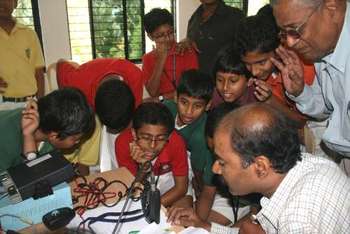
HAM Quiz on air, was conducted on September 3rd. Pic courtesy: Hoopla Club.
Why a quiz conducted on the HAM Radio network? Hoopla Club’s Reena Mirpuri and Balchander Gandhekar, say that they were looking for ways to create awareness of HAM Radio among today’s children who are otherwise well-informed, and together with Indian Institute of HAMs, they struck on the idea of an on-air quiz where children can experience the excitement of HAM Radio for themselves.
HAM Radio, also known as Amateur Radio (amateur = non-commercial), is a unique hobby that uses the basic scientific principles of telecommunications. There are different methods of communication using HAM Radio – voice is most common, but one can still use the ancient method of Morse code or the modern computer. Before the advent of cellular phones and the internet, HAM Radio was one of the only means of contacting people around the globe and also locally when on the move, apart from the land-line telephone. Even today, during earthquakes, floods and other natural disasters, HAM Radio remains the one dependable source of communication when other communication lines may be destroyed.
To become a HAM, one needs to pass an exam conducted by the WPC (Wing of the Ministry of Communications and Information Technology), after which a licence and call-sign is issued. A call-sign is a unique identifier and Indian call-signs are prefixed ‘VU’. For more information on HAM Radio and becoming a HAM, see www.indianhams.com.
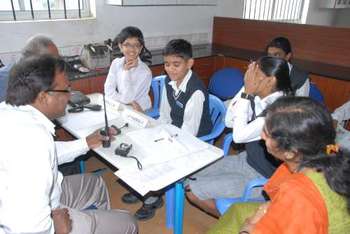
HAM Quiz on Air saw ten schools participating in the final round. Pic Courtesy: Hoopla Club.
For the quiz, a HAM control station was set up at the office of Indian Institute of HAMs, from where the quiz master operated. At each of the participating schools, a HAM radio station, manned by a licensed HAM operator was set up specifically for the purpose. So teams sat within the premises of their own schools (with live audience to support them) while the quiz master was at a different location – and all listened in and answered questions on the same frequency (VHF 145.650 MHz minus shift).
This year’s quiz had a special focus on traffic – so a short talk on road safety and traffic rules preceded the quiz. During the quiz, Praveen Sood, Additional Commissioner of Traffic Police was on air and he answered traffic-related questions posed by the children.
What is the scientific term used to explain why an athlete running on a curve bends inwards? Centrifugal Force
True or False – When you are tired while cycling, it is okay to hold on to a bus in front of you? False
What is the 2-metre frequency on which HAM Radio is licensed to operate? 144-146 MHz
Each school team comprised of three students from classes VIII to X. They faced several rounds of questions on science, traffic and HAM Radio, from quiz masters HAMs G Venkatesh (VU2COC), Member, IIH and S Satyapal (VU2FI), Managing Trustee & Director of IIH.
The teams competed enthusiastically and ran neck-to-neck, so tie-breaker questions were needed to decide the top three places. The team from Delhi Public School, Bangalore South (Pooja Arya, Shruthi Satish and Niel Kulkarni) won the quiz, followed by the teams from Kendriya Vidyalaya, Hebbal (Manav Gurumurthy, Manu M Pillai and Vinayak Garg) and Little Flower Public School, Banashankari (Nikhil Vashisht, Anand and Sharath). All the ten finalist teams received certificates of merit, T-shirts and books on traffic. ⊕