Due to rapid urbanisation and unplanned development, Bengaluru’s groundwater is getting increasingly contaminated. This issue requires urgent attention as approximately 40% of the city’s population depend on groundwater (borewells, open wells and tankers) for their daily water needs such as drinking, cooking and bathing.
Contaminated groundwater could lead to health issues if it is directly consumed. If used for agricultural purposes, it could even enter the food chain.
Residents across the city have reported that borewells discharge coloured or smelly water. This indicates percolation of sewage and chemicals into the water table. Discolouration, cloudiness and bad odour are some of the visual indicators of water contamination.
Bengaluru’s groundwater system
Groundwater is the water stored below the ground, in between the pores of soil and rocks, known as aquifers. There are two types of aquifers – unconfined (with ground surface on top and solid rock as the base layer) and confined (between two layers of impermeable, solid rock).
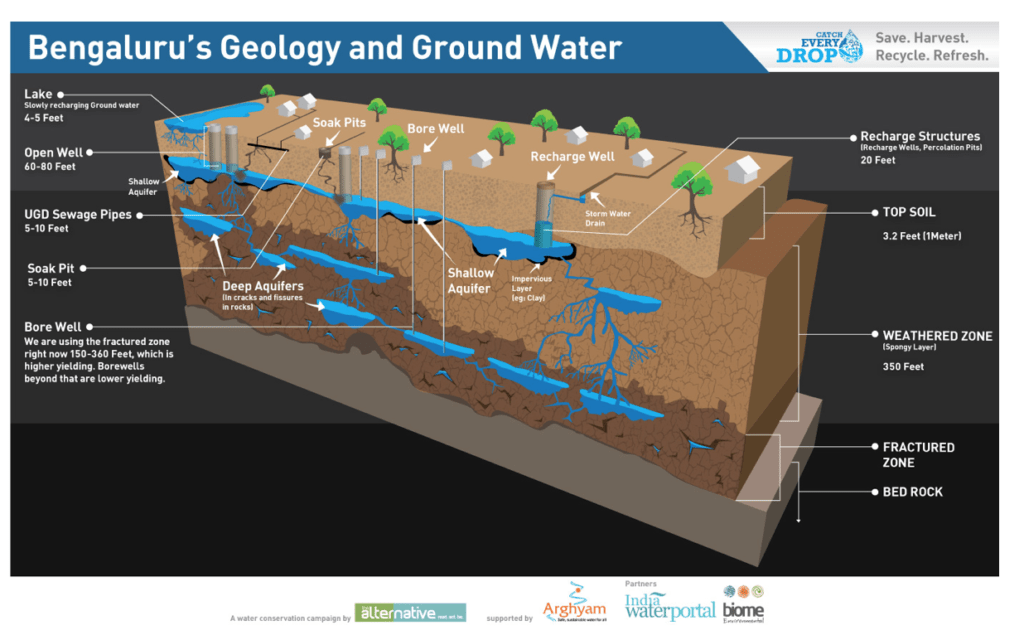
As shown in the graphic above, unconfined aquifers are usually shallow, and are highly susceptible to surface water pollution. In Bengaluru, shallow aquifers can be 60 – 80 ft deep. Open wells and shallow borewells tap into these unconfined aquifers.
In contrast, confined aquifers are deeper aquifers, located 150-360 ft below the ground. They can only be accessed when borewells are dug deep into bedrock. These aquifers are not affected by surface contaminants as they lay in between two impermeable bedrock layers. But water in these aquifers may have contaminants such as excess fluoride, arsenic and iron that naturally occur in rocks.
In this article, we are referring to contamination of only unconfined/shallow aquifers, which affect water quality in open wells and shallow borewells. These aquifers can be contaminated by polluted surface waterbodies such as lakes, or directly from faulty sanitation systems or solid waste leachate from dump yards and unlined landfills.
Contaminants are commonly of two types – biological and chemical. Biological contaminants are organisms such as bacteria, viruses and parasites. Chemical contaminants include nitrates, metals and salts, to name a few. The main source of biological contaminants is sewage, whereas the sources of chemical contaminants are sewage, industrial effluents and solid waste.
Mismanaged waste, lakes can contaminate groundwater
The following system map indicates the ways in which shallow open wells and borewells, which receive water from unconfined aquifers, get contaminated.
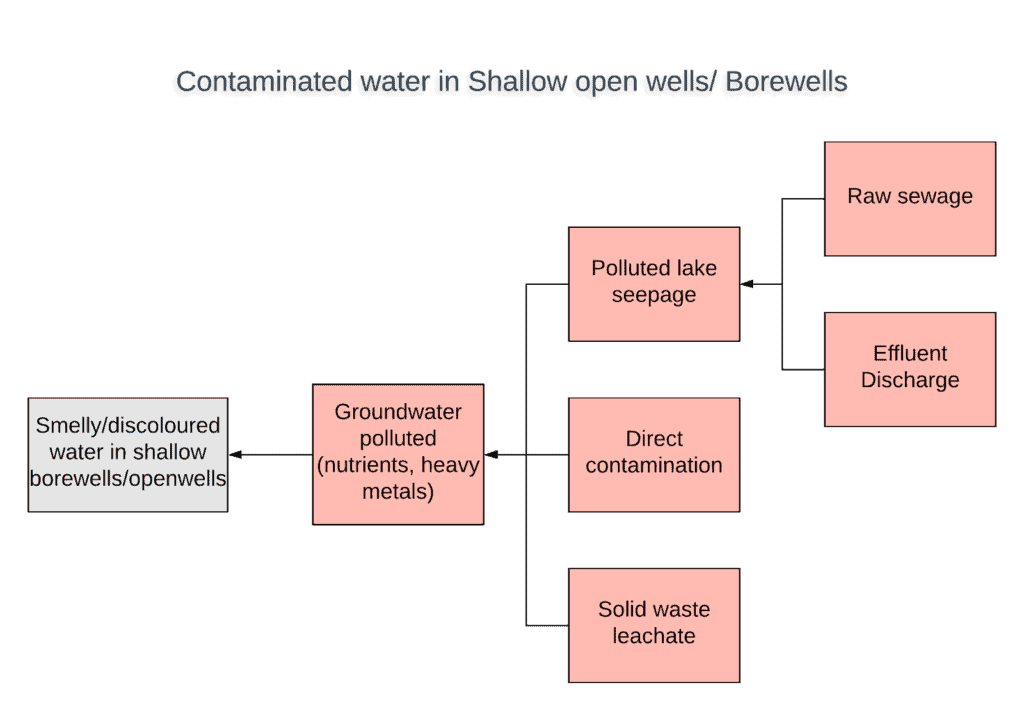
From lakes: If a lake is contaminated, open wells and shallow borewells near it could also be contaminated. BWSSB (Bengaluru Water Supply and Sewerage Board) does not have the capacity to treat all the sewage generated in Bengaluru. Hence much of the sewage is discharged into stormwater drains (rajakaluves), and finds its way into the city’s lakes.
Since these surface waterbodies (lakes and sewers) recharge groundwater, the latter is at risk. A study conducted by the Environmental Management & Policy Research Institute (EMPRI) states that about 85% of Bengaluru’s waterbodies are polluted by industrial effluents, sewage and solid waste dumping.
From sewage and industrial effluents: Groundwater may get directly contaminated from industrial effluent that is illegally discharged in open pits. Also, in unsewered areas, many residents have septic tanks. These are emptied a few times a year by “honey suckers” – trucks that are supposed to transport the sludge to fecal sludge plants.
The problem is, in practice, unscrupulous drivers dump the sludge in open grounds or stormwater drains. Even where sewerage pipes exist, the sewage often leaks into the groundwater. Sewage is rich in pathogens and nitrates, whereas industrial effluents may contain heavy metals.
From solid waste leachate: When solid waste is dumped in open areas, leachate from it seeps down, directly contaminating groundwater.
Evidence of groundwater contamination in Bengaluru
Surface waterbodies and groundwater are directly connected, as seen at Kaikondrahalli lake in Sarjapur. Pre-rejuvenation, when the lake did not have enough water, the open well in the lake’s periphery was dry. But once the lake filled up post rejuvenation, the open well also started discharging more water. Read this article to learn more about how lakes impact groundwater in Sarjapur.
A groundwater study conducted by IISc in a 1-km periphery of Bellandur and Varthur lakes showed increased levels of nitrate, traces of heavy metal, and biological contamination in the samples.
A recent sampling study was done by Ramaiah Advanced Testing Laboratory (RATL), with samples from borewells, taps and tanks from over 100 residential localities in Bengaluru. As much as 80% of the borewell samples had high bacterial contamination; almost all failed the colour test; and 70% had E. coli in them, indicating the percolation of sewage into the borewells.
Recently the residents of a locality in southwest Bengaluru found their borewell water discoloured and smelling like petrol. They collected water samples from different households which had similar complaints, and sent them to the KSPCB for testing. BBMP was also alerted about the issue.
How to prevent groundwater contamination
Top- down approaches
- The primary goal should be to stop the dumping of sewage, industrial effluents and solid waste into lakes. This could be through building better infrastructure to treat wastewater locally, in a decentralised manner.
- Lakes’ water quality should be monitored, and steps should be taken when it does not meet minimum standards. Lakes are currently monitored monthly by KSPCB; the data can be found here.
Bottom-up approaches
- All borewells need to be registered, and permits should be mandatory to dig new ones. To register your borewell, download the required forms from BWSSB here. To learn more about groundwater regulations in Bengaluru, read this blog.
- Contact KSPCB if you notice any visual indicator of groundwater contamination, such as discolouration or odour. Get the water quality tested.
- If there are any issues with the quality of water from your registered borewell, you can contact BWSSB on their online portal or by phone at 080-22238888.
- Citizens can get water tested at water-testing labs as well. For drinking water standards, you can refer to the IS 10500 standards established by the Bureau of Indian Standards. Alternatively, you can use smartphone-based portable kits from companies such as FFEM to test drinking water and lake water.
- If you are using groundwater for drinking, please confirm that your treatment system removes all contaminants. Some treatment systems such as UV and boiling of water only remove pathogens. The treatment system that you choose should be based on the contaminants present.
Steps to prevent groundwater contamination are similar to those mentioned in our previous articles: