Brinjal, badanekayi, the king of vegetables comes with its own crown! Let’s revisit the world of Brinjal and explore it’s amazing diversity! It is a celebration of the diversity of brinjals and to contemplate our role in protecting it. Good Food, healthy food, safe food… should be a primary concern for all of us.
The Brinjal festival to be held at Lalbagh is an attempt to bring a better consciousness and respect for our rich diverse food. Genetically Modified (GM) food crops pose a grave threat to the diversity and to our health as consumers. Let us all make informed choices about food, one of most fundamental necessities.
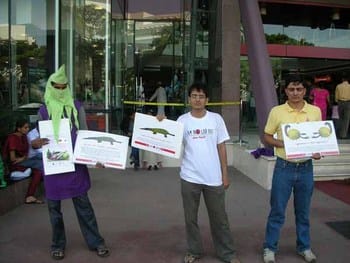
From left to right: Sahaja Samrudha volunteer, Teja, AID volunteers Pulkit Parikh and Arun, displaying ‘Brinjal Festival’ and ‘I am no lab rat’ posters, at the Forum Mall. (pic courtesy: AID India)
Earlier last week, on 29th March, volunteers from AID Bangalore and Sahaja Samruddha carried out an awareness drive on the hazardous health effects of Genetically Modified (GM) foods, right outside Forum mall at Koramangala.
Two volunteers sported a unique Brinjal outfit to draw more attention from the passers-by. The response was quite encouraging, with many youngsters happily sharing their email ids to know more and keep abreast of the campaign’s activities. A large majority of them were found entirely unaware of what GM foods are, let alone their consequences.
The event this Sunday will include:
- Food stalls with brinjal specials for you to savour
- Cooking competition for innovative brinjal dishes (12:15 PM)
- Drawing competition and more fun events for kids (2:45 PM)
- Brinjal diversity exhibition showcasing more than 30 varieties of brinjal
- Screening of Mahesh Bhatt’s film Poison on the Platter
- Awareness campaign about GM foods and the risk to our health and environment. Meet scientists, farmers, doctors and Ayurveda practitioners
Brinjal Festival
Venue: MHS Hall, Lalbaug (Double road gate)
Date/Time: Sunday 5th April, 11 AM – 5PM
To confirm your participation and registration for cooking and drawing competition, Click here or E-mail to brinjalfest@gmail.com.
You can also call AID India volunteers, Deepa at 9900194183 for details on cooking competition and Sejal at 9901201279 for information on drawing competition.
Organized by
- Association for India’s Development (AID)- Bangalore
- Sahaja Samrudha
- Samvada
- Jaivika Krishi Society (JKS)
- Mysore Horticulture Society (MHS)
For any queries:
E-mail: brinjalfest@gmail.com. Contact: Guru (9845294184), Siddesh (9880600840) ⊕