In early January, an NGO that focuses on reuse and recycling of clothes sent out an urgent appeal to people on their mailing list to contribute woollens and blankets for homeless people who were suffering the harshness of a prolonged winter.
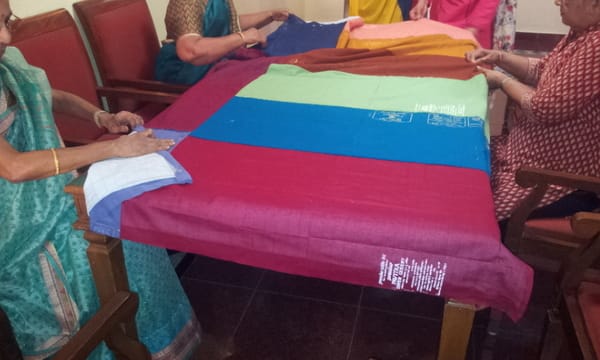
Quilt-making in progress. Pic: Lalana Zaveri
What would most of us do, on receiving such an email? Possibly spare a thought for these poor people and then mark the mail unread with the intention of doing something about it at the earliest opportunity, or perhaps gather our spare blankets and woollens and set off in search of a collection point. That spans the spectrum of the least and the most that one can do. Right? Apparently not.
A group of women (about five of them) from a housing complex in Koramangala decided to do more than just think and collect clothes. Having already concluded one round of collections and dispatch, they decided to get together and start preparing quilts for the poor and then keep sending batches of them to other NGOs as well as orphanages.
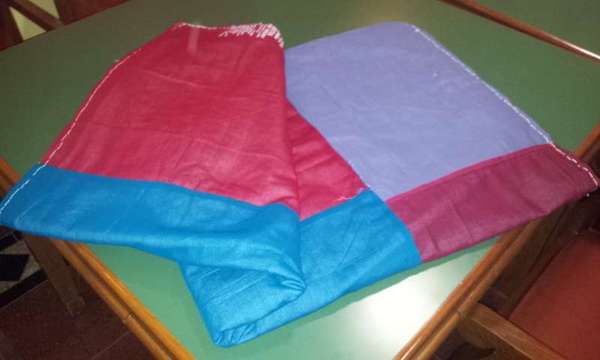
Finished quilt. Pic: Lalana Zaveri
One of the women (who wanted to remain anonymous) visited various fabric and clothing stores in the vicinity and asked if they had some spare cloth material that they could donate – material that could not be sold either because of an odd shape, size or discolouration. But a strict condition was that the pieces had to be clean and intact with no tears or gashes. Most of these retailers were quite willing to hand over their unsellable pieces of cloth. The woman was able to gather enough material to get started on a couple of quilts, including the filling for the quilt.
The next bit was a little more tricky. None of the women had ever made a quilt before! So while they were now armed with sufficient material, they had no idea how to get started. Then one of them remembered a friend who might have done something similar before and requested her to guide them. The friend agreed to come in and show them how to make the patchwork outer layer of the quilt. Using her advice, as well as a bit of their own ingenuity, the women proceeded to make five quilts in about five sittings from the first batch of material. These quilts were pretty as well as warm, as was the feeling in the hearts of the women as they packed them up for dispatch.

Learning from quilt-making expert, Erika Craig-Rielly. Pic: Lalana Zaveri
This was just the start. The women, three of them being senior citizens, continue to meet every week in their housing complex clubhouse, and continue to weave warmth into the lives of strangers, seeming to have discovered a new raison d’etre. Of course, the other side of the coin of this altruism is their gain in the form of community participation, occupation and the joy of giving.
The day I went to observe the activity, it was their seventh session. The ladies spent nearly 30 minutes discussing better fillings for the quilts. A quilt is not effective unless it has the right filling. The filling has to provide warmth and at the same time, it cannot be so thick as to make the quilt impossible to stitch by hand. (Yes, all the quilts they made were stitched by hand!) The filling issue was sorted out by selecting a double layer of material as a filler, rather than cotton wool or bits of cloth which could bunch up. The women brought out the pieces that they had been stitching at home. Then there was a lot of activity around measuring the stitched pieces and aligning them.
As always, what made this activity most appealing was the well-thought out process and methods employed. “Since there are many of us, we need to plan and divide the work in a way that is most efficient”, said one of them.
While the women meet for about one and a half hour every week, they continue to stitch pieces even at home. They come together for the insertion of the filling and final stitching of the sides and the lines of stitching that run across in the middle to keep the filling in place. Nothing is done haphazardly; the final result is good-looking as well as functional.
Now they even invite experts in quilt-making, whom they actively seek out through their networks, to gain skill and expertise in an activity that is not earning them anything other than goodwill from people that they do not know.⊕