I meet Lavanya Keshavamurthy on a lazy afternoon at the Indian Institute of Science (IISc). I am here to know more about a unique bicycle sharing programme called "Namma Cycle" which has been active in IISc the last four months. It was started by a group of cycling enthusiasts, including Lavanya (operations in charge at Namma Cycle) and Murali H R (founder-director of Namma Cycle).
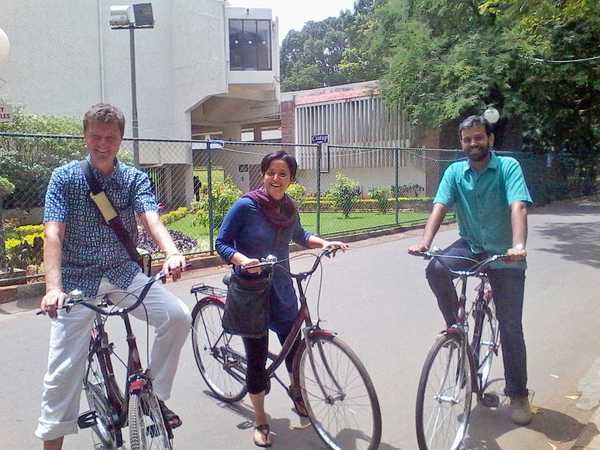
Cyclists in the campus. Pic:nammacycle.in
A former technology professional, Lavanya Keshavamurthy left her MBA in Canada mid-way to come back to Bangalore and work on this unique and experimental initiative. "Its been an adventure," Lavanya adds. They use two guiding principles to devise their working model: "easy to replicate" and "community involvement", the latter would enable sustenance of the process.
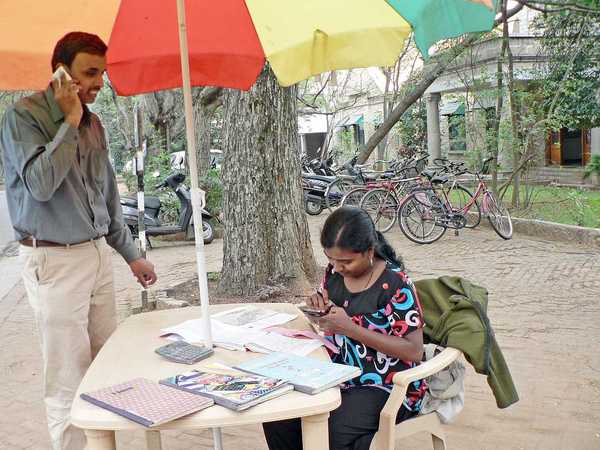
Rani, an employee of Namma Cycle, registers a user online, using her mobile phone. Pic: SKS
The experimental social enterprise – The challenges and joys
The initiative was started with just some seed capital from BBMP, BESCOM and Imagine Bangalore (a group that works on city initiatives) and it required a lot of lobbying to realise it! And for similar reasons, their initial plan to establish the system at Bangalore University did not materialise. Most of their effort went into convincing people about the idea.
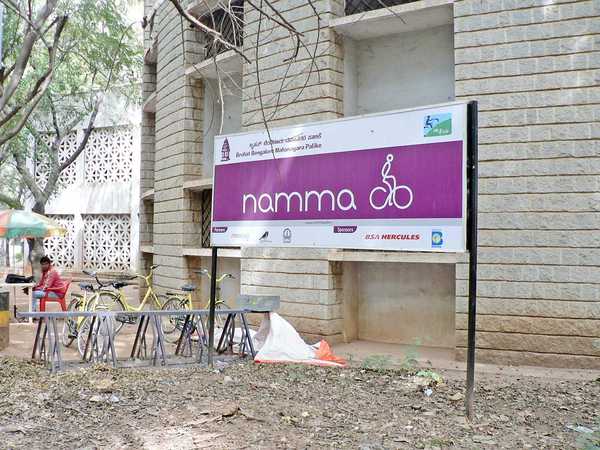
One of the ‘Namma Cycle’ nodes (or bicycle station) at IISc.
"So when everything came together and we had the infrastructure in place at IISc, we didn’t have the time come up with a typical hierarchical structure of a company. We decided to go with the experimental spirit of the whole thing and 10 employees were literally hired on a first-come first-serve basis". Six of them have been with them for the last 5 months.
The team includes mechanics and node managers, who help users with the commute plans, register them online, note the cycles coming in and going out on their mobile application.
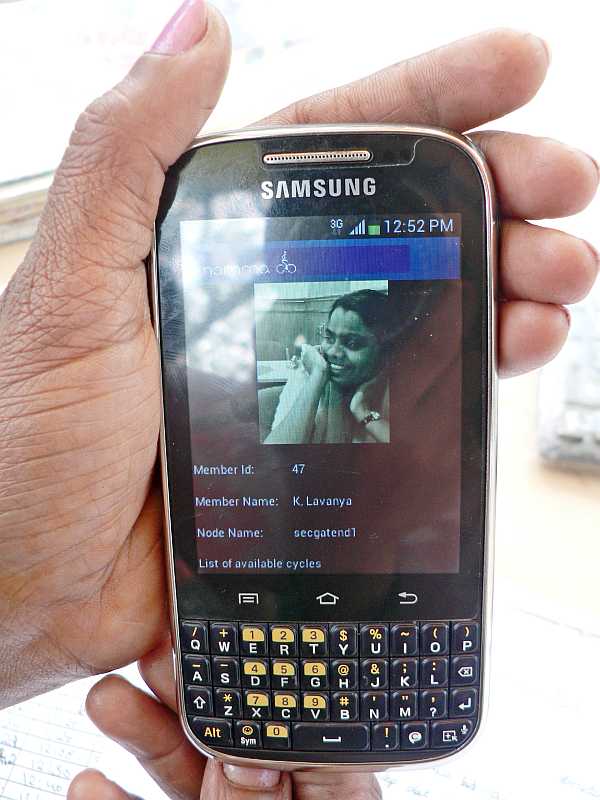
Few easy steps to register and check users on mobile phone.
Technology – We are now ‘mobile’
"Although it helps, we never hired people based on their computer skills. And using the ‘namma cycle’ interface is simple and easy. Our employees come from backgrounds that requires them to be quick and responsive, which is a big plus", says Lavanya. For example Raju (Chief Mechanic at Namma Cycle) and his cousin Mahesh Kumar (Asst. Mechanic) are from a village (near Magadi road) and for them mechanics comes naturally. Plumbing, motor-generator problems, cycle repair – these are skills you literally inherit in a village.
The software system that Namma Cycle runs on is called EcBike and runs on PCs as well as Android based phones. Gubbi Labs, the developer of the app plans to release this as an open source software.
Benefits onsite!
“Namma Cycle has registered over 3000 trips and has 100 resident members. The service has also been very useful to visitors of the Institute with about 40% of the trips being made by visitors.
There are around 2000 bicycle users in the campus with their own cycles. The effort is to integrate all of them into the sharing initiative. Namma Cycle will track and maintain the cycles using the software. Once the software stabilises and easy to use we could hand it over to the student community at IISc. That would make us free to take this working, sustainable model and simply replicate it elsewhere…even for a city, if the forces : political will, public enthusiasm, good urban transport designs, come together.”
— Lavanya Keshavamurthy
The employees are mostly 18-20 years of age and come from lower middle class backgrounds. They are paid a monthly salary of Rs 7500 and perks include breakfast and lunch. These school or college dropouts aspire to become entrepreneurs later in life.
They are committed to their job. When three of them had to go to Sabarimala, they found replacements (from their friends and family network) and ensured that functioning of ‘Namma Cycle’ continued without a hitch in their absence.
When they went to Mysore to promote cycling during the Dasara festival part of an event organised by Ride a cycle Foundation (RACF), they saw the large number of cycling enthusiasts in the State Level Open Cycle Championship, from across the country. Then they felt proud of what they do. Lavanya says this was a breakthrough, "As new joinees, they never understood why cycling was so big a deal."
Namma Cycle is an informal setup that’s working well at IISc. Clean air, brightly lit, greenery all around – this sounds more like a getaway than an office!
With the number of cyclists on the rise in Bangalore, there are initiatives to keep up with the trend. Kerberon systems are setting up a fully automated bicycle sharing system for commute to/from Metro stations. Namma Cycle and RACF have also worked with the government to make Jayanagar ‘bicycle friendly streets’ and install bicycle racks (parking facility) at key locations in the city: At Koshys (sponsored by Tata Structura), at Lalbagh (Bharathi Cement and BBMP).
With more such working models and positive initiatives, we could, in near future, reclaim the ‘garden’ city that had more cycles than cars in the 1960s and even until the 1980s.⊕
Hi This sounds very interesting. What do I have to do to register in Namma Cycle Progaramme. Is this facility available anywhere in Malleswaram..
Kudos to the people who conceived this idea and I assure I will do my bit to promote this
Sreedhar Govindarao
919686200482
This is operational within the IISc campus only. So if you happen to visit IISc you could use their service and get in touch with them. Their website “http://www.nammacycle.in/”