The response to PNLIT’s request for volunteer teachers to help the children from the slum abutting Puttenahalli Lake was overwhelming! 15 people volunteered their services for various subjects. Usha Rajagopalan, who initiated this activity, found out that classes are already being held in the temple located in the slum. She met the temple priest and the teacher Mrs Rajeshwari, who said that some students were in need of supplementary tuition and closer attention in certain subjects.
Vivek Krishna and Vijay Kumar are the volunteers coordinating the PNLIT Teachers. Classes are being fixed with students at mutual convenience and any breaks or complaints about absenteeism are reported to them for follow up with the parents/the temple priest.
The first class at the lake gazebo on 25th August was a 1-to-1, where Mr Rajagopalan taught Physics to Deepubai of Std X. While there are many children who are enthusiastic to gain from extra classes to understand their school subjects better, there is a specific interest in spoken English and Computer Science and these are the subjects for which classes are currently being conducted.
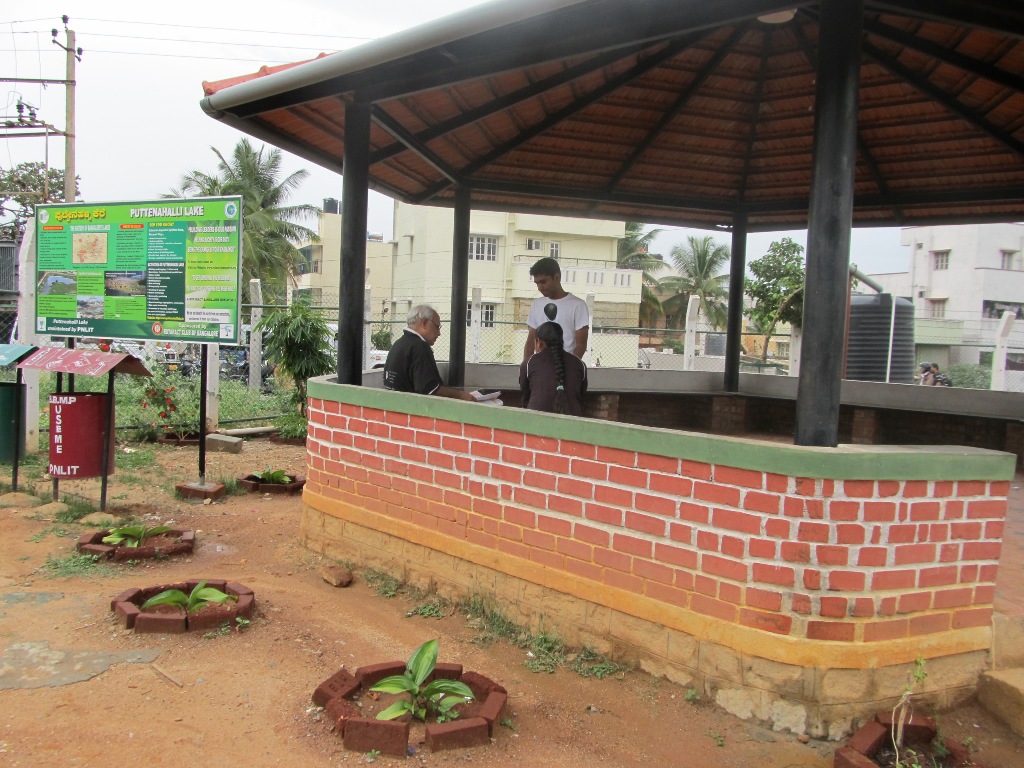
First class at the lake (Pic: Usha Rajagopalan)
Mr Narayanan, a resident from BM Mayflower has been teaching spoken English on Sundays. In one of his reports after just a couple of classes, he wrote, "Today 3 students came. They brought 2 others too. These 3 are smart. I hope they continue. They talked more in English than Kannada today."
Vijay Kumar had a two-hour Computer Science session with five children last Sunday evening. They learnt about computer user logins, types of OS and MS Office basics with hands on practicals.
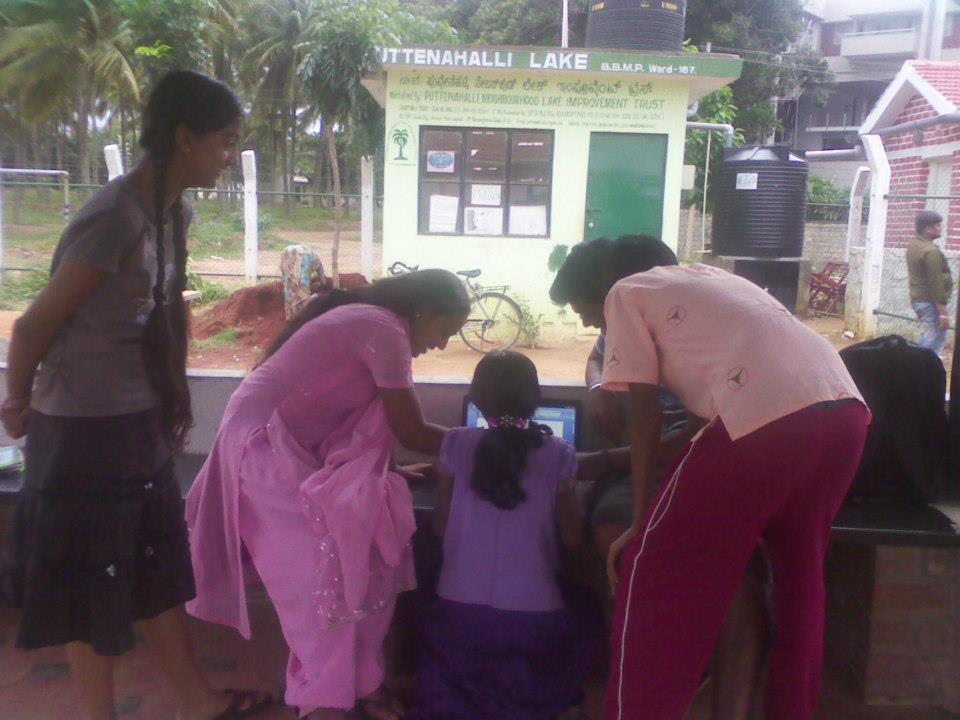
Computer excitement (Pic: Vijay Kumar)
The location of the classes has been a talking point. Some of the parents of the children wanted the classes to be held either at their homes or the temple. The temple has constant distractions with bell ringing and movement of devotees and many of our volunteers were not comfortable with this. The classes at the gazebo have been going well thus far, and it will be a pity if the children are held back from learning because of the location.
Inputs: Vivek Krishna, Vijay Kumar, Usha Rajagopalan
⊕