Students march for eye donation

Almost an entire school marched to create awareness about eye donation. Some of the students also decided to pledge their eyes at the end of it.

Around 400 students from NSVK (Nehru Smaraka Vidya Kendra) school, Jayanagar, participated in the eye donation awareness walk on August 25th early morning shouting slogans ‘Nethradana, Mahadana,’ (Eye donation is the best of all donations).

NSVK school students in the rally. Pic: Abhishek Angad

This walk was organised by Nethradhama, a superspeciality eye hospital in Jayanagar 7th block. The walk started from the hospital premises and moved to Yediyur, Kanakapura Road.

Renowned people like Thara Anooradha, President, Karnataka Chalanachitra Academy, Vijay Kumar, MLA Jayanagar and Dr Manjunath C N, Director, Jayadeva Institute of cardiovascular Sciences and research were present on the occasion along with doctors, hospital staff, school teachers and general public.
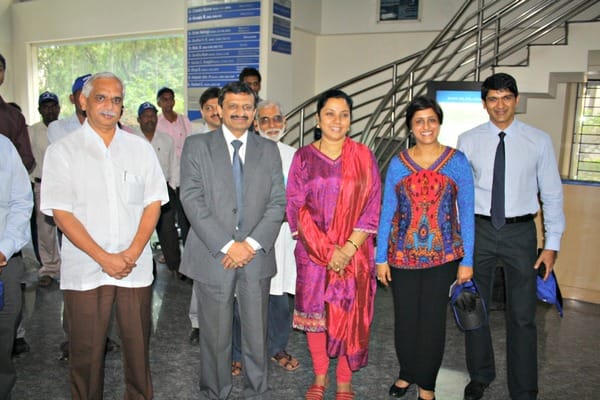
(L-R) Jayanagar MLA Vijay kumar, Dr Manjunath C N-Director, Jayadeva Institute of cardiovascular Sciences and research, Thara Anooradha, President, Karnataka Chalanachitra Academy, Dr Suman Shree R, CEO, Nethradhama and Dr Ganesh MD, Nethradhama. Pic: Abhishek Angad

Manjunath said that students’ participation would create more impact for the eye donation awareness. On Bangalore’s eye-donation scenario he said that people need awareness.

Girija Uchila, NSVK school teacher found out that there were many students from the school who wanted to donate eye after death. Sukesh H G, a 10th class student of this school said, “I would donate my eye after the death. It will be useful for needy people.”

Every year, from August 25th to September 8th, eye donation awareness week is observed throughout India.

Leave a Reply

Your email address will not be published. Required fields are marked *

Similar Story

Shaping Bengaluru: “Citizens can add real capacity through local knowledge, feedback”

We spoke to authors of the Janaagraha report, ‘Shaping Urban India’ to understand its recommendations in the context of Bengaluru.

“The road is broken, buses are overcrowded, traffic disrupts daily life, garbage piles up on the streets”—these are everyday complaints of citizens across Indian cities. In Bengaluru, these issues only seem to be worsening with passing time. Bengaluru’s built-up area grew by 85.19% between 2001 and 2020, resulting in commuters losing 168 hours (one week) annually to traffic congestion. As the city grows rapidly, governance systems, data frameworks, and citizen participation have failed to keep pace with its increasing complexity. What would it take to bridge this gap?  A report by Janaagraha, a non-profit working to improve the quality of…

Similar Story

India Civic Summit 2026: Spotlight on changemakers transforming cities

From waste management to urban forests, the Indian Civic Summit spotlights residents that are driving change in their cities

Cities are the heart of the Indian growth story. Vibrant. Crowded. Diverse. Multidimensional. And yet, as we look around us, we find that they are ridden with problems and face multiple threats to their ecology, habitats and human lives. The crises in our cities make it hard to imagine an urban future that is truly inclusive, sustainable and marked by high liveability standards. But as the oft-cited quote from anthropologist Margaret Mead goes, "Never doubt that a small group of thoughtful, committed, citizens can change the world. Indeed, it is the only thing that ever has."  That is perhaps the…