As you walk up the 22nd cross of the 17th main in the 3rd sector of HSR Layout, the lush green around the unplastered house, is not something you will miss. This is Hombelaku – the Kanavi residence in HSR layout.
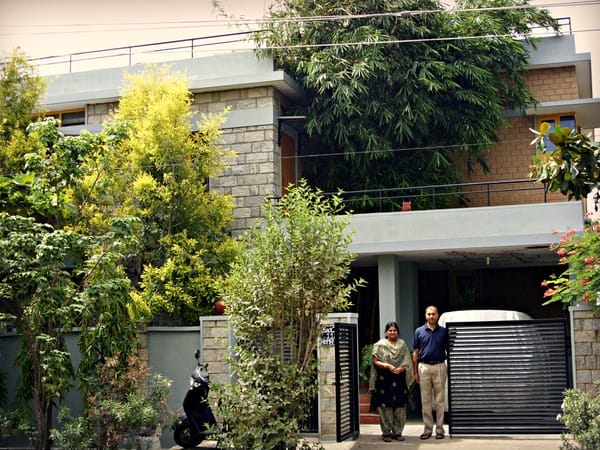
‘Hombelaku’- Kanavi residence in HSR Layout. Pic: Anisha Nair
A vintage brass bell hangs outside for a doorbell. Bright sunlight seeps through large skylights and a strong aroma of incense sticks greet you. This is HSR Layout’s famous green concept house. Karunaprasad Kanavi, 50, the son of Chennaveera Kanavi – the popular Kannada poet, and Vishakha Kanavi, 44, an artist, along with their son Kushal, and dog – Dhoni, are the residents of this beautiful house. The house is named Hombelaku after his father’s collection of poems.
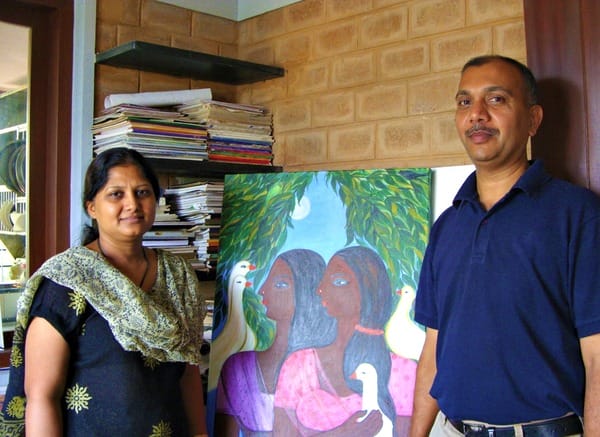
Karunaprasad Kanavi and Vishaka Kanavi. Pic: Anisha Nair
This 50×80 site with an area of 4000 sq ft, is an inspiration for the Bangaloreans who strive to be eco friendly. Out of 4000 sq ft total area, 2000 sq ft is dedicated to a garden space. This house has also been mentioned by the Center for Science and Environment, New Delhi under the sustainable buildings category.
The bricks used for construction has been made on-site with clay and mud blocks. The walls have not been plastered or painted to avoid lead. This also gives a beautiful natural texture. Simple kota and clay tiles have been used for flooring instead of mosaic tiles. This brings natural cooling in the house and lesser energy consumption in terms of fans and Air Conditioners.

Have you ever come across an eco friendly dining table? Pic: Anisha Nair
During power shortage, solar lanterns are used instead of the inverters or UPS to save electricity. Water is heated through solar water heater no electric geysers are used in any bathrooms. Two big skylights are used for lighting during daytime cutting down any need for electric lighting.
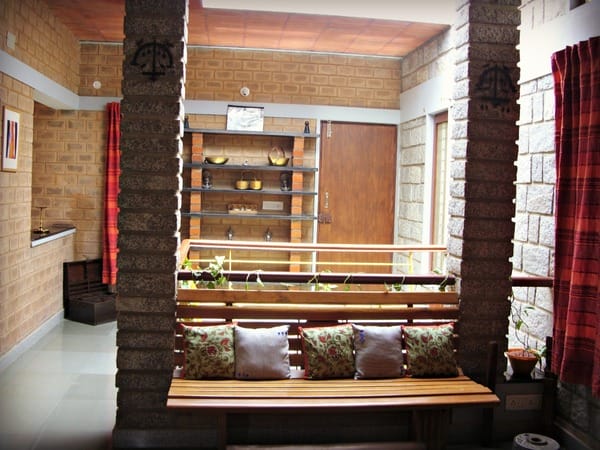
Natural lighting inside the house. Pic: Anisha Nair
This is not it. The Kanavi family completely believes in the three ‘R’s – Reduce, Reuse and Recycle. The grey water that comes out of the washing machine is reused for flushing in the ground floor toilets. Wet garbage waste is also recycled for preparing compost.

Pic: Anisha Nair
The beautiful garden, however is the highlight. The 2000 sq ft garden has trees like Ashoka, badam, neem, coconut, Mango, Chikku etc.,
Karunaprasad Kanavi, 50, the owner of the house, who is a general manager of a software company, says, “A middle-class man builds a house only once in a lifetime. So initially I was skeptical about the usage of mud and clay thinking that it might not be sustainable. But the architect Deepak Godhi convinces us that there will be no issues about it.”
He also adds that his wife Vishakha Kanavi, 44, who has done her Masters in Arts, also gave a lot of inputs for the designing of this house. Vishakha says, “Small parts of the walls inside are plastered with clay. So I can easily remove the old paintings and drawings and put up new ones.”

Paintings by Vishaka Kanavi. Pic: Anisha Nair
Excerpts from the Interview:
How did this whole idea of an eco friendly house come up?
My wife and I always believed in the conservation of environment, recycling and reusing. When we thought of building a house, we wanted it to be a completely eco friendly house with lots of open space. When we came across our architect, he told us about this idea. Initially we were skeptical as we thought that a mud and clay house might collapse easily. But when our Godhi convinced us, we were quite excited about it.
You used mud and clay bricks in the house. Are the mud bricks expensive than the normal bricks?
Yes, the bricks are a bit expensive than the normal bricks. But on the other hand, the clay bricks are larger in size so lesser number of bricks are required here. So it more or less costs the same.
What are your future plans related to the house?
I want to make the house run completely on solar power. So I am planning to install solar panels so that everything from the lights and fans runs on solar energy. I am just waiting for the prices of the panels to decrease a bit.
What do you think of HSR Layout as a place to live compared to the rest of the city?
The layout is planned with wide roads and also has Cauvery water connections in all the sectors. There are very few power cuts and there is an implementation of door to door garbage pickup by BBMP contractors. The layout also has many schools and parks.
But at the same time, there are issues such as bore wells are being dug up everywhere despite a proper water connection. Since this is a new layout, construction work keeps happening throughout the year leading to to air and noise pollution. Also there is very minimal bus connectivity.
I feel it’s a very good place to live in if small problems are solved.⊕