Spaces of serenity

National Geographic Traveller India (Indian edition of the American magazine) was launched in India in July 2012. 

The August 2012 issue cover story is on "Quiet Places, Spaces of serenity". 

While skimming through the magazine, we found a page for Bengaluru/ Bangalore where there is an article on the Someshwara Temple in Ulsoor, and below this there is a mention of "4 other spots for quiet time". One of the spots named is Puttenahalli Lake!  
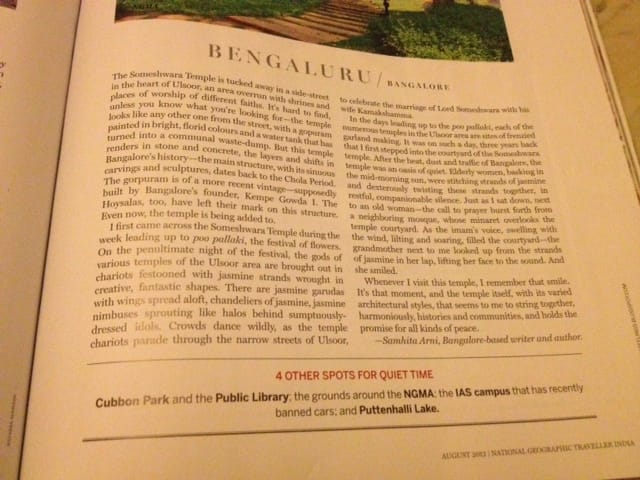
We would love to think that it is our JP Nagar Puttenahalli Lake that the editorial team means, but given that there is a Puttenahalli Lake in Yelahanka, we aren’t sure. Anyway, it is a pleasant surprise to see a Bangalore lake recognised as a quiet place, alongside Cubbon Park and the Public Library, the grounds around the National Gallery of Modern Art and the IAS campus (which we think should read IISc campus where motorised vehicles have been banned recently).  

Leave a Reply

Your email address will not be published. Required fields are marked *

Similar Story

Mumbaikars are fighting for their mangroves. Here’s how you can join them

Mumbai is about to face a monumental loss—its mangroves are being cut to build the coastal road. Citizens, however, have not given up the fight to save them.

​“What happens when we remove this natural infrastructure of the city? What happens if it floods? What happens if the air quality (index) goes really high?” asks Pooja Domadia, a member of the Save Mumbai Mangroves campaign. These are questions that many Mumbaikars have as work begins on the Versova-Bhayandar Coastal Road, which is set to affect 45,000 mangrove trees. In March this year, the Supreme Court dismissed a petition challenging the Bombay High Court order to greenlight the cutting of mangroves for the project. Is the SC decision a fatal blow to the movement? The BMC has already begun…

Similar Story

Where are the pollinators in Bengaluru?

Despite the volumes of citizen-generated data on the city's biodiversity, pollinators who sustain the urban ecosystem do not seem to be getting their due attention.

Urban biodiversity is often discussed in terms of tree cover, lakes, or flagship species, but far less attention is paid to pollinators—the insects and birds that quietly sustain urban ecosystems. In Bengaluru, a rapidly urbanising city with a strong culture of citizen science, large volumes of biodiversity data are now being generated by the public. But what does this data tell us about pollinators in the city? This article draws from a data jam hosted by OpenCity in Bengaluru that explored pollinator observations using publicly available, citizen-generated datasets. By analysing long-term observation records and spatial data on land use and…