On August 24th 2012, the Karnataka High Court, in a major verdict, has instructed Maverick Holdings, a construction company, to build 1512 flats in 24 months for the original allottees at the economically weaker section (EWS) colony in Ejjipura.
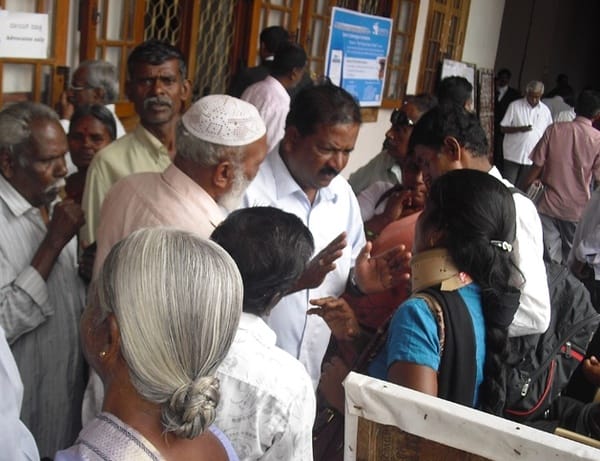
A group of allottees from the original 1512 beneficiaries waiting outside the High Court for the verdict. Pic: Sankar C G.
The decision came on a Public Interest Litigation (PIL) filed by 13 original allottees of the flats to be built at the EWS colony. The original allottees went to High Court after facing the prospect of unauthorised settlers at the EWS colony getting the new flats. The verdict came on the back of an agreement signed between Maverick, BBMP and around 60 original allottees who were petitioners in the case.
The court gave priority to the original allottees and their rehabilitation. Maverick has to start the construction from October 8th this year. By that time, the BBMP will have to identify all the original allottees, and Maverick has to take necessary steps for the rehabilitation of them, according to the verdict.
“The court’s priority is to get the flats for the original allottees without any fight. It should not go to the hands of any unauthorised people,” said Vikramajit Sen Chief Justice of High Court.
Aniyan Joseph, the advocate pleading for the original allottees is very happy with the High Court verdict. “All the 1512 original allottees will get a 312 square feet house. There will be a park, parking area, driveways, anganwadi, public health center, community center and a compound wall”, he told Citizen Matters.
All amenities and flats will be constructed in 7.25 acres land out of the total 15 acre. Of the 1512 original allottees, some of them were in the court. “We are so happy with the court verdict”, they told Citizen Matters. “It is Aniyan Joseph’s greatness that gave us this luxury,” said Meena S, an original allottee, full of praise of the advocate who fought it out for them.
As noted earlier, BBMP and Maverick have entered into an agreement with original allottees over the construction and rehabilitation. Citizen Matters has a copy of this agreement.
Major points in the agreement
- If the construction of the flats are left incomplete or did not commence, BBMP should take the necessary steps to finish the works.
- Original allottees are not supposed to lease out or sell the house for twenty years.
- Maverick has to maintain the common areas of EWS like park, community center, etc., for 32 years.
- A handbook of maintenance of common areas and the respective apartments should be signed by the respective allottees at the time of taking possession of the property.
- BBMP should ensure that the park, civic amenity and open houses are utilised as per the CDP for the specific purpose only.
- The project engineer will be appointed by BBMP.
- The construction of the building will comply with the requirements of CDP 2015 and existing building bye-laws.
Panel to identify the original allottees
The High Court has asked BBMP to form a panel to identify the original allottees and to monitor the construction works.
“BBMP has to take initiative for the formation of the panel consisting of BBMP commissioner, Chief Engineer, and an engineer nominated by CPWD (Central Public Works Department). The panel will decide who are the real allottees and monitor the reconstruction till the end,” said Joseph.

An original allottee with the sale cum agreemnet given by BBMP. Pic: Sankar C G
The original allottees would be identified on the basis of sale cum agreement deed given by BBMP in 2006 after the old building collapsed at the colony. Citizen Matters has a copy of this deed.
Relocation problem ‘solved’
Relocation and rehabilitation of original allottees was the other issue that delayed the court’s verdict. The land where the flats are to be constructed needs to be vacated for the work to start. BBMP’s suggestion of relocation to Iggalur, near Hosur Road, was not acceptable to the original allottees.
To force a settlement, the court finally asked BBMP, Maverick and the original allottees to have an out-of-court meeting to sort out matters. “In the meeting we took a decision to give Rs 30,000 for 300 original allottees for relocating to some other place. The rest of them have to be relocated to Iggalur or find alternative ways,” says Joseph.
The High Court has given 15 days time to Maverick to give Rs 30,000 for the relocation of original allottees. Court also gave six weeks time for Maverick to construct temporary houses at Iggalur for the rest of the 1512 allottees. As per the agreement, BBMP has to ensure accessibility of roads, medical facilities and transportation in the rehabilitation site.⊕
- Unauthorised residents may get new BBMP flats
- High Court mounts pressure on BBMP, Maverick to resolve Ejipura quagmire
- Unauthorised residents may get new BBMP flats
- High Court mounts pressure on BBMP, Maverick to resolve Ejipura quagmire
Related Articles
Unauthorised residents may get new BBMP flats
High Court mounts pressure on BBMP, Maverick to resolve Ejipura quagmire