S Laxminarayan, 36, a software engineer by profession, is also a part-time urban farmer. He aims to get people started on kitchen gardening. He is a co-founder of Garden City Farmer’s Trust that aims to spread awareness on organic farming. He lives in ISRO layout with his wife Sowmya M, a physiotherapist.
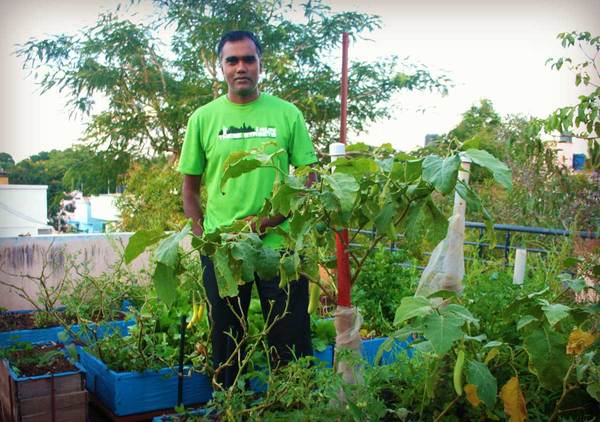
S Laxminarayan. Pic: Abhishek Angad
Excerpts from his interview.
You use a bicycle for commuting while your motorbike and car are covered in dust. Are you a green enthusiast?
Well, I am just getting ready for the future. Natural resources are depleting due to use and abuse of it. So I thought of using a bicycle, at least doing my bit. Also, this was the apt moment to buy as petrol prices are going high.
Why did you get into urban farming all of a sudden?
It happened during the financial crisis, around 2008. I was scared of losing my job. And I started wondering, what kind of sustainability we have. I wanted go back to the basics and develop ways to sustain myself. I also met Dr B N Vishwanath (former UAS Professor and an organic farming expert), my dad’s friend and at his place, there was a tomato plant. It made me think, why can’t I grow that? I also realised whatever I am eating, however beautiful it may be, I am not sure whether it has come without chemicals or pesticide. There was also a lot of noise about ill-effects of the usage of endosulfan. So all this led me to farming.
Do you think people really care about going green?
It’s very difficult to generalise. There are three kinds of people – one, those concerned about environment and practising sustainable means. Second – are those people who remain on the edge (undecided). These people just needs to be educated. Third, are the kind of people who don’t care at all. For them the natural resources are infinity.
Does this require any agricultural background. What do you grow? Does it suffice?
Though I got tips from my parents as they practised agriculture, one really doesn’t need any farming background to start farming.
I grow veggies like tomato, brinjal, spinach and fruits like grapes which I have started recently. It won’t suffice for daily needs but I remember the producing around 25 kgs of tomato and 6 kgs of brinjal from Jan to April, 2012.
So how is the concept of urban farming evolving?
There’s nothing new in this practice. People want to contribute something towards saving the environment. Also, people have become aware that food that they are eating may not be free from chemicals.
What does Garden City Farming Trust do?
It’s an NGO formed to popularise urban farming. Our motto is ‘grow what you eat and eat what you grow.’ We hold workshops and train interested people and we are open to all. We also organise our flagship event-’Oota from the Thota’ where people can learn about organic kitchen gardening.
Also, lot of farmers have migrated from villages in search of work. Now who’s going to grow food for us? Through our NGO we are trying to reduce this gap.
We are also working with loyola school, where we train students about terrace gardening. It’s very important that the kids know about the process of agriculture.
Do you also exchange ideas with other NGOs?
We are open to working together. We work with Vanastree for participating in Malnad Mela and work with Green foundation for saving seeds.
How has social media helped you?
Ah! It has helped a lot. We have started facebook community page-” Organic Terrace Gardening” where we have close to 1100 members and we try helping out everyone queries related to farming. The medium has helped us to share the knowledge with lot of people.
How do you get time for terrace gardening while balancing personal and professional life?
If you have passion for something you will always find time. I spend about 30-45 minutes on weekdays and on weekends I spend a little extra.
Would you call this a form of therapy?
It feels satisfying, I am so happy that I am actually taking care of my health. Also, you feel satisfied when you eat what you grow.
Any plans to set up a grocery store or dining place?
Not as of now. I am worried we will become business minded and the real quest for knowledge gaining and sharing will decrease. But if someone comes in with an enterprise idea, we are there to help.
For your daily needs where do you buy vegetables from?
It’s very hard to determine if the vegetables have been grown without chemicals. However, I buy veggies from the store set up by Bangalore horticulture department, as it is set up with a vision to help the farmers and consumers.
Do you play any sport?
I play a game called ultimate frisbee on weekends, sometimes on weekdays too. It is a sport with a disc, a mixture of football, basketball and rugby. I also run and have participated in events like the TCS 10k.
Any favorite place in Bangalore?
I like south Bangalore, it still has some greenery.⊕