“Tower pots” lie as waste

Last week, some "columns" made of plastic (of terracotta look, complete with fake "burnt" patches, with rectangular frames on top for advertisements, suddenly made their appearance on M G Road.

All the newspapers picked up on this uglification of the scene, and also remarked on how these ugly things were supposed to be beautifying Bangalore but were actually put there to fetch further revenue for BBMP (which seems to have developed a bottomless thirst for raising cash) through ads in the rectangles. The columns were impeding traffic and Deccan Herald pointed out how one pedestrian had been injured by a badly-placed one.

The "tower pots" quietly disappeared.

On Saturday, I found a whole lot of them piled up at Mayo Hall.
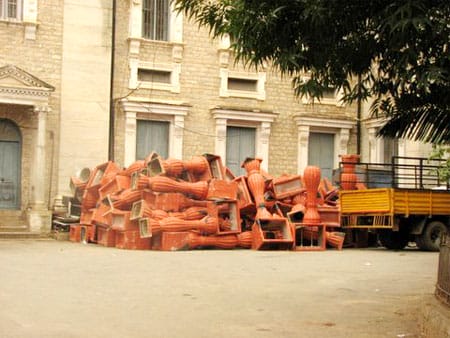
Tower Pots piled up at Mayo Hall

How much was spent on these "pots"? Who gave permission to put them up? Who gave the order to move them away? Why is BBMP so opaque about its spending, and why is it not accountable to the general public about such wastage of money and effort?

Would it be frivolous to file a PIL about the wasteful, profligate ways of the BBMP? They don’t seem to have money to repair the pavements but are perfectly willing to squander money on such ugly, foolish things….

Leave a Reply

Your email address will not be published. Required fields are marked *

Similar Story

Shaping Bengaluru: “Citizens can add real capacity through local knowledge, feedback”

We spoke to authors of the Janaagraha report, ‘Shaping Urban India’ to understand its recommendations in the context of Bengaluru.

“The road is broken, buses are overcrowded, traffic disrupts daily life, garbage piles up on the streets”—these are everyday complaints of citizens across Indian cities. In Bengaluru, these issues only seem to be worsening with passing time. Bengaluru’s built-up area grew by 85.19% between 2001 and 2020, resulting in commuters losing 168 hours (one week) annually to traffic congestion. As the city grows rapidly, governance systems, data frameworks, and citizen participation have failed to keep pace with its increasing complexity. What would it take to bridge this gap?  A report by Janaagraha, a non-profit working to improve the quality of…

Similar Story

India Civic Summit 2026: Spotlight on changemakers transforming cities

From waste management to urban forests, the Indian Civic Summit spotlights residents that are driving change in their cities

Cities are the heart of the Indian growth story. Vibrant. Crowded. Diverse. Multidimensional. And yet, as we look around us, we find that they are ridden with problems and face multiple threats to their ecology, habitats and human lives. The crises in our cities make it hard to imagine an urban future that is truly inclusive, sustainable and marked by high liveability standards. But as the oft-cited quote from anthropologist Margaret Mead goes, "Never doubt that a small group of thoughtful, committed, citizens can change the world. Indeed, it is the only thing that ever has."  That is perhaps the…