
The newspaper write-up for Dustin Bayi describes the play as "the complex relationship of a Christian family with local rituals and belief in spirit worship". Further "a powerful plot, reputed artists, authentic sets, music, and colorful costumes make this play a must-watch". This write-up seemed exciting enough, particularly in the light of the recent incidents with churches in Mangalore and Bangalore. Also, the play being staged on Christmas Day seemed symbolic as the occasion to watch it.
The plot
Pic: Kriyative Theatre
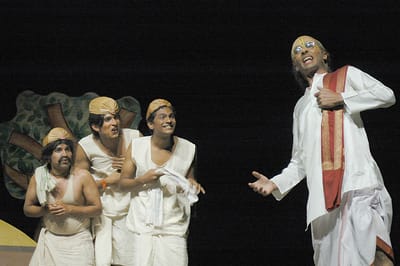
Dustin Bayi is a short story by Gopalakrishna Aithal. It is adapted for the stage by S Ramakrishna and directed by Krishnamurthy Kavathar. The story begins with Antony, a pensioner from the British Army before the days of Indian independence, who is given some land in a village near the coast. The village is the heartland of Hindu rituals; this is established by means of a dance in the beginning of the play. Although the villagers are initially wary of him, he soon wins their hearts over.
He is generous with his money and buys them free liquor. He proves his bravery by shooting a tiger prowling the jungles, and he regales them with his tales of the wars he has been in. The villagers help him with his land, and soon the fields are full of produce. That he is a Christian does not seem to bother his friends, except for the priests who threaten to set spirits to ruin him.
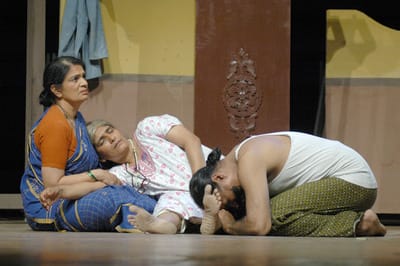
He soon brings his aged mother with his wife Dustin Bai to the village. At this point, things look bright and sunny for the family. Dustin is pregnant with Antony’s child, and her mother-in-law eagerly anticipates the birth of the little one. However, the ailing old lady suddenly passes away. The slide into bad times begins at this point.
Soon after the passing of Antony’s mother, Dustin has a stillborn baby. Dustin appears to be haunted by the threat of the elders to set the spirits on their family. This is reinforced by village gossip, the fact that Dustin’s mother-in- law and child died within a three-month interval cannot be explained away.
Antony, however, is inflamed by this idea and declares it nonsense. In the aftermath of this incident, Dustin becomes moody and temperamental, a transformation from the sweet bride and daughter-in-law. Antony is too busy spending his time with his villager friends in the liquor shop. A series of incidents quickly happen from here.
Pic: Kriyative Theatre
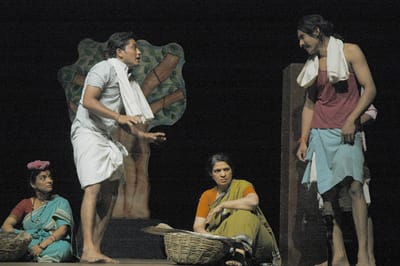
Dustin decides to sell fish to alleviate her boredom. One day at the market, she is accosted by the lecherous Shripathi. She teaches him a lesson by beating him up, but this is seen in a bad light against a religious backdrop. She longs for company during the day. Her wish is soon granted when she becomes pregnant again. She dreams of a rosy future for her son, of his getting a government job and a beautiful wife and so on. At the back of her dreams is the threat from the spirits.
However, their son Inthru is a different kettle of fish. Dustin spoils him, and he turns out be a vicious and vengeful child. He drops out of school and gets into bad company and the vices of liquor and cigarettes. Antony suspects his doings but Dustin turns a blind eye. Things come to a head when Inthru is accused of raping a village girl and drowning her in the river.
Dustin is still foolishly unbelieving while Antony is deeply hurt. At this point, the tale takes a religious twist. The Christian community rescues him from the clutches of the law, and he is sent to the army due to the influence of a big man in the community. Dustin believes that this all God’s handiwork-her son is now going the right way as per her dreams. Antony alone realises the implications of overlooking Inthru’s misdeeds, and he dies perhaps of shame.
With Antony dead, Inthru’s true nature is completely revealed. In the army his misdeeds continue. H e is caught selling ganja to the men, and he is court-martialed and thrown out of the army. Upon his return home, he tries the fish business with a bank loan that he squanders away. He ignores the pleas of Dustin and his wife Anita, and cares little for their son Antony. Eventually, in a drunken quarrel he winds up killing Anita.
Dustin is now completely disillusioned and longs only for little Antony’s well being. The matter of the spirits surfaces in her mind, and she succumbs to the blasphemed idea that they can be appeased by a Hindu ritual. Inthru is enraged by her spending money on the ritual and decides that killing little Antony is the way to get the money she has saved for the ritual. As a conclusion, Dustin finally strangles Inthru, in her own way releasing the ghost that had haunted their household.
Script and direction weren’t intense
The performances in the play are excellent. Laxmi Chandrashekhar (Dustin) and Ashok Kumar (Antony) dominate the stage with their presence. The secondary actors provide able support. However, the script and the direction seem to drop the intensity. The script seems unable to transition from a short story to a play. Though incident packed, there is little drama.
Pic: Kriyative Theatre
The direction also seems to reflect this difficult transition. For example, Antony and his mother simply fall down and die in a very undramatic and teleserial fashion. As a short story, the tale can make one pause and think. However, as a play, things happen too swiftly for the audience to register the implications of the thoughts and actions in the story.
Somehow, the powerful religious undercurrent is never explored. Does Dustin believe that a Hindu ritual can appease the spirits because perhaps she was a Hindu before she converted to Christianity? What about the havoc that organised religion can play on the minds of people? These questions could have been better explored. It is easy to play an armchair critic sitting safely in the darkened section of the audience and take potshots at everyone, but somehow you feel the disconnection, and this is echoed by the audience’s lack of energy and reaction to many scenes.
The lighting is adequate but Muddanna seems to be in a hurry sometimes, as the emotions are not allowed to register before blackouts. The music by Gajanana Naik (another well known theatre name) is very apt. But it is used too often-you feel that there is an overdose of aural reinforcement to the scenes.
Despite such distractions, the play holds its own due to the strong performances by the actors. If you find yourself sitting in the audience for the show, you will not be bored for certain, but it is difficult to make a choice to go and watch the play for a second time.
However, from a broader point of view, it is a pleasure to watch Kriyative Theatre ceaselessly churn out consistently excellent performances. Dustin Bayi appears like a small blip in the radar, and it cannot prevent one from looking forward to Kriyative’s next efforts.