A few days ago I was at a junction where the traffic signal wasn’t working and cops were not to be seen. All hell had broken loose and there were vehicles turning in every direction, as a result of which no one was moving.
Tempers were rising and honking crossing all known limits of sound pollution. I was right at the front and seeing the mayhem ahead I tried to stay put, in order to not add to the utter confusion ahead of me. A few sensible drivers stood by too.
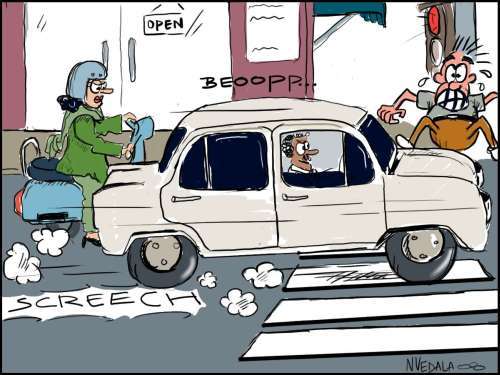
Illustration: Narasimha Vedala
But as usual there was one impatient driver who honked and yelled. He was asking me to move ahead. I moved aside and asked him to go forward. He went ahead, loudly wondering how I had managed to get my driving license. Not very surprisingly he didn’t get too far ahead. And there it was – for full five minutes four vehicles facing each other, honking and not knowing which way to go!
What makes people drive like there is no tomorrow? Are these remnants of evolution we have supposedly grown beyond? Yes, evolution. Remember evolution? Remember how men had to go out and hunt for food and for survival? And once they had figured out a civilised way of life, hunting became a sport, an adventure. But as we evolved further, there were less and less opportunities for blood sport; certainly so for the common man.
The inventive men found newer ways of seeking such pleasure. And I do believe driving is one of them. However, not everyone can afford Formula 1 racing.
But they discovered that breaking rules that they themselves had made up in the first place, gave them pretty much the same high, that too within acceptable social, if not legal norms. In comes city driving. Skip lanes, honk at hapless small vehicles stuck in the legal speed limit range, make pedestrians beat Usain Bolt’s record in order to save their own lives and when there is no one looking, even skip a red light. All in a day’s work.
No wonder women are considered are bad drivers. They stick to rules. Wait for the traffic light to turn green, think twice before honking at a pedestrian and they absolutely refuse to get down give a good show when they accidentally ram in to someone’s vehicle. Instead they apologise and show remorse. Where is the fun in all that?
⊕
It was a shock to misunderstand from the headlines . But the text really supports women who are good drivers and humans on the road respecting the road rules. Standing at a zebra crossing, anyone can spot all the men drivers blatantly disobeying all norms and rules of road behaviour. Until the roads are manned by sincere , non-currupt Police, we cannot enforce road disipline in this city of chaos.
Absolutely….women’s driving is no fun…that’s why I’ve taken to going by bus 🙂
There is connection between the headlines and the text ! its misleading and seems as though you somehow want to increase traffic to this article – which is otherwise a pedestrian stuff.
What’s up, folks ?