Five years since the international community agreed to the list of 17 UN Sustainable Development Goals or SDGs, achievement of the sixth (SDG 6) — ensuring inclusive access to clean water and sanitation facilities — remains a far cry in Indian cities.
What obstructs inclusive and resilient access to water, sanitation, hygiene (WASH) and healthy spaces for all urban dwellers?
What are the challenges specific to Indian cities, especially the metros?
Are there successful experiments led by communities or organisations, using either technology or nature-based solutions, that can be showcased and scaled to bridge the gaps that exist?
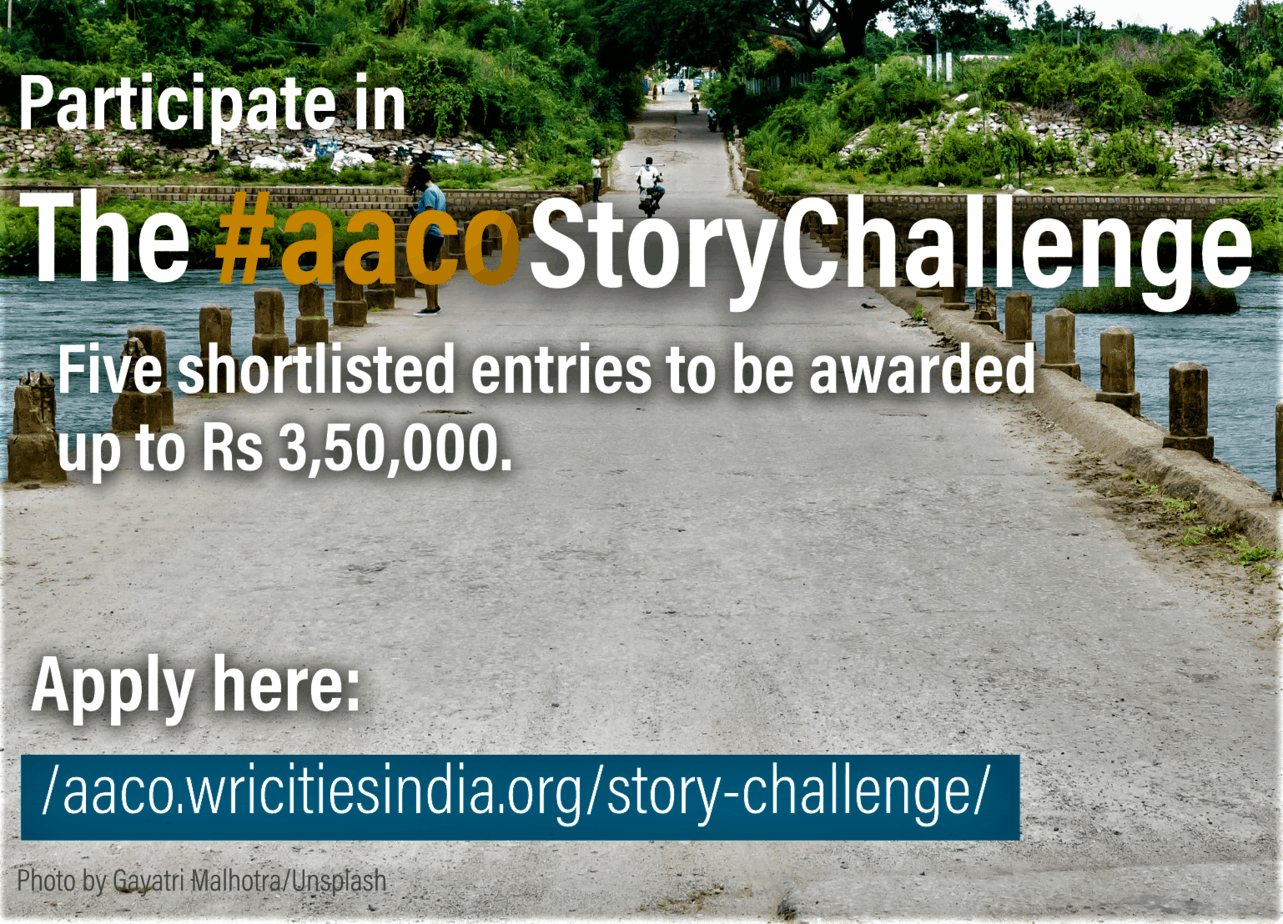
To probe deeper into these questions and explore solutions, WRI India, in collaboration with Citizen Matters, is launching the #aacoStoryChallenge with the theme ‘Improving citywide inclusive and resilient access to WASH and healthy spaces in India’.
The Accelerating Access Coalition (aaco) is a collective action model of a community of core partners that aims to improve citywide inclusive and resilient access to WASH and healthy spaces for all.
Who can apply?
The Challenge invites entries from freelance writers, communicators, scholars, independent directors and videographers, based in India.
They should be interested in urbanization, sustainable development, climate change, water or related issues and must be passionate about documenting challenges faced by vulnerable communities in the WASH sector as well as developments regarding the same.
What are we looking for?
The Challenge invites entries in the form of 300-500 word proposals for text articles, photo features, videos or vlogs, that will look at particular city-based WASH challenges and interventions.
Entries are welcome from all cities in India, but preferably Delhi, Bengaluru, Mumbai, Kolkata, Ahmedabad, Chennai, Surat and Hyderabad.
The award
Five shortlisted entries will be awarded Rs 50,000 each (text-based story/photo story) and Rs 1,00,000 each (video story).
Domain experts from WRI India will assist selected writers in contextualising and analysing the issues broadly, while experts from Citizen Matters will provide editorial guidance and direction in the production of the final feature.
The final stories/features will be published on Citizen Matters as well as the WRI website.
The last date for sending in your proposals is December 20, 2020.
To know more about the aaco platform, the Story Challenge and how to apply, check out https://aaco.wricitiesindia.org/story-challenge/