‘I can’t risk passing on an infection to my baby’
‘Giving a stranger’s milk to my baby feels weird’
‘I will not be able to feed my baby if I donate the excess milk.’
These are a few misconceptions among new mothers that deter them from donating to human milk banks or accepting milk from them. To be fair, human milk banks are a relatively new concept in our cities. The World Health Organisation recommends mothers worldwide to exclusively breastfeed infants for the child’s first six months to achieve optimal growth, development and health. But there are many mothers who cannot breastfeed their babies due to problems in lactation or other complications. But such mothers can opt for milk from human milk banks, where mothers with excess milk can donate.
The objective of these banks is to ensure that all newborn babies can be fed mother’s milk, thus discouraging formula milk for at least six months.
Unknown to many, the number of human milk banks is increasing in Chennai, with a lot of private hospitals following in the footsteps of government hospitals such as RSRM hospital, Institute of Child Health and Hospital for Children (ICH) etc. However, neonatologists say that it is a huge task to motivate mothers to donate excess milk. Myths such as the above prevail among both donors and recipients of human milk, which remains the biggest challenge in the functionality of these milk banks.
“There is a deficiency of 100 ml to 200 ml every day at the hospital, despite back-to-back awareness sessions on the importance of breastfeeding and donation,” said Dr Kamala Rathinam, Head, Neonatology, ICH. ICH gets an average of 1,200ml to 1,500ml every day.
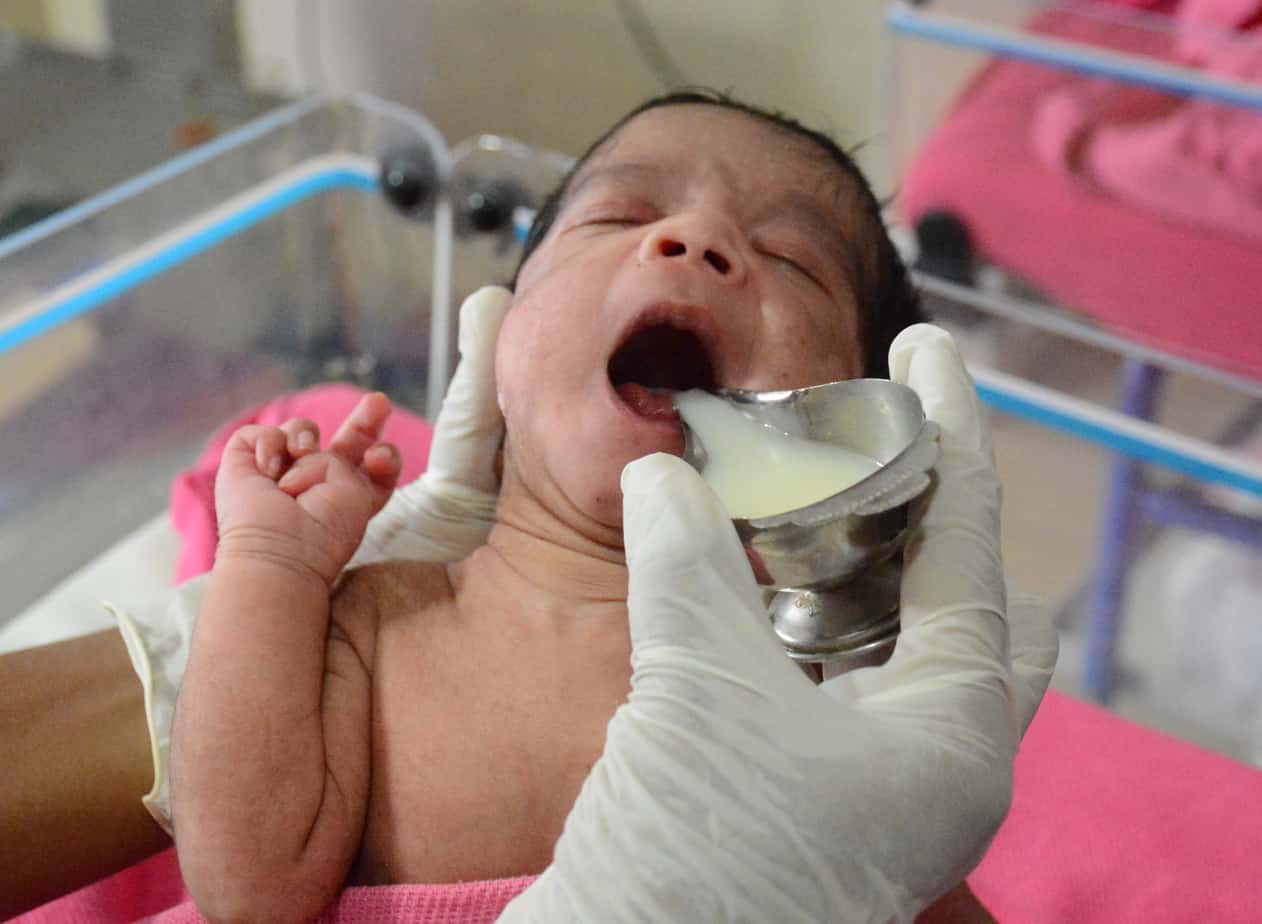
A baby is fed milk from the human milk bank at ICH, Egmore. Pic: Laasya Shekhar
Busting myths around feeding borrowed milk, Dr Shanthi, Assistant Professor, Neonatal ICU, RSRM hospital said that a thorough procedure is followed to ensure that the milk is safe. “ We sterilise and run the necessary tests in the lab to rule out the growth of microorganisms. The milk can be saved in the hospital for up to three months,” said Dr Shanthi.
The hospital educates new mothers in the hospital about the ‘why’ and ‘how’ of donating milk. Every day, 30 to 80 mothers donate the milk to the facility. The one and half year old facility at RSRM hospital thus receives 5 to 8 litres of breast milk a day.
|
List of human milk banks in Chennai
|
How to avail services
- In Chennai, you can visit any of the above human milk banks, with a letter from an authorised doctor about the mother’s inability to produce the milk. All these facilities supply milk for free.
- Mothers who encounter issues with breastfeeding can visit any of the government maternity hospitals. “It is important to know why they cannot lactate. Many times, it is linked to stress that could be solved by proper diet and rest,” said G Shanthi, a nurse in charge at ICH.
- The mother should sign a consent form at the hospital, indicating willingness to opt for donor’s milk.
- The amount of milk given to an infant depends on availability of the milk. In the city’s government hospitals, priority is given to the infants who are born in the hospital itself.
- The sterilised and stored milk is given in a steel container to the mother.
Looking for mothers milk donor urgently for mother less baby in Chennai please. Any breast feeding mother willing to donate please help. Thanks for looking please.