Home to several prominent hospitals, malls, office complexes, restaurants and residential areas, Parel is a busy, bustling ward in central Mumbai. With more public spaces, the responsibility of waste management and effective ways to manage it rests largely with the Brihanmumbai Municipal Corporation (BMC). And the civic body has done well. Parel, or the F/S Ward of Mumbai, has the best performance in solid waste management, according to recently released report on civic issues by Praja Foundation.
The report goes into the details and statistics of solid waste management (SWM), sewage treatment, and pollution among other civic issues. The report also gives a comprehensive overview of the performances of all the wards in Mumbai. Parel and neighbouring areas, which fall under the F South (F/S) ward, has best or second best performance in most of the categories making the best ward overall in terms of solid waste management.
How did the citizens and the BMC manage this feat?
What is the SMPA scheme?
The F/S ward, among others, has rigorously implemented the Swachh Mumbai Prabodhan Abhiyan (SMPA), which streamlines the waste management process in the region. Dhiraj Bangar, senior engineer F/S, who heads the SWM department says that the SMPA is a public participation scheme. This scheme is particularly implemented in the slum areas, where they try to get the participation of the residents. Through local NGOs, they provide employment opportunities to the people.
Work includes waste collection, cleaning of sewers, sweeping. Every employee under this scheme is allotted 150 houses and has to look after the cleanliness of the designated area. They are provided with basic wages. They are employed through a lottery process that is conducted every six months. All those who qualified in the scrutiny, they make a lottery out of them and the work is assigned to them. One condition that the person needs to fulfill is that they should be belonging to the same area.
“We assign people to the area that they belong to, so they it really well. This increases public participation and response, which in turn helps keep the area clean,” says Dhiraj.
Segregation and recycling
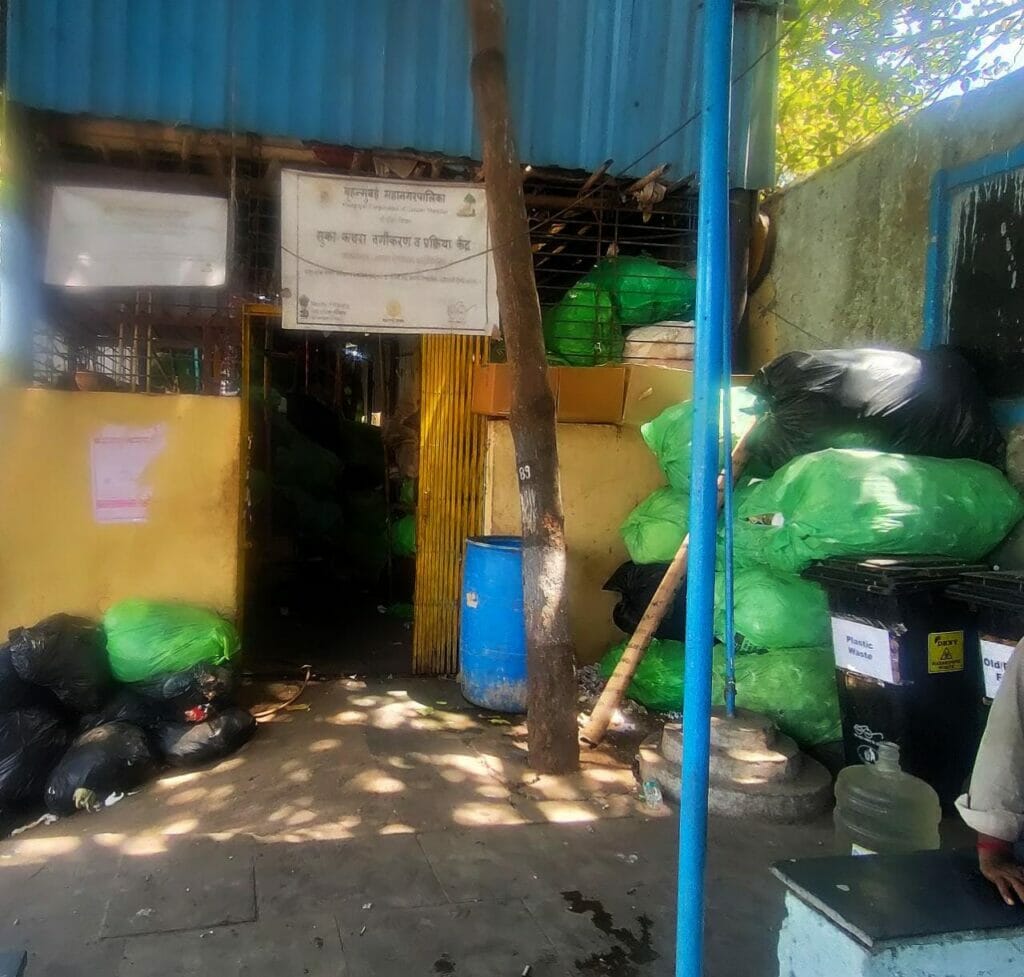
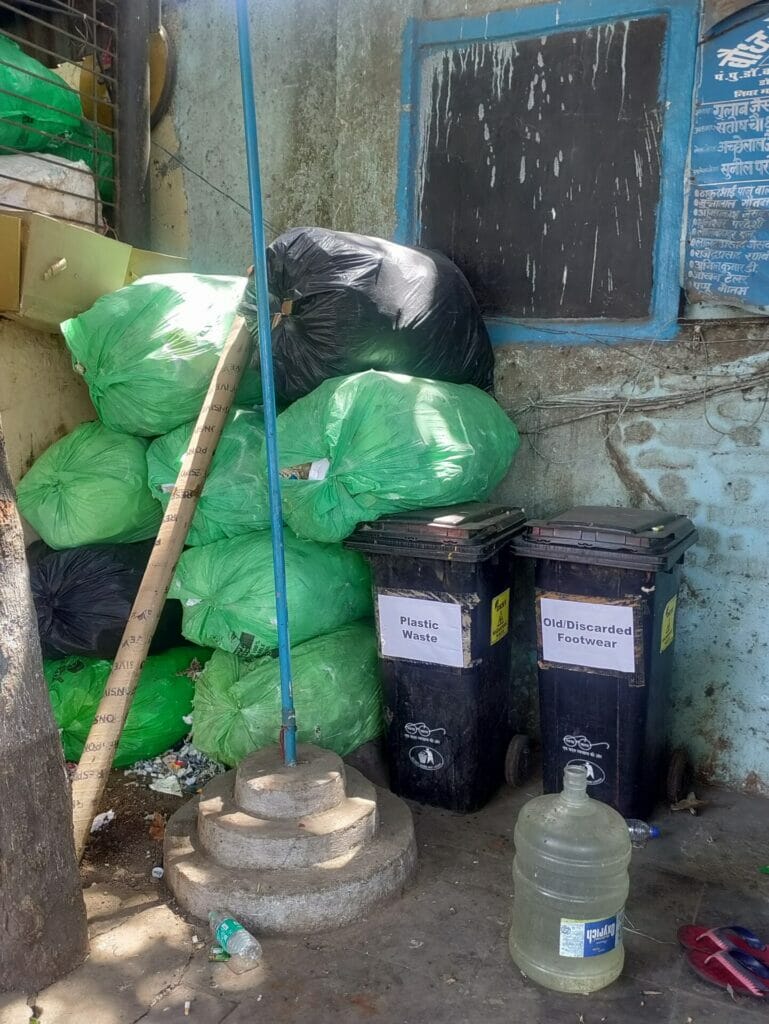
The ward has the second highest amount of dry waste collection, indicating that garbage segregation is going well. To deal with this high amount, the BMC has given dry waste centres to some local NGOs, with necessary permissions. Approximately 18 such centres are operational.
An officer at a dry waste segregation center in Lower Parel, “All the dry waste collected from neighbouring societies comes here by a tempo everyday. There are around 5-6 employees here who segregate the waste like in terms of bottles, electronic waste, hazardous waste etc. Another tempo comes daily, and the segregated waste is collected by it and taken to a recycling center, or a dumping ground. We ensure that the segregation is carried out perfectly.”
According to Dhiraj the NGOs collect segregate the the dry waste further on the basis of different categories like paper, hazardous waste, bio waste. This helps the BMC in recycling it effectively, even if the quantity is high.
And so, expectedly, the Praja report also notes that it has the lowest amount of dry waste sent to dumping grounds, implying successful recycling. The BMC has created linkages from dry waste collection to recycling, involving different agencies so that the segregated waste does not end up on landfills.
A center in the same ward services the garbage trucks and tempos and dispatches them for their assignments. Wet waste is sent to dumping grounds in Kanjurmarg and Deonar.
Read More: Mumbai’s no.1 source of trash: Food waste
Spreading awareness
The BMC in the F/S ward is constantly involved in many activities to create awareness about waste segregation. According to the law, every household is required to segregate its dry and wet waste. The BMC has the power to prosecute if someone fails to segregate. They take action on various societies that fail to segregate their waste.
In the F/S ward, some routes/trucks are exclusively meant for wet waste and dry waste and the staff is trained to only collect the particular type. Other routes may have mixed waste too.
BMC carries out its sweeping activities usually on the morning, not in the afternoon. However, under the Manning Mopping scheme, which is a scheme under the SMPA, wherein sweeping is also carried out in the afternoons in areas with high footfall and VIP roads. At main roads, sweeping is carried out by MPS or mechanically powered sweeping.
Challenges and citizen participation
It’s not all great always, though. Several civic officials spoke about challenges such as various roadside dumping spots, lack of civic sense and poor response to the schemes.
Dhiraj laments that the public considers waste segregation to be BMC’s work. He says the BMC partners with many NGOs to conduct door to door campaigns to spread awareness about the issue, conduct street plays, and put up posters, hoardings and banners. The main hurdle is segregation. If that is carried out effectively, less waste will go to the dumping grounds, he emphasises.
However, compared to other wards, many more residential societies in Parel actually segregate their waste. Mrs. Patil, a resident said, “Garbage is collected separately, dry and wet, in our society. The housekeeping staff are trained to refuse to collect waste that is not segregated.”
The focus on solid waste management has ensured smooth segregation and recycling processes. Overall, implementation and due follow up of schemes for waste management by the civic body and the citizens in the F/S Ward, has made the area a better place.