Sanitation woes
Public toilets in the city have come under the scanner for poor maintenance, lack of facilities and sheer inadequacy in number required to cater to a population the size of Chennai’s. A subset of this issue is the lack of access to toilets for women. Dhagam Foundation’s recent event, Kakkoos-a-kaanom highlighted this problem plaguing people from all walks of life, especially women. The NGO had undertaken a meticulous social audit that covered 613 public toilets across the 15 zones in the city. A perception survey was also conducted among 1351 individuals on the myriad issues that prevent them from using public toilets.
The Reasons
The survey conducted by the 50-strong volunteers of the NGO quizzed people on why they shun the usage of public toilets. Some of the key reasons that emerged from their conversation were:
- Toilets were found to be unclean
- Toilets were found to be foul-smelling
- Toilets were found to be locked
- Toilets were found out-of-order
- Fear of disease as a result of public toilet usage
- Fear for safety while using public toilets
- Lack of locks or broken locks in toilets
- Lack of trash cans in toilets
- Inability to locate public toilets
- No space to leave belongings
- No vending machines for sanitary napkins
- No means to dispose sanitary napkins
- Unsuitably designed for use by the differently-abled
The Wishlist
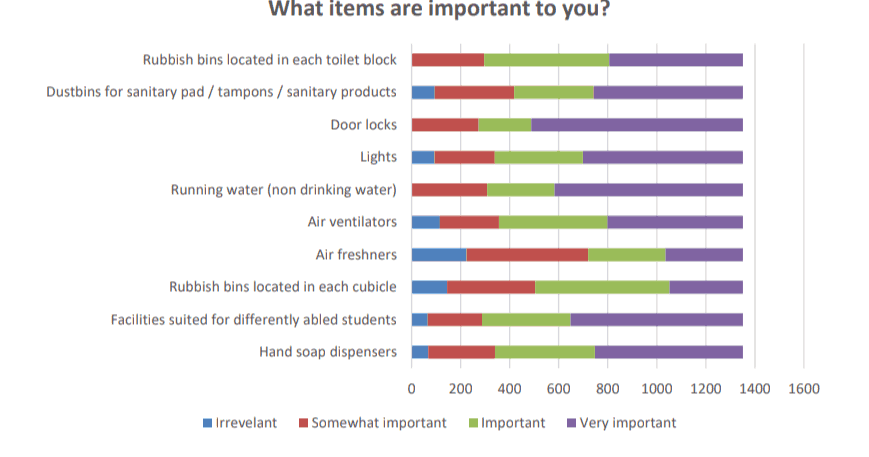
Out of the 1352 respondents, 62.5% felt that the number of public toilets in the city is insufficient. With regard to amenities that are vital for public toilets, 66.6% said that functional locks are vital, 61.1% lobbies for proper running water and 54.1% called for inclusive toilets that can be accessed by the differently-abled.

Source: Dhagam Foundation
Source: Dhagam Foundation
Shifting the focus to facilities that women wished to see in public toilets, the survey found that the main necessities were functional locks, lights, facilities such as changing tables for babies, sanitary napkin vending machines and disposal facility and trash cans in each cubicle.
A majority among the respondents cited the inability to locate public toilets, a concern that the surveying team also shared during their social audit. To remedy this, the respondents’ suggestions included locating public toilets at places that see high footfall – sites of worship, railway stations, bus stands, schools and colleges, parks and playgrounds, arterial roads, shopping malls and restaurants.
What next?
The impact that lack of access to toilets has on citizens is far reaching. While the city has prematurely declared itself open defecation free, the ground truths do not corroborate these claims. Some respondents in the survey even admitted to preferring defecating in the open as opposed to using public toilets that fell short of their requirements.
“With the release of the report and our findings, we hope to catch the ear of the authorities. Out initial idea was to push for toilet facilities for each household. While that remains a larger goal, for now we would like the authorities to at least renovate and revamp the existing facilities according to the needs of the public, especially women and differently-abled persons. We hope to see the formation of the Chennai Toilet Management Board (CTMB) so there is a nodal body that can be approached for all issues related to public toilets in the city”, says Akash Madhi, a trustee of Dhagam Foundation.
Lalitha S, an urban planner, says “Such events are extremely crucial .These conversations must be had by the public and with the authorities. It is impirimpo to highlight what the gaps are and hope that the civic body is listening to the needs of the people.”