India sustains 16 percent of the world population with only 4 percent of the world’s water resources. With the rapid growth and expansion of metro cities like Chennai and Bengaluru in South India, providing safe drinking water is one of the biggest challenges that the region faces today. One of the major challenges to tackling water stress is the ongoing mismanagement of resources that has led to the overexploitation of water resources, particularly groundwater.
It has been predicted that in South India, climate change would affect water resources in terms of, increase in both drought-like situations and flood events, change in groundwater quality and groundwater recharge, and increased saline intrusion of coastal and island aquifers due to rising sea levels. Therefore, it is important to leverage technological expertise to explore innovative solutions to these problems and at the same time generate awareness about water sustainability in the region.
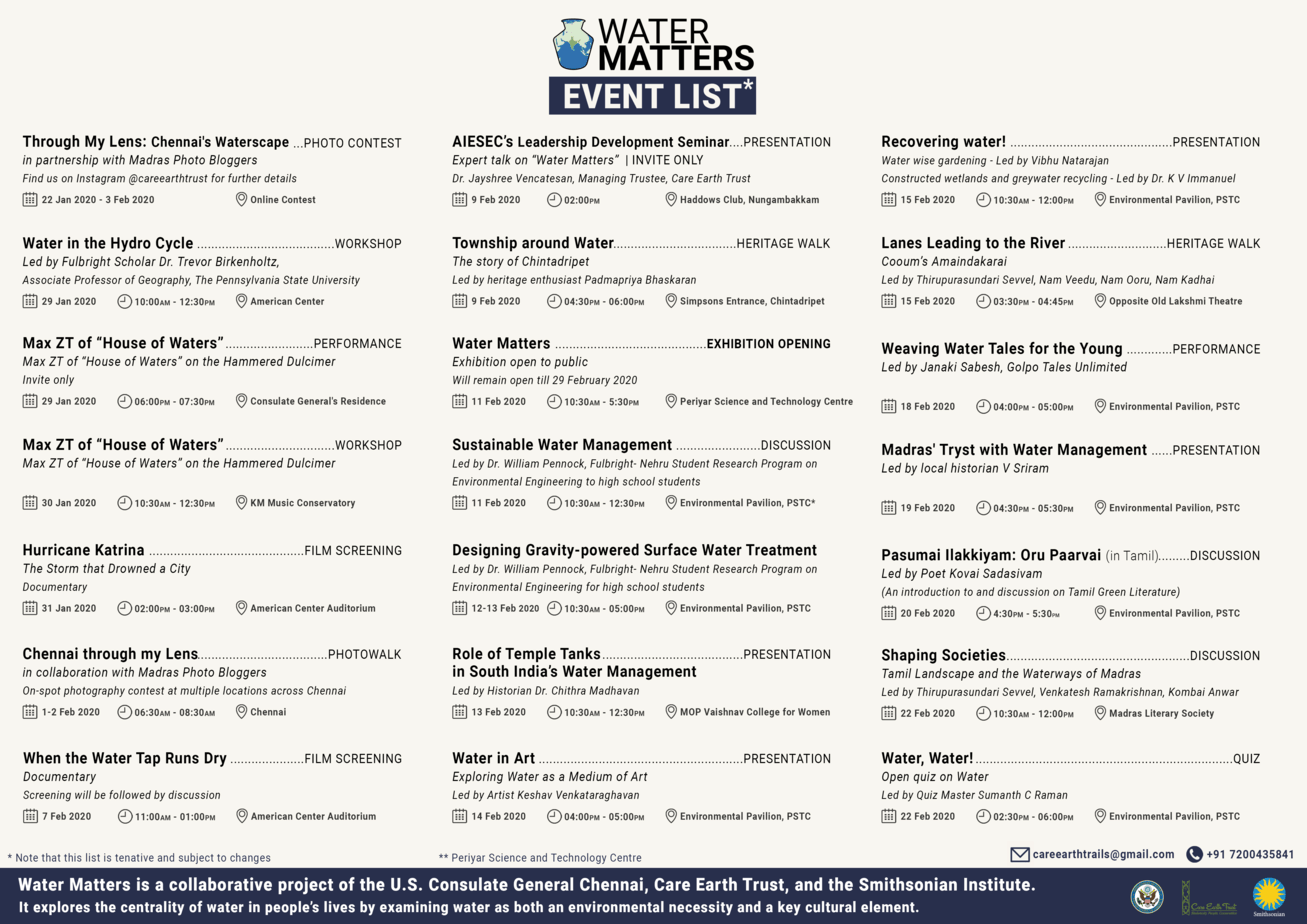
| Date: Open until February 29, 2020
Time: 10:30 am to 5:30 pm Venue: Periyar Science and Technology Centre, Gandhi Mandapam Road, Chennai Note: Open to all | Entry free |
In many cities in South India, the limitations in groundwater availability and unreliable piped supply have led to an increase in demand for private water supply, which is largely informal as it is not monitored by any regulatory agency in terms of quantity of water extracted, quality as well the economic value of water in the system. Therefore, it is important to leverage technological expertise to explore innovative solutions to these problems and at the same time generate awareness about water sustainability in the region.
Water Matters, a collaborative project of the U.S. Consulate General Chennai, Care Earth Trust, and the Smithsonian Institution is one of a kind in the country that explores the centrality of water in people’s lives by examining water as both an environmental necessity and a key cultural element.
About the exhibition
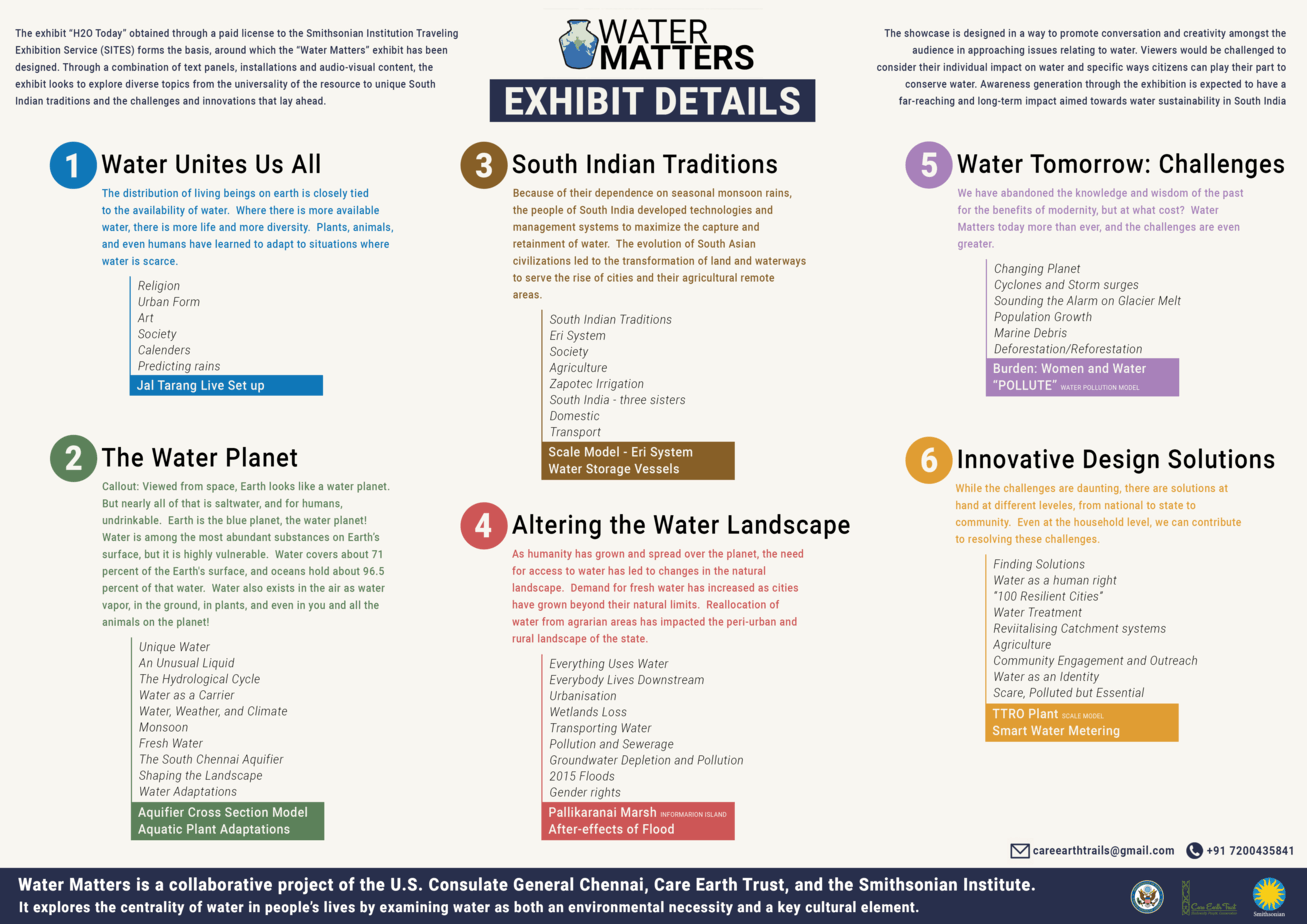
The interactive environmental showcase aims to generate awareness on the importance of managing water efficiently and promoting sustainable environmental practices. Curated by an expert panel consisting of U.S., Indian, and international experts in ecology, regional history and heritage, and international institutional expertise from the Smithsonian, ‘Water Matters’ explores the centrality of water in people’s lives by examining water as both an environmental necessity and a key cultural element.
“H2O Today” obtained through a paid license to the Smithsonian Institution Traveling Exhibition Service (SITES) form the basis, around which the “Water Matters” exhibit has been designed. Through a combination of text panels, installations and audio-visual content, the exhibit looks to explore diverse topics from the universality of the resource to South Indian traditions and the challenges and innovations that lay ahead.
The showcase is designed in a way to promote conversation and creativity amongst the audience in approaching issues relating to water. Viewers would be challenged to consider their individual impact on water and specific ways citizens can play their part to conserve water. Awareness generation through the exhibition is expected to have a far-reaching and long-term impact aimed towards water sustainability in South India.
For more details, visit the Water Matters website here.
[This article is based on a press release from Care Earth Trust, and has been published with minimal edits]