Press release from Save Bangalore Lakes Trust
The Save Bangalore Lakes Trust (SBLT) along with residents of the Horamavu area (organised as the Save Horamavu Lakes group) held a walkathon on the morning of Sunday, February 16, 2014, to spread awareness about the status of lakes in the Horamavu area.
The two lakes in Horamavu, i.e., Horamavu Agara Keré (50.34 acres) and Horamavu Keré (37.14 acres) are both under the jurisdiction of the BDA. Over the years both have suffered from massive encroachments, destruction of the raja kaluves flowing into and from them, dumping of waste and other debris, and are now used as open toilets and for releasing untreated sewage.
These lakes serve as the lifeline to water security in the area. The residents fear that if the lakes disappear or die out they would face a bleak waterless future, with borewells running dry and the promise of Cauvery water remaining a pipe dream.
The walkathon that took place at Horamavu Agara Keré saw more than one hundred residents and friends of Horamavu’s lakes participate. They walked along the perimeter of the lake and experienced the widespread damage caused by encroachments, dumping of waste, destruction of the raja kaluves, and the release of untreated sewage.

The present state of the lake
A human chain was formed along sections of the fencing that has been breached. These breaches were being used to dump waste along the northern border of the lake. Several longtime residents of Horamavu shared their experiences of growing up in the area when the lake was filled with water and supported a rich ecology.
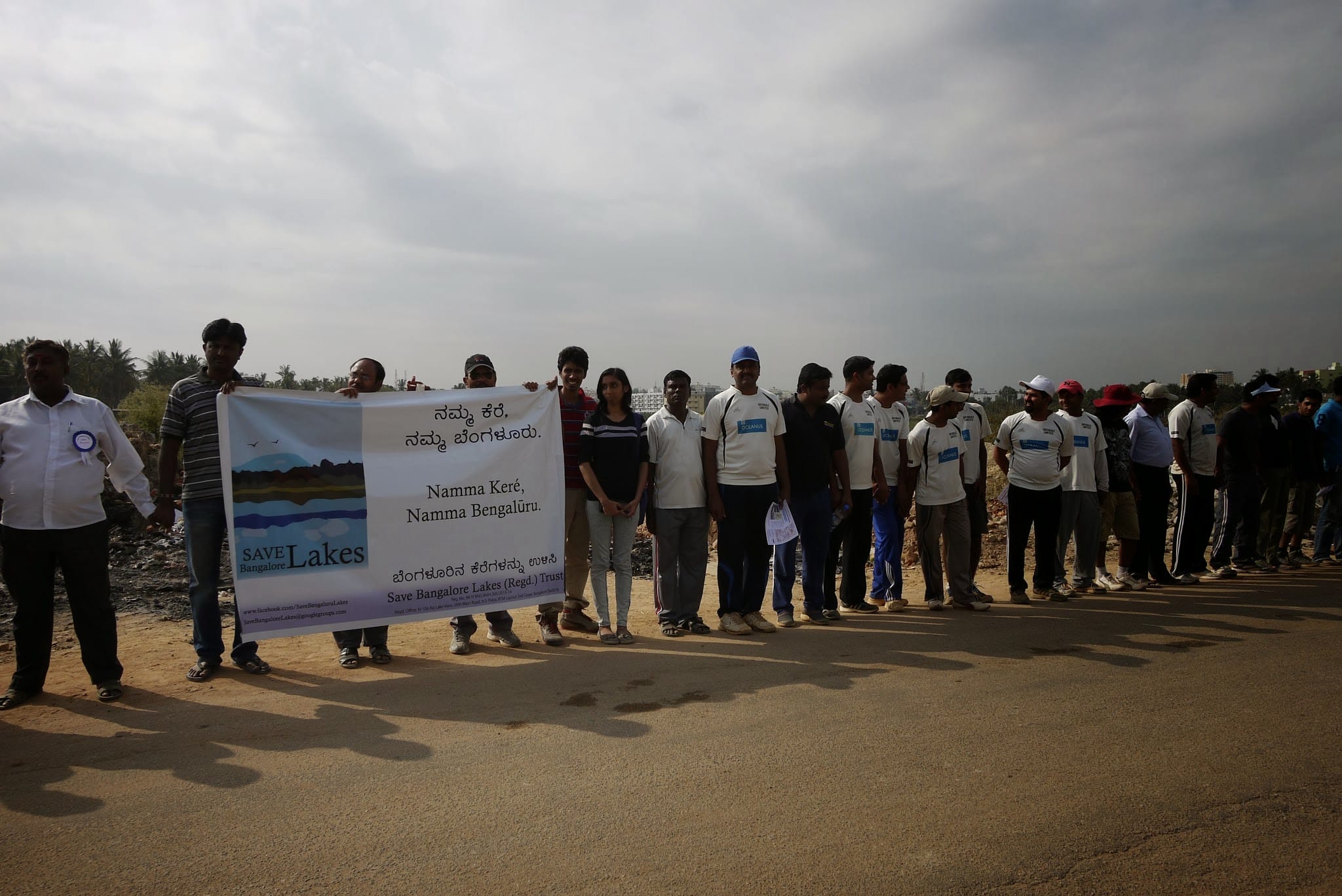
Human chain
A petition to secure, restore, and revive the lake was signed by all the participants. This petition will be circulated to all the RWAs and residents of the area to get their signatures. After the signature campaign, the petition will be submitted to the CM, local MLA, local corporator, and heads of the BDA, BBMP, and LDA. Prof. Rajeev Gowda, Congress aspirant for the Bangalore North MP seat, dropped in to lend his support to the movement. He also signed the petition, in addition to promising that he will work with the local MLA, Mr. Byrathi Basavaraj, to make the whole place a beautiful centre of attraction so that it becomes a public space that the entire neighbourhood is proud of. This, he said, would address the problems of contamination and make available clean water in the area. He concluded, “That much I can see with my mind happening and we’ll make that happen.”
More pictures of the event can be seen here.
This was the second walkathon in the Connect-the-Lake series of the SBLT. The first walkathon was held at Halanayakanahalli Lake on January 19, 2014. The idea for this series emerged at the workshop on saving Bangalore’s lakes organized by SBLT, Citizens’ Action Forum, and Namma Bengaluru Foundation. on November 30, 2013.
For more information about the Connect-the-Lake series or this walkathon, please contact:
– Dr. Ted K. Dass, Save Horamavu Lakes group 9900569955; ted.k.dass@gmail.com
– Dr. Arbind Gupta, Trustee, SBLT 9845193233; arbind.gupta@gmail.com
– Mr. Bala T., Trustee, SBLT 9632733700; bathirun@gmail.com
See this my son has uploaded
http://www.youtube.com/watch?v=pIIzQ6waitk&list=UUKNQj5ltE0tj9hRobcMGm8Q