Random, unauthorised LPG checks cause confusion among residents

Residents in Adyar and other parts of the city have found themselves subject to LPG installation checks without prior intimation; these checks are being conducted at random intervals and often by untrained personnel. Here's what you must know to avoid being duped.

Residents across the city have at one time or another faced sudden inspections of the LPG connection at home. These often catch them by surprise as most people are unaware of the requirement of these checks and the frequency at which these should be conducted. Inspections are recommended once every five years, to be conducted by authorised personnel from the respective gas agencies which supply the cylinders. Lack of awareness about this has led to residents being duped by unauthorised individuals who carry out inspections at will and fleece them.

However, before we decide to do away with inspections altogether, here are some facts that all LPG users must be sensitised to: 

1. LPG is an obedient servant but a dangerous master.

2. Irregularities or problems in LPG installation can lead to hazardous situations such as fire, suffocation, explosions. Therefore periodic inspection of installation is a must by trained people to detect and rectify irregularities.

5. Stoves, tubes, regulator connections wear out with use and ageing and need to be checked and attended to periodically.

4.  Lay citizens would not know enough about the technical requirements. Avoiding inspections is therefore *NOT* a safe practice.

5. Even though the period for an inspection is now set at 5 years, if you suspect any abnormality — smell, gas leak noise, suspected leakage etc — you must call your provider and get these attended to at the earliest.

While periodic inspections are crucial to prevent instances of mishaps or hazardous situations, citizens report rampant inefficiency and instances of deceit. Recent shared experiences show that many have fallen prey to it.

Some customers have been duped into believing that annual inspections are mandatory, instead of once in five years. Inspections are often carried out by technically non-competent people, defeating the purpose of the entire exercise. There have also been case where fraudulent persons came for inspection, with fake or inappropriate ID cards.
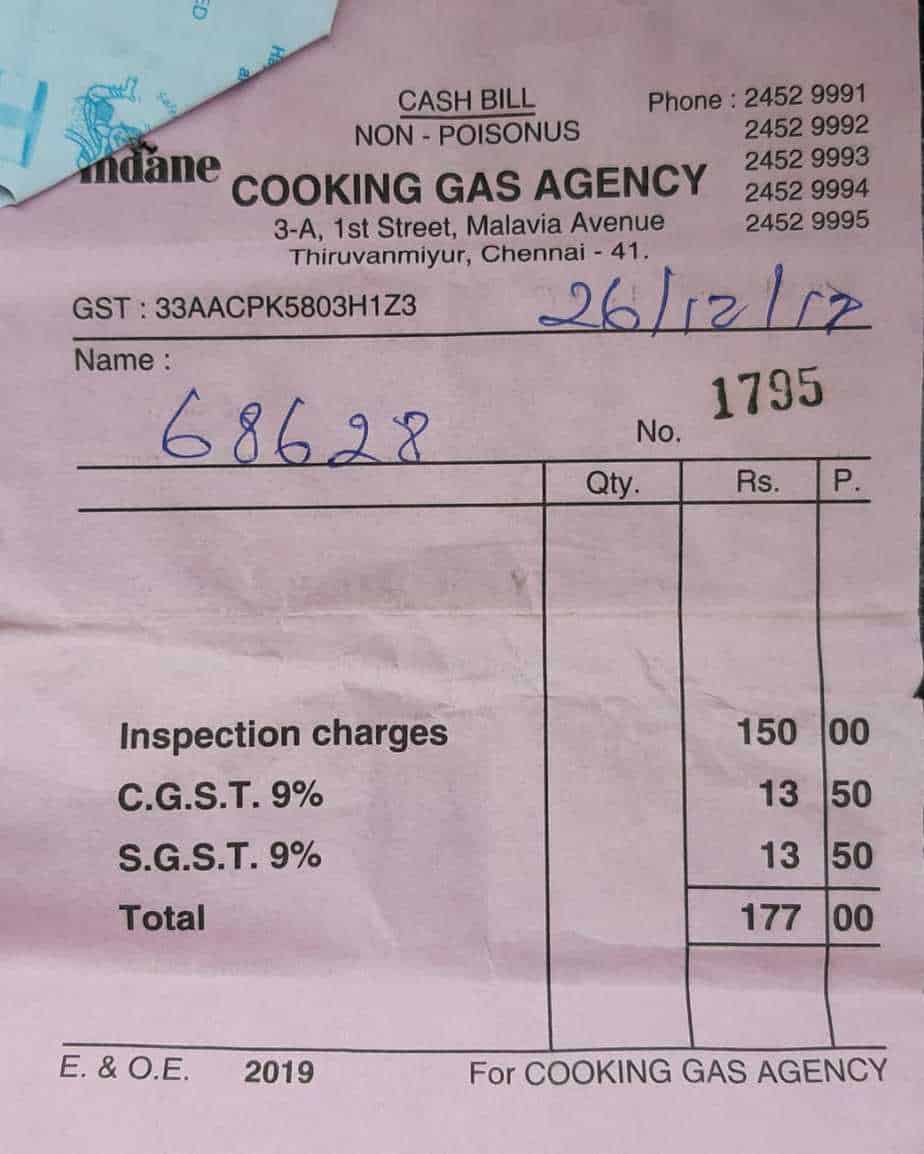
Two checks had been carried out in two years instead of the prescribed period of five years though a receipt was issued by the agency. Pic: Namasivayam.

Several residents of Adyar and nearby neighbourhoods received such visits. Some even turned the personnel away, as they were not aware of the process and uncertain whether the visiting technician was indeed an authentic representative of the gas agency. There has also been an instance where a customer was asked to pay Rs 200 and sign a blank inspection form without any inspection being conducted. 
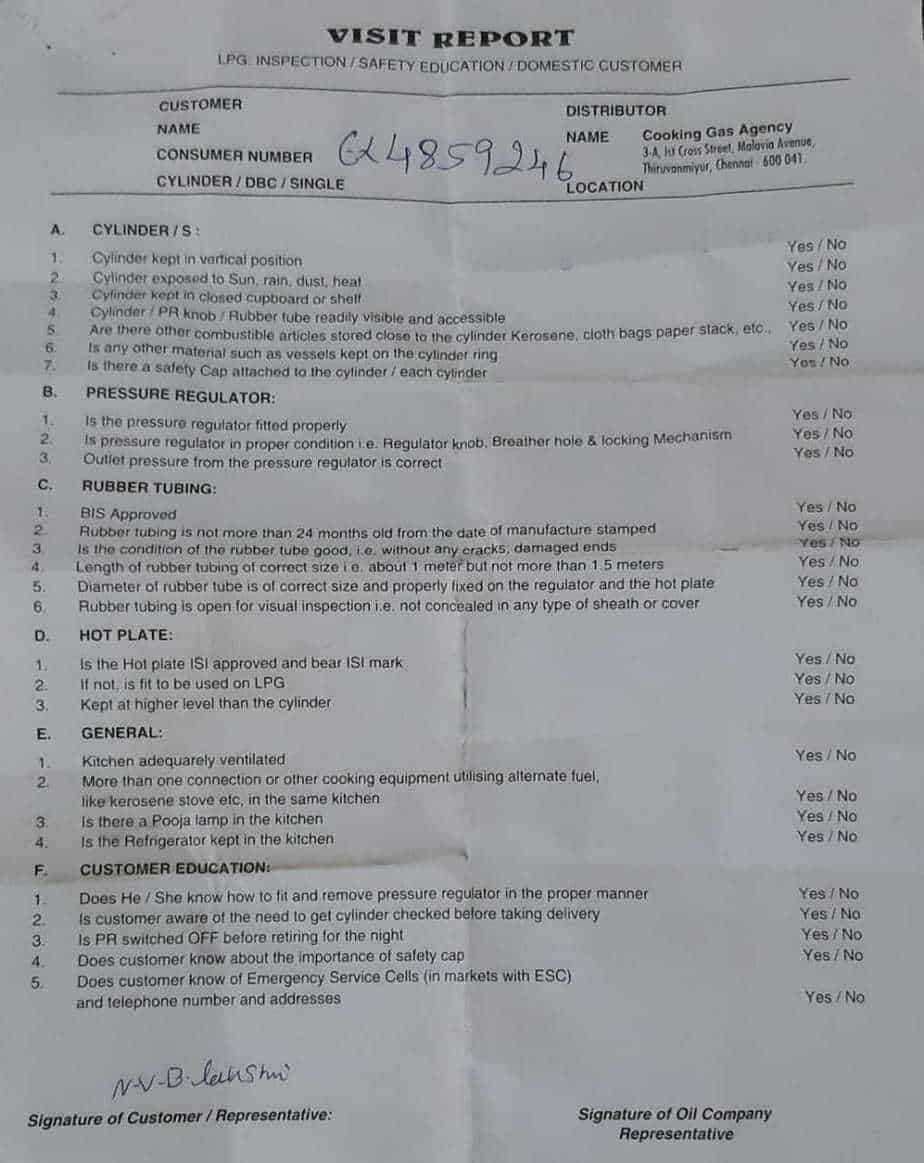
Some residents were asked to sign off on inspection forms without the inspection being conducted. Pic: Namasivayam C

Since I personally received two such visits over the last two years, I’d raised this with the Indian Oil Corporation who sent a fact finding team to my house along with the gas agency manager. Action is awaited on their part. Meanwhile, we must always check for a genuine ID card and credentials before allowing any stranger to enter the house for a check. If in doubt, please call the LPG dealer and verify before permitting entry of the person into your house.

My complaint is only against the undue frequency of inspections, lack of competence of visiting inspectors, and the absence of proper identification papers in many cases, NOT against the need for an inspection itself. 

What do the guidelines say?

The Petroleum and Natural Gas Regulatory Board has issued several guidelines with the objective of protecting consumers from fraud.

  1. Domestic consumers should provide right of access only to an authorized agent for the purpose of reading, repairing, replacing or testing of the equipment, provided the agent carries a tamper-proof photo identity card and other proper identification and authorisation documents.
  2. It shall be the responsibility of the OMCs (Oil Marketing Companies) to intimate consumers about the type of documentation and identification provided to their employees or the employees of their agencies, so that an ordinary consumer would be able to distinguish between an authorised person and one who is posing as such.
  3. Authorised entities shall intimate in advance to the consumers any scheduled inspection in an area.
  4. In order to facilitate verification, authorised entities are required to give contact numbers and names of designated officers, who can be contacted to verify whether the entity has deputed any authorised person/s to a particular area. At least one of these phone numbers will be a human interface and not an automated response.
  5. Authorised representatives shall also carry an approved price list of items to be replaced in case of defect.
  6. Invoices sent out by authorised entities shall also indicate details like Name, Address and Telephone numbers of the person in charge of Complaint Receiving Cell and the appellate authority for dealing with consumer complaints.

Leave a Reply

Your email address will not be published. Required fields are marked *

Similar Story

The Saundarya story: Ahmedabad’s women-led cooperative presents alternative to modern gig work

Saundarya, a women's cooperative formed by organising marginalised informal workers, provides professional housekeeping services in the city.

Ten years back, Kamlaben Chavda was a stay-at-home mother of two children in the Gomtipur ward, at the far eastern end of Ahmedabad. Till one day, a neighbour and relative asked Kamlaben to accompany her to where she worked, the Saundarya Safai Utkarsh Mahila Sewa Sahakari Mandali Ltd. Today, thanks to that visit and the work she eventually found through Saundarya, Kamlaben says, “Now I have this experience where I can confidently go to any workplace and perform. And I can definitely say that I am standing where I am because of the support of my mandali (cooperative).”  Kamlaben is…

Similar Story

From Kovalam to Kokilamedu, livelihoods of hundreds threatened by proposed Mamallan reservoir

Citizen Matters travelled from Kovalam to Mahabalipuram to talk to fisher communities about the upcoming Mamallan reservoir dam project

With eyes closed, *Jayalakshmi wades in and weaves through the Great Salt Lake, in the Kovalam-Nemmeli backwaters, her fingers scooping up prawns and fish. From morning to evening, she fills prawns inside a bag punctured with holes at the bottom. For as long as she can remember, the 43-year-old, who belongs to the Irular community in Thiruvidanthai, Chengalpattu, has practised the art of catching prawns and fish, by hand.  “Everything depends on this aaru (the lake). We know exactly where the prawns are, beyond the thorns, snakes and seru(mud or mud flats ”she says. The salt burns her eyes and…