Migrant wastepicker manages discards of the city

A huge loss in his pressure cooker manufacturing factory and the financial crisis that followed made Ajay a migrant, or footloose informal worker. Eight years ago, he moved from Delhi to Bangalore. Having to start life from scratch, he became a waste picker. Bangalore offered him the veil of anonymity from his past. After a few years in the profession, he met a Hasiru Dala activist and became associated with the organization.

Recognizing his potential in running a micro-enterprise, organization offered him to operate one of the 33 Dry Waste Collected Centers (DWCC), located in Gottigere, installed by Municipal Corporation of Bangalore (Bruhat Bengaluru Mahanagara Pallike) and managed by Hasiru Dala.
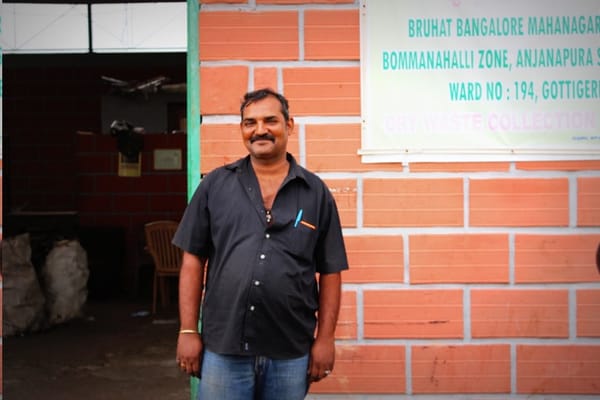
Today, Ajay runs one of the most successful Dry Waste Collection Centres in the city. It segregates over 1-ton dry waste every day/32 tons a month, in over 15 different categories ranging from milk packets, glass bottles, newspapers to hard and light plastic. Using the capacity of a DWCC to the fullest. With very little knowledge of Kannada, he still was able to coordinate with officials in Municipal Corporation, sanitary workers and wastepickers.

What makes him tick in this business? we asked. “You have to recognize that there is money in this business. I make myself available and accessible at all times. Me and my staff live near the premise of the DWCC and are able to attend to it when the situation demands.”

His three daughters go to school. Two of them study in a hostel and he visits them every other weekend with his wife. His youngest daughter recently joined a private school.  He says he feels happy and settled in Bangalore.And his three daughters are very much fluent in Kannada.

Ajay recently bought a bike and he loves to drive around.

(Republished from the blog Waste Narratives)

Leave a Reply

Your email address will not be published. Required fields are marked *

Similar Story

Open letter to Chief Justice of India: Withdraw unjust remarks made against environmental groups

In the letter, conservationists, lawyers and civil society groups highlighted the constitutional right of citizens to demand the enforcement of environmental laws.

A collective of citizens, environmentalists, legal experts and civil society organisations from across India has demanded that the Supreme Court withdraw oral remarks made by the Chief Justice of India (CJI) during the Pipavav Port hearing on May 11, 2026. The group aims to ensure these comments are not misinterpreted as questioning the legitimacy of genuine environmental public-interest litigation, or the constitutional right of citizens and affected communities to demand the enforcement of environmental laws. In an open letter to the CJI, the coalition outlined urgent environmental concerns and the right of citizens to question irregularities in projects negatively impacting…

Similar Story

The trees we forget: What a city loses when the canopy disappears

Bengaluru's trees are more than shade; they are memory, identity, and resistance. Their loss leaves the city harsher and emptier.

Summer in India has been merciless this year, with many states recording temperatures above 42 degrees Celsius and rising reports of fatalities. Despite these harsh conditions, urban support continues for development projects that clear trees, wetlands, mangroves, and forests near cities. A recent Article 14 report provides data on thousands of trees that will soon be sacrificed nationally for infrastructure projects. Those opposing such unscientific large-scale tree felling are often labelled 'tree-huggers', 'anti-development' and 'anti-nationals'. While capitalism accelerates environmental degradation and the world faces a growing climate crisis, societal divisions deepen.  Yet, we give trees too little credit: Beings necessary…