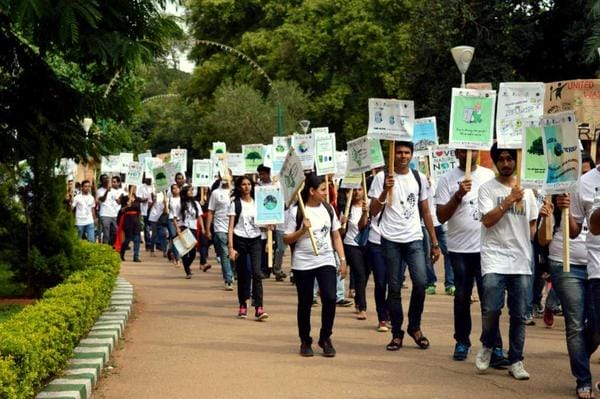
Students team up with Saahas to spread zero-waste message

Students from NMIMS and Sahaas participated in Walk-a-thon, an event to raise awareness about the need for Zero Waste. In addition to a 3 km walk at Lalbagh, they also performed a street play.

Narsee Monjee Institute of Management Studies, Bangalore in association with Bangalore-based NGO Saahas, organised its flagship event called ‘Walk-a-Thon’ for creating awareness about Zero Waste on August 9th at LalBagh Botanical Garden. The walk was organised to raise cognizance and sensitise people about this issue which has been plaguing our society for far too long and needs to be addressed immediately. The event was organised by Udyam, the social responsibility cell, in association with Rang, the cultural committee of NMIMS.

The day started with a corporate event at the institute, where the guest speakers and participants from the NGO came forward and shared their experiences. As a preamble to the event, Saahas gave a presentation about Zero Waste, which was followed by Walkathon Symposium – a corporate and student interactive session with CSR cell.
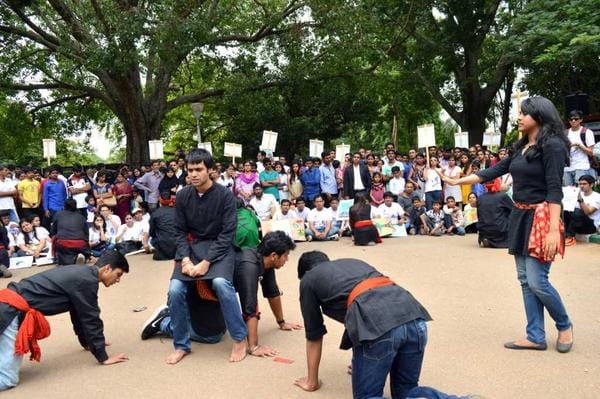
Amidst the huge crowd at Lalbagh, the walk was commenced with a street play titled ‘Dekh Bhai Dekh‘ that was performed to spread awareness about waste segregation and different ways to reduce it, keeping in mind that waste reduction is the need of the day.
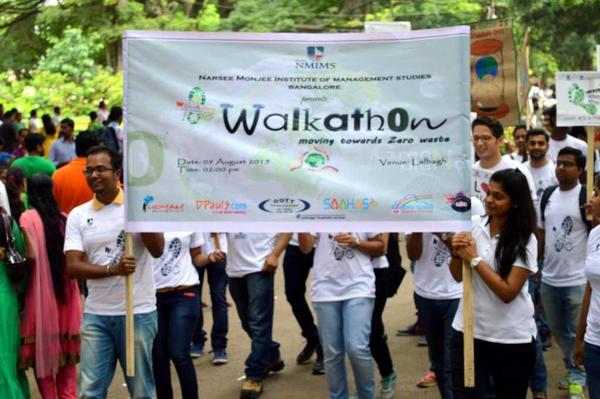
This was followed by a 3 km walk in the garden, with the students and representatives of NGOs raising relevant slogans.

The event received high involvement from the localites, and the idea of zero waste for the city and our lives was well accepted.

Related Articles

Six amazing groups in Bangalore that show how to manage waste in style
From anti-plastic steps to zero waste management
Children urge eatery owners to say no to plastic and disposables

Leave a Reply

Your email address will not be published. Required fields are marked *

Similar Story

Mumbaikars are fighting for their mangroves. Here’s how you can join them

Mumbai is about to face a monumental loss—its mangroves are being cut to build the coastal road. Citizens, however, have not given up the fight to save them.

​“What happens when we remove this natural infrastructure of the city? What happens if it floods? What happens if the air quality (index) goes really high?” asks Pooja Domadia, a member of the Save Mumbai Mangroves campaign. These are questions that many Mumbaikars have as work begins on the Versova-Bhayandar Coastal Road, which is set to affect 45,000 mangrove trees. In March this year, the Supreme Court dismissed a petition challenging the Bombay High Court order to greenlight the cutting of mangroves for the project. Is the SC decision a fatal blow to the movement? The BMC has already begun…

Similar Story

Where are the pollinators in Bengaluru?

Despite the volumes of citizen-generated data on the city's biodiversity, pollinators who sustain the urban ecosystem do not seem to be getting their due attention.

Urban biodiversity is often discussed in terms of tree cover, lakes, or flagship species, but far less attention is paid to pollinators—the insects and birds that quietly sustain urban ecosystems. In Bengaluru, a rapidly urbanising city with a strong culture of citizen science, large volumes of biodiversity data are now being generated by the public. But what does this data tell us about pollinators in the city? This article draws from a data jam hosted by OpenCity in Bengaluru that explored pollinator observations using publicly available, citizen-generated datasets. By analysing long-term observation records and spatial data on land use and…