Street art points to Bengaluru’s missing green cover

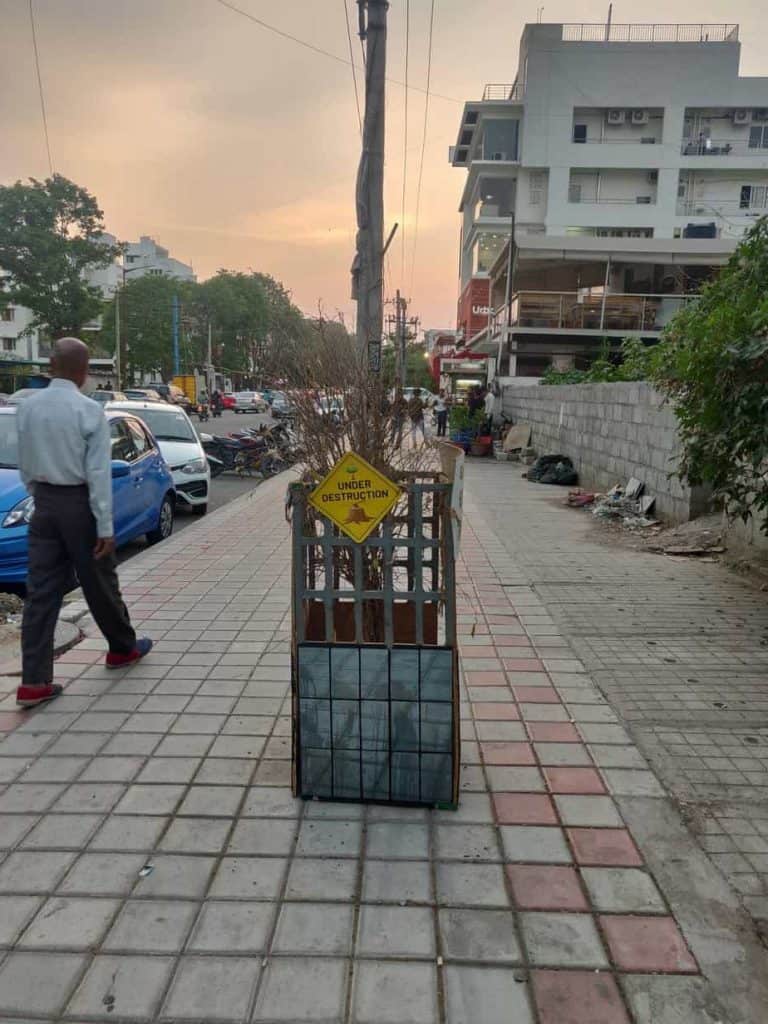
A Bengaluru resident puts up an art installation in HSR Layout to bring attention to the city's rapidly depleting green cover

Pic: Gaurav Choudhary

Recently, I came across an article about the rate at which Bengaluru is losing its greenery. I was born and brought up in Jodhpur, Rajasthan, but I love Bengaluru and its culture. I was disturbed to know about the loss of Bengaluru’s green cover. Hence I decided to spark a conversation on this issue by putting up a piece of street art.

I built the model at my house, and assembled it at the site. The installation, named ‘Under Destruction: Garden City to Grey City’, involves a plant at the centre, and glass panes plastered upon its fencing. The idea was to show a glass building under construction, and a tree trapped in it; the tree would have to be cut down to construct the building.

The glass building signifies the ‘Silicon Valley’ aspect of Bengaluru. The objective of the art was to show how construction for urban development is leading to slow death of our tree cover. A map showing the reduction in Bengaluru’s green cover over the years, was also put up over the installation.
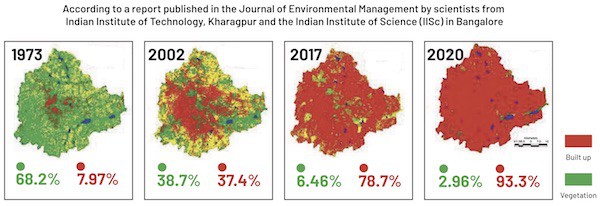
Map showing Bengaluru’s depleting green cover, on the installation. Pic: Gaurav Choudhary

The installation is displayed on a footpath near the junction of 17th Cross road and 27th Main road, in HSR Layout Sector 2. Around 300 people view the installation everyday. They are shocked to know the current state of green cover in the city. The general perception is that Bengaluru is very green, so they feel bad after understanding the data.

There is a good side to the city’s growth, but we need to redefine our perspective of growth. Construction for urban development is encroaching on and destroying our heritage green cover. We need the right policies to maintain the balance between greenery and development in the city, so that everyone can breathe healthy, clean air.

Leave a Reply

Your email address will not be published. Required fields are marked *

Similar Story

Air quality management is a governance problem, not just an environmental one

Despite massive funding, Indian cities face weak governance, poor data, and limited capacity, as air pollution continues to worsen.

Indian cities are struggling to breathe. Air pollution is a year-round governance challenge. In 2024, 35 of the 50 most polluted cities globally were in India, with PM2.5 concentrations above 66.4 μg/m3. This is at least 13 times the World Health Organization (WHO) guidelines and at least 1.6 times the National Ambient Air Quality Standards (NAAQS) in India. Citizens continue to bear the brunt of worsening air quality, and urban local governments (ULGs) are at the forefront of the problem, being primarily accountable for their citizens' first mile. While they do have a role to play in addressing this threat,…

Similar Story

Protecting urban green cover: The process and penalties for tree felling in Chennai

As green spaces shrink amid rapid development, here's a citizen's guide to navigating Chennai’s updated permit system for tree cutting.

​Two decades ago, Gandhi Nagar in south Chennai was a shaded green canopy, recalls Meera Ravikumar, a resident. “Now, in the name of development, many incidents of tree felling have occurred in the past 15 years on avenues and across private properties. In highly populated and polluted urban areas, green lung spaces are important,” says the member of Swacch Gandhi Nagar, a citizens group.   Since 2000, India has lost 2.33 million hectares of tree cover, according to the 2024 Global Forest Watch. Tamil Nadu has fared better than most states — its forest cover has remained “largely stable” since…