For some time, there was a debate about which butterfly should represent Karnataka. The State has a record of about 318 species of butterflies, and the choice of butterfly had to be one which would be the most representative of the State.
The proposal to adopt the Southern Birdwing as the State butterfly had been sent by Sanjay Mohan, Additional Principal Chief Conservator of Forests (Research and Utilisation).
A few butterflies had been shortlisted, including the Common Jezebel, but the Southern Birdwing was finally chosen, as its colours match those of the Karnataka flag.
Maharashtra had chosen the Blue Mormon as its State butterfly a year ago; Karnataka is the second State in the Indian Union to choose a State butterfly.
The Southern Birdwing, whose scientific name is Troides minos, has a wingspan of 140-190 mm, it is the largest butterfly in India.
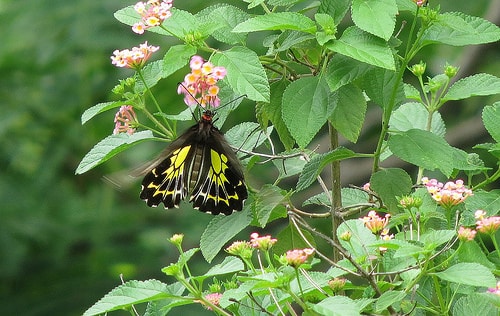
Pic: Deepa Mohan
The butterfly is more common in the Western Ghats, but there have been sightings around Bengaluru, too.
It feeds exclusively on flower nectar, feeding from forest food plants, and also garden plants like Ixora, Lantana, and Mussaenda.
It’s a strong flier, flying both high and over long distances; it can be found sailing around 30-40 feet high in the air, and can cover distances several kilometres, before settling. Both the male and female are very active in the mornings, as they feed.
Primarily endemic to South India, it is found in abundance in Karnataka.
Why choose a State butterfly?
“As it is easily sighted, we can hope that more people become aware of the importance of butterflies in the eco-system. These are important pollinators, and their preservation is necessary for the eco-system,” said Nitin R, an entomologist with the National Centre for Biological Sciences, in an interview to The Hindu newspaper.
However, he said there could be a downside to this, particularly as the declaration of a State butterfly does not come with any additional protection.
With this particular species of butterfly shooting to prominence, there could be a chance of the colourful creature being targeted and becoming collectibles, he added. So, in spite of the fact that it is not listed as a rare or threatened species, it would be good to continuously monitor the numbers of this striking butterfly, that we have chosen to represent our State!
Here’s a short video I took, at Kabini, of the beautiful creature nectaring on a Morning Glory flower.