The Horamavu area (BBMP Ward 25) in the north eastern part of Bangalore is dotted with several lakes. As is the case with most of Bangalore’s lakes, they are subjected to dumping of debris and garbage, sewage and encroachment.
Saddened by the plight of these lakes, some residents of the area have taken it on themselves to try to save them. They got together a few days ago, evaluated the state of the lakes and decided to focus on the two larger lakes for now – Horamavu Agara Lake and Jayanthinagar (Horamavu) Lake. To spread awareness about the status of the lakes, they have created a Save Horamavu Lakes Google Group and Facebook page. They can also be reached by email save.horamavu.lakes@gmail.com or phone 9900569955 (Ted K Dass).
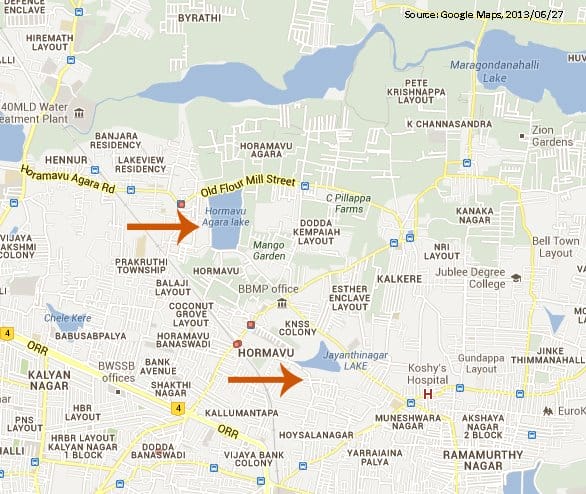
Pic: Save Horamavu Lakes group
Horamavu-Agara Lake is said to be about 51 acres, but presently there is not much water in it. The lake has been fenced but the fencing has been breached in places and people have started using the lake as a dumping yard.
This youtube video shows the rampant dumping, and one can hear the chirping of the birds (crying out for help?) amidst the din of traffic.
Jayanthinagar Lake is smaller, about 37 acres, and currently facing extensive dumping. Residents of the area have reported that the pace of dumping is so high that in 15 days, it has resulted in a huge pile covering about “10,000 sq ft area with a height of about 17 feet (10 under water and 7 above water)”. Tractors, they say, have been working on this job from 7 a.m. to 7 p.m. every day.
This youtube video taken at the lake shows about a week’s worth of dumping.
The issue of dumping at Jayanthinagar (Horamavu) Lake was reported to the Lake Development Authority (LDA) on 28th Jun 2013. However, according to the publicised lake list, this lake, like the Horamavu Agara Lake, seems to be under the jurisdiction of the Bangalore Development Authority (BDA). Apart from contacting the BDA, the group is now exploring other options that will stop the dumping and save the lake.
If you’re concerned about the lakes of Horamavu and would like to join in the efforts to save them, do get in touch with the group.
Gathering on 6th July – Message from Ted K. Dass
We are planning to meet at Jayanthinagar Lake tomorrow, Saturday, 6-July-13, 10:00 a.m. to noon – to create awareness in the local community about the status of the lake, especially the alarming rate at which dumping has taken place within the last two weeks.
If you live in Horamavu or a neighbouring area, please make some time to come along to lend your support. Also, bring your friends and family along. As we all know, we gain strength from numbers; without that we risk losing our voice and our valuable lake.
Entry to the site of dumping is via 20th Cross, 3rd Main Road, Hoysalanagar, Bangalore 560016. The nearest landmark is the Om Shakti Temple (aka Adi Shakthi Temple) on 3rd Main Road. Also, please see this map for more info: http://goo.gl/maps/vjieF.
Please email us at save.horamavu.lakes@gmail.com to let us know the number of people you’re bringing along. It will help in planning the event better. Thank you.
Update from Ted K Dass: On 06-July morning, around 20 people from the neighbourhood participated in an awareness walk along the boundary of Horamavu Kere (aka Jayanthi Nagar Lake). We also created a barricade where the fence was breached to prevent easy passage of dump trucks. The barricade is still in place as of 10-Jul!
Later, in the afternoon, a small group met with Dr. R.P. Sharma, ADGP, BMTF, to present our concerns. He has assured to respond within 15 days. A petition was also submitted in the office of the Commissioner of BBMP.